
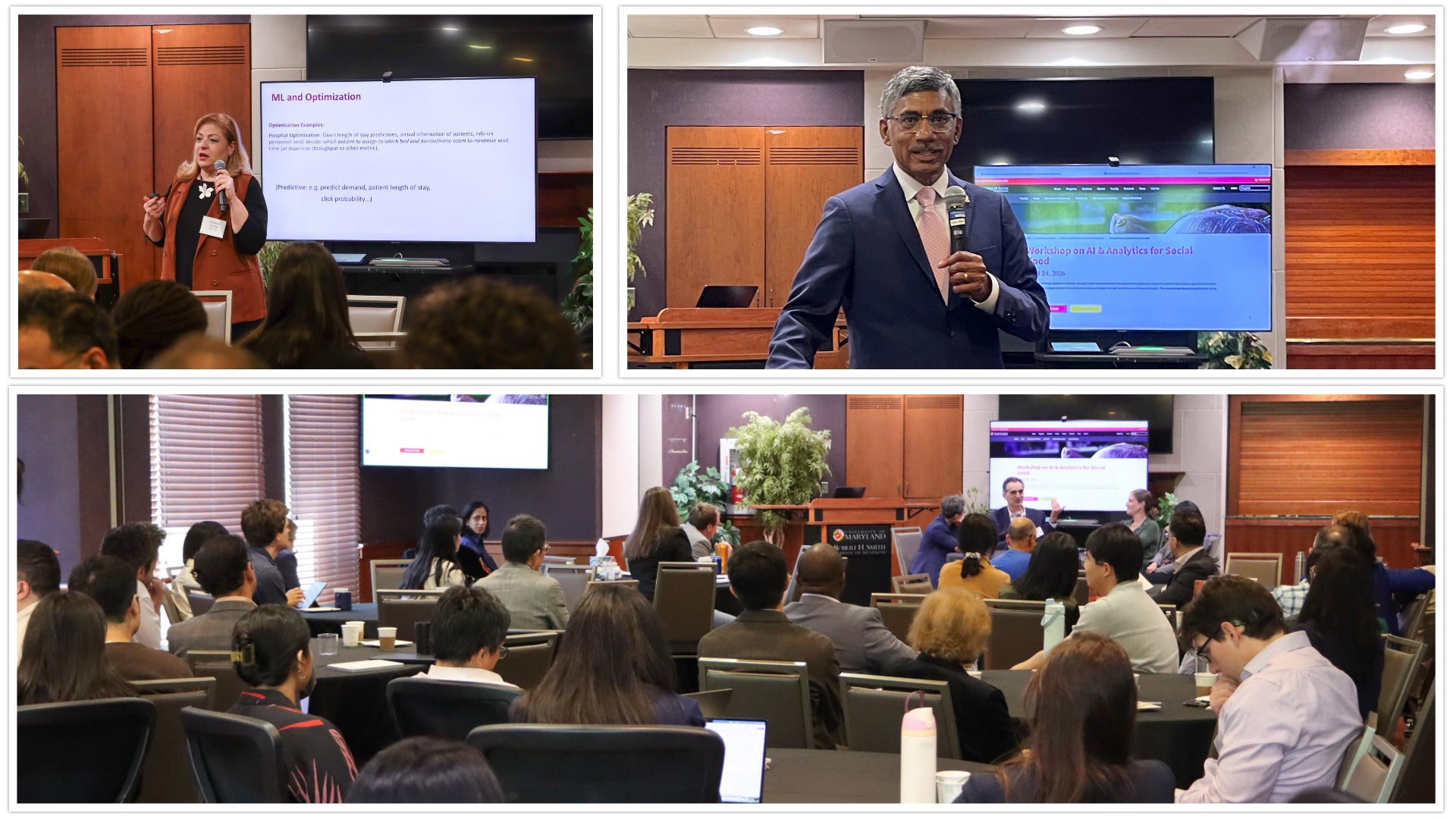
The University of Maryland’s Robert H. Smith School of Business convened leading scholars, policymakers, and industry practitioners on April 24, 2026, for its annual AI and Analytics for Social Good Workshop, a daylong program showcasing how data‑driven research can address urgent societal challenges—from human trafficking and gender pay equity to sustainable agriculture, policing practices, and the future of work.
Hosted in Van Munching Hall and organized by Smith School Associate Professors Jui Ramaprasad, Margrét Bjarnadóttir, John Silberholtz and Jessica Clark, the workshop marked its fifth year by drawing experts from across the country and from global institutions, including the World Bank. The event underscored the Smith School’s growing role in shaping national conversations around responsible AI and analytics.
Setting the Stage: AI’s Promise and Perils
In opening remarks, Smith Dean Prabhudev Konana reflected on the rapid evolution of AI and the stakes of its societal impact. “Having worked in machine learning and natural language processing since the late 1990s, it’s remarkable to see how far the field has come,” Konana said. “We’re now interacting with AI agents that feel almost more empathetic and capable than the customer‑service systems we’ve relied on for years. That shift brings extraordinary opportunities for social good, but it also raises real questions about jobs, equity, and how these technologies reshape communities. Workshops like this one are essential because they help us move beyond isolated anecdotes and toward evidence‑based insights that can guide responsible policy and innovation.”
A Full Day of Research on Social Impact
The morning sessions highlighted research at the intersection of analytics and human well‑being. Elena Katok (University of Texas at Dallas) opened with work on optimizing time allocation in animal shelters to save more lives under capacity constraints. Huifeng Su (Yale School of Management) presented machine‑learning tools that help reunite forcibly separated families through shared memories. Mohammad Zhalechian (Kelley School, Indiana University) explored interpretable design for coordinated mobile health applications. Alp Sungu (Wharton School) shared field‑experiment evidence from India and the Philippines on how LLM‑powered advisory services can improve outcomes for smallholder farmers.
After a brief break, Yanchong (Karen) Zheng (MIT Sloan) examined sustainability incentives using an iterative lab‑in‑the‑field approach, followed by a panel moderated by Professor Hamsa Bastani (Wharton School) featuring Anja Sautman and Gabriel Demombynes of the World Bank alongside Zheng. The discussion focused on the realities of implementing AI systems in government and development contexts.
The lunchtime keynote, delivered by MIT Sloan’s Georgia Perakis, mapped the emerging research agenda for operations management scholars working at the intersection of AI and social good.
Afternoon sessions turned to labor markets, fairness, and public safety. Prasanna (Sonny) Tambe (Wharton School at the University of Pennsylvania) analyzed how the Dobbs v. Jackson decision reshaped the geography of startup job applications. David Anderson (Villanova School of Business and Smith PhD graduate) presented analytics‑driven approaches to closing the gender pay gap. Jiannan Xu (Smith PhD candidate in Operations Management) examined AI self‑preferencing in algorithmic hiring. Ilya Ryzhov (Smith Dean's Professor of Decision Sciences) explored fairness in geographic partitioning. Gordon Burtch (Boston University's Questrom School of Business) assessed the effects of gunshot detection technologies on policing practices in Chicago, and Ziqing Li (HEC Paris) shared findings on how suicide risk unfolds in private conversations with LLMs.
The day concluded with three AI demos showcasing applications in cultural heritage, legal reasoning, and environmental monitoring.
Why Smith? A Platform for Interdisciplinary Leadership
For Ramaprasad, the workshop’s strength lies in its ability to convene diverse expertise. “We highlight some of our own researchers’ work, but the goal of the workshop is bringing together leaders from outside the university from diverse fields of study to highlight that answering these challenging questions is inherently interdisciplinary,” she said. “The continued success of the workshop, the energy in the room, and the challenging conversations highlight our leadership in impactful AI and analytics. And our location in D.C. matters—we can engage with governmental entities, this year we are bringing researchers from the World Bank to share their expertise, and we actively take advantage of the policy ecosystem around us.”
Responsible AI as a Research Frontier
Asked how the workshop reflects UMD’s role in shaping responsible AI, Ramaprasad emphasized the school’s commitment to societal benefit.
“Today’s presentations reflect the goals of the workshop, what our focus is, using AI for the benefit of society,” she said. “Yes, these tools can be used nefariously, but we’re pushing the conversation toward how they can be used for good. The human‑trafficking work, for example, where the goal is to reunite forcibly separated children with their families, has a tragic backstory that was difficult to listen to and digest, but the solution is aimed at solving a real problem centered on improving human lives.”
Preparing for an AI‑Driven Workforce
The program also addressed the future of work and the skills students will need. “This helps educate all of us on what AI can be used for—in developing countries and here at home,” Ramaprasad said. “We have speakers working directly at leading AI and technology companies who bring real‑world insight into how these technologies are shaping labor markets and what companies value. The opportunity to have those conversations is a big part of this program.”
As the workshop concluded, Ramaprasad noted that she and Bjarnadóttir have co‑organized the event for five years and are considering how to evolve leadership for future iterations. “It’s a decision we’ll make together,” she said, “but the commitment to this topic remains strong.”
Media Contact
Greg Muraski
Media Relations Manager
301-405-5283
301-892-0973 Mobile
gmuraski@umd.edu
About the University of Maryland's Robert H. Smith School of Business
The Robert H. Smith School of Business is an internationally recognized leader in business education and cutting-edge research. The school’s world-class faculty facilitate experiential learning opportunities rooted in the real world. Smith students learn to think like entrepreneurs, prepared to drive positive impact. The school offers undergraduate, online and on-campus business master's, full-time, part-time, online and executive MBA, plus PhD and DBA degree programs, and non-degree and executive education programs. Where Smith leads, the future follows.