
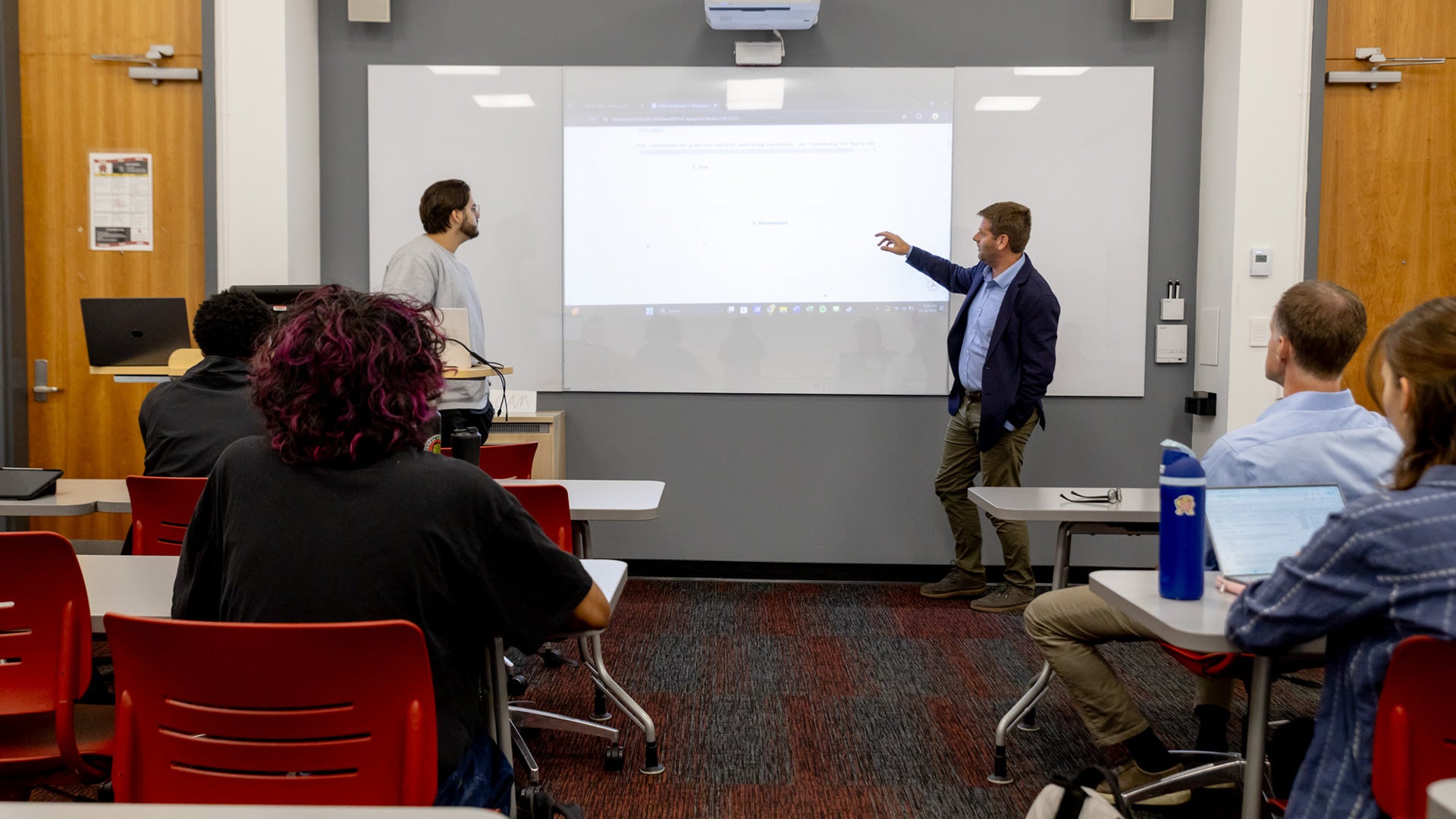
Despite an increasing proliferation of data and analysis tools, “making informed predictions about how and when policy decisions will influence performance outcomes remains challenging,” says Smith professor Dave Waguespack. While inroads have been made to close this gap curricularly at the master’s and PhD levels, Waguespack and faculty colleague Evan Starr are breaking new ground to benefit undergraduates.
They have co-created and co-teach a course designed to equip management majors to link data analysis to strategic decision-making with the insight of their graduate-level peers. It’s an advantage, the professors say, that makes students who take the course better prepared for both graduate studies and immediate internship and job opportunities.
The course, “Making Better Business Decisions with Data: An Introduction to Causal Inference,” is in its third iteration—first offered in fall 2023 for undergraduates in the University of Maryland’s Robert H. Smith School of Business. Its enrollment has increased from 10 students to 20 in fall 2024 to 40 students currently. Its curriculum is “typically taught at the PhD level and maybe the master's level, but not to undergraduates,” says Starr. Why? Because undergraduates typically lack sufficiency in advanced math, like matrix algebra, and coding for the coursework.
But Waguespack and Starr, both professors of management and organization who have taught PhD and master’s students, solved the barrier—in part with AI. “First, we reduced the mathematical complexity so that a basic statistics class could sufficiently prepare a student to understand our course,” Starr says. In terms of coding, he adds, “Previously, you'd have to spend a lot of time memorizing code and syntax—it was just very cumbersome. But by applying AI tools, we can get students up to speed quickly.”
With the time saved from teaching coding, the course covers advanced topics, including double/debiased machine learning methods, Starr adds. And for undergraduates, such graduate- or PhD-level learning “can be impactful by the time they're applying for internships and jobs.”
The students are especially prepared for questions in the vein of: “Should our company invest in ‘X’ right now? Should we do employee training? Should we have a loyalty program?" says Waguespack. “These questions align with the very common kinds of strategy considerations we're teaching—hypotheses about things that will improve performance.”
Post-interview, the selected student is equipped to thrive to benefit both the employer and their own career viability, says Glen Goldstein, an adjunct professor and former executive vice president at TransUnion, who has guest-lectured to students taking the course.
Student Point of View
Exemplifying Goldstein’s point is Nikki Sur, a Smith senior double-majoring in marketing and management. She says the course was instrumental in preparing her for an internship and subsequent full-time position as a Chase Leadership Development Program Analyst at JPMorgan Chase. “During recruiting, I was asked to share an example when I worked with a large dataset and was able to directly reference a project we worked on in class.”
The course “gave me hands-on experience identifying trends, drawing meaningful conclusions, and communicating recommendations clearly—skills that directly translated into the role,” adds Sur, who stays involved with the course as a teaching assistant.
Gabriella Szyc, a Smith finance major and teaching assistant colleague of Sur, says the course “taught me to move beyond surface-level analysis and instead ask: ‘What is the true cause-and-effect relationship here, and what does it mean for business strategy?’ That mindset has given me confidence in interviews, where I’ve been able to clearly articulate how I would evaluate strategic decisions such as launching a new product or maximizing funding for startups,” she says. “Employers have responded positively when I’ve explained that I’ve worked with real causal inference tools, because this is something they don’t usually expect from undergraduates.”
As new hires, students like Sur and Szyc “are closest to the data and work with the data most directly,” says Goldstein. “And as they progress from junior to senior analysts, what differentiates the best analysts and drives career progression is the ability to take the results of data analysis and (1) figure out what story the data is telling, (2) understand and communicate what it means and why it is important from a business perspective, and (3) take the analysis one step further to the recommendation of what action(s) management should (or should not) take.”
Those three steps, he adds, “represent ‘the downstream value added’ in causal inference, which is increasingly critical to the students’ career viability. This is driven by basic data analysis, a skill increasingly offshored to India, while AI becomes more adept at basic data analysis.”
Back in the Smith classroom, Szyc says the course "has been one of the most impactful parts of my undergraduate experience."
She adds, “Serving as a TA has reinforced this learning, as teaching concepts like identification and regressions has strengthened my own understanding and communication skills. Altogether, the course has equipped me with the ability to turn data into actionable recommendations that matter for business performance."
Media Contact
Greg Muraski
Media Relations Manager
301-405-5283
301-892-0973 Mobile
gmuraski@umd.edu
About the University of Maryland's Robert H. Smith School of Business
The Robert H. Smith School of Business is an internationally recognized leader in business education and cutting-edge research. The school’s world-class faculty facilitate experiential learning opportunities rooted in the real world. Smith students learn to think like entrepreneurs, prepared to drive positive impact. The school offers undergraduate, online and on-campus business master's, full-time, part-time, online and executive MBA, plus PhD and DBA degree programs, and non-degree and executive education programs. Where Smith leads, the future follows.