
The University of Maryland’s Robert H. Smith School of Business will play a central role in a statewide initiative to evaluate how Maryland can better support the more than one million residents who provide unpaid care to aging adults and individuals with disabilities.
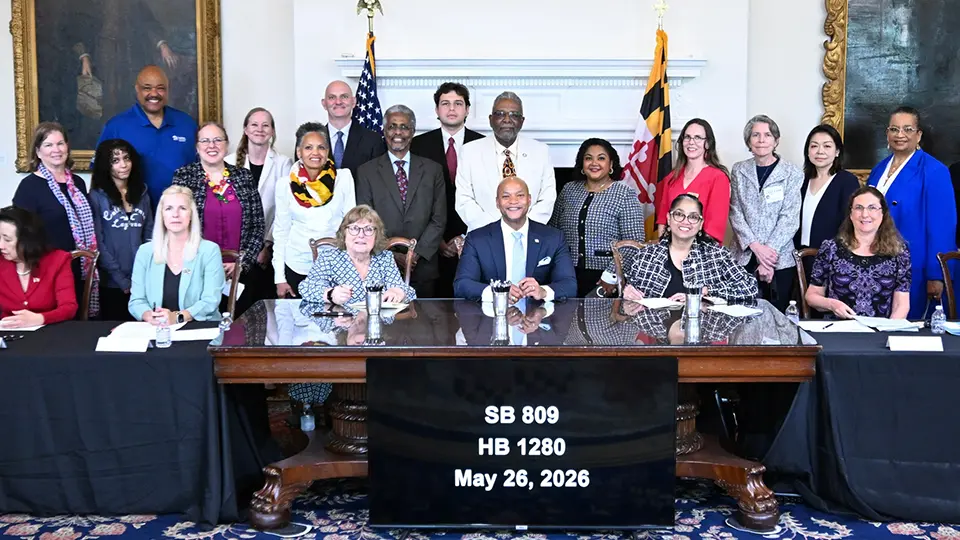
Gov. Wes Moore this week signed Senate Bill 809/House Bill 1280, directing UMD—led by the Smith School and in partnership with the Maryland Department of Human Services—to conduct a comprehensive feasibility study for a proposed Supporting Our Caregiver Infrastructure Program.
Leading the study will be Smith Associate Professor of Finance Liu Yang, founding executive director of UMD’s Federal Statistical Research Data Center. Yang will work closely with Vojislav Maksimovic, Smith’s William E. Mayer Chair in Finance.
The legislation tasks the Smith School with assessing the feasibility, costs and economic impact of establishing a statewide framework to provide monthly stipends to unpaid family caregivers. The study will examine how such a program could strengthen Maryland’s labor force, reduce reliance on institutional care, and generate long-term savings through improved health and economic stability for caregiving families.
UMD’s involvement, says Maksimovic, signifies “the importance of evidence-based policies and the Smith School’s expertise in rigorously applying appropriate evaluation techniques and data.”
Yang further describes an approach grounded in rigorous modeling and real-world data. “Our team brings expertise in finance, policy modeling, and data analytics to help state leaders evaluate the need for a caregiver infrastructure program and the practical implications of implementing it,” she says. “We will use data to assess costs, demand, program design options, and long-term fiscal sustainability. The goal is to provide policymakers with clear, evidence-based analysis that supports a feasible, targeted, and financially responsible approach for Maryland.”
She adds that the study also aims to broaden how caregiving is understood in economic terms. “We hope our effort will help frame caregiving not only as a family responsibility, but also as an economic issue that affects labor-force participation, employer productivity, and the state’s long-term growth. More broadly, we hope the study gives state leaders a clear framework for understanding how investments in caregiving infrastructure can strengthen both families and the economy.”
Experiential Learning and Student Engagement
Yang and Maksimovic will also involve graduate students in the Master of Finance and Master of Quantitative Finance programs through experiential learning project courses. Students will contribute analytical support beginning in fall 2026. Their work will help extend the study’s modeling capacity and provide hands-on experience applying quantitative finance tools to a major state policy initiative.
Extending Data-Driven Support for State Leaders
Yang and Maksimovic have been coordinating with the Maryland Comptroller to model how federal spending shifts affect Maryland’s economy. This includes Yang and Master of Finance students analyzing publicly available data to estimate the economic consequences of recent and potential federal spending and employment reductions. Research Professor and Academic Director of the Center for Global Business Kislaya Prasad helped organize the collaboration, which also supports agency-specific projects for the Departments of Labor, Veterans and Military Families and the Maryland Aviation Commission.
Regarding the new initiative, advocacy organizations—including AARP Maryland and the Alzheimer’s Association—have highlighted that Maryland caregivers provide billions of dollars in uncompensated support each year, often at significant personal and financial sacrifice. The UMD-Smith contribution will help shape a data-driven policy framework for strengthening families, supporting aging in place and advancing Maryland’s long-term economic resilience.
A final report with findings and recommendations is due to the General Assembly by July 1, 2028.
For more information, go to the Maryland General Assembly’s SB0809 information page.
Media Contact
Greg Muraski
Media Relations Manager
301-405-5283
301-892-0973 Mobile
gmuraski@umd.edu
About the University of Maryland's Robert H. Smith School of Business
The Robert H. Smith School of Business is an internationally recognized leader in business education and cutting-edge research. The school’s world-class faculty facilitate experiential learning opportunities rooted in the real world. Smith students learn to think like entrepreneurs, prepared to drive positive impact. The school offers undergraduate, online and on-campus business master's, full-time, part-time, online and executive MBA, plus PhD and DBA degree programs, and non-degree and executive education programs. Where Smith leads, the future follows.