
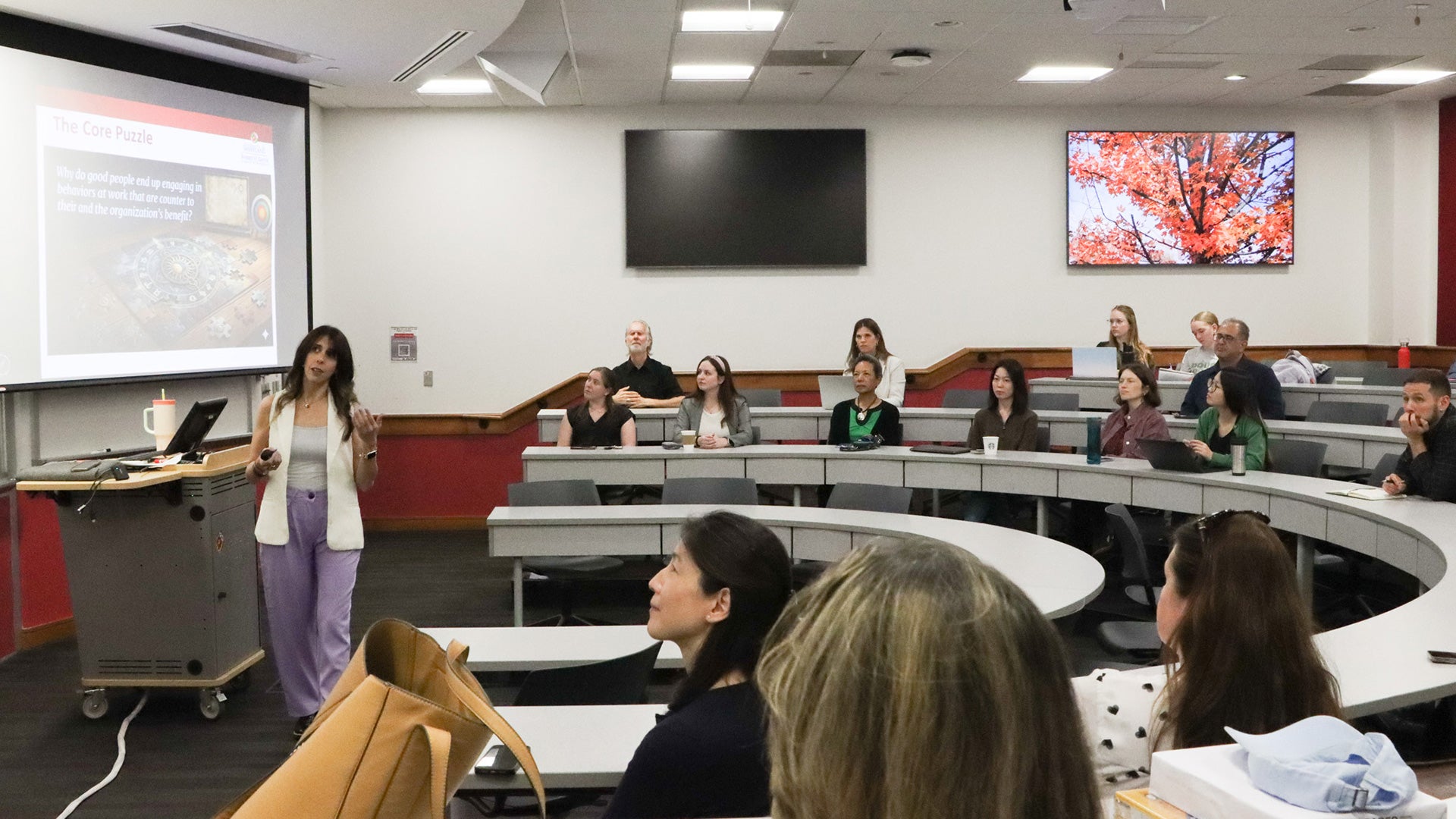
Rellie Derfler-Rozin, management professor at the Robert H. Smith School of Business, was honored with a 2025 Distinguished Scholar-Teacher Award. Sponsored by the Office of Academic Affairs and administered by the associate provost for faculty affairs, the University of Maryland award honors a small number of faculty members each year who have demonstrated notable success in scholarship and teaching.
To celebrate the achievement, Derfler-Rozin delivered a March 26 talk, entitled “Rethinking the Game: The Zero-Sum Trap in Workplace Behaviors,” to a room full of fellow faculty members, staff, students and family.
Her work on zero-sum mindsets — the belief that one person’s gain must come at another’s expense — has appeared in top journals and has received multiple awards.
“In addition to her research, Rellie is a dedicated and award-winning teacher who is deeply committed to experiential learning projects and helping students challenge their own zero-sum thinking,” said Subra Tangirala, Dean’s Chair of Organizational Studies and department chair, and Derfler-Rozin’s faculty mentor.
He said the Smith School is “extremely fortunate” to have her on the faculty. She has developed innovative courses on negotiation, leadership, challenging conversations and decision-making. She also serves as academic director of the Master’s in Management Studies program.
Derfler-Rozin said she was proud to receive the recognition for her research, teaching and service — all of which she has been equally dedicated to since joining the faculty in 2012 after completing her PhD from London Business School.
She said the core puzzle she’s been trying to solve with all of her research is: “Why do good people end up engaging in behaviors at work that are counter to their and their organization’s benefit.”
Derfler-Rozin presented her research along three pillars exploring the zero-sum mindset: financial vulnerability; belonging, status and ethics; and motivation and hiring.
“This zero-sum trap does not only manifest in hiring decisions, but also with managers who don’t speak up in their workplace and do not endorse others’ creativity; it’s when team members do not intervene to help a co-worker who is being mistreated,” she said.
She said changing this mindset can have big impacts.
“It’s not bad people — it’s sometimes just the rules of a broken game. When people rethink the game, behavior can change.”
In most cases, Derfler-Rozin said, people want to do good but make mistakes because they are trapped in zero-sum mindsets.
“This is actually good news because it’s much harder to correct moral character. If you can create interventions that will redesign the games, then it can be helpful.”
She said it takes people understanding that the size of a pie is not fixed when it comes to negotiations, status, and belonging.
“The most transformative moments I’ve seen in my research and in my classes are when people realize that they can actually go from thinking ‘how can I protect everything that I have?’ to ‘how can I create an increase for everyone — including myself.’”
Media Contact
Greg Muraski
Media Relations Manager
301-405-5283
301-892-0973 Mobile
gmuraski@umd.edu
About the University of Maryland's Robert H. Smith School of Business
The Robert H. Smith School of Business is an internationally recognized leader in business education and cutting-edge research. The school’s world-class faculty facilitate experiential learning opportunities rooted in the real world. Smith students learn to think like entrepreneurs, prepared to drive positive impact. The school offers undergraduate, online and on-campus business master's, full-time, part-time, online and executive MBA, plus PhD and DBA degree programs, and non-degree and executive education programs. Where Smith leads, the future follows.