AI & Risk
Executive Certificate Program

Generative AI adoption is accelerating faster than most governance and risk frameworks can adapt. Boards are demanding clearer oversight. Regulators are sharpening expectations. At the same time, organizations are investing aggressively in AI, often without a disciplined roadmap for capturing value or managing enterprise exposure.
AI & Risk is an executive certificate program designed to help leaders move beyond experimentation and into structured, enterprise-level execution. Participants learn how to unlock measurable business value from Generative AI while building the governance, risk, and oversight capabilities required to scale it with confidence. The program bridges strategy and control, balancing innovation with accountability, speed with discipline, and ambition with defensible risk management.
Designed for professionals responsible for AI initiatives, enterprise risk, compliance, or executive oversight, the program delivers practical frameworks for prioritizing use cases, sequencing investments, modernizing governance structures, and integrating AI into enterprise risk management (ERM). Participants leave better equipped to strengthen executive decision-making, increase board-level confidence, and deploy AI initiatives strategically, responsibly, and sustainably.
The program provided valuable insights into AI governance, model risk, regulatory considerations, implementation strategies, and practical business applications. What I appreciated most was the balance between innovation and risk management—understanding not only what AI can do, but how organizations can responsibly scale these capabilities.
Jim Miller
SVP
Credit Portfolio Group Manager
Program Details
Next Cohort: October 29 to December 10, 2026
Location: 100% Synchronous Online, plus a networking dinner in Washington, DC, for local registrants
Weekly: Thursday mornings from 10 a.m. to Noon EST
Audience: Individual contributors to AI initiatives, managers of AI implementations, and personnel and leadership in oversight roles for managing AI risk
Tuition: $1,495 including dinner
Contact: rhsmith-execed@umd.edu for information and one-day registration & payment options
 Who is this for?
This program is for anyone asking the following questions:
- How can I identify high-value use cases for generative AI?
- How should I prioritize generative AI projects?
- How can I garner internal support for my top-priority use cases?
- How can I identify and manage generative AI risk?
- How can I instill governance to effectively manage the risk of generative AI initiatives?
- How can I find professionals to form a community of practice around generative AI and risk?
Valuable Outcomes
- Learn from senior industry risk practitioners and academic thought leaders who have been working in the AI space for decades.
- Understand what tools and practices strengthen governance and risk infrastructure to leverage AI for maximum impact.
- Build AI risk management skills through applying lessons learned from real-world case studies.
- Gain critical insights about how to execute an AI strategic transformation plan.
Networking dinners: Join professionals in the Washington, D.C., metro area for dinner and cultivate a peer network to share experiences and lessons learned from AI implementations.
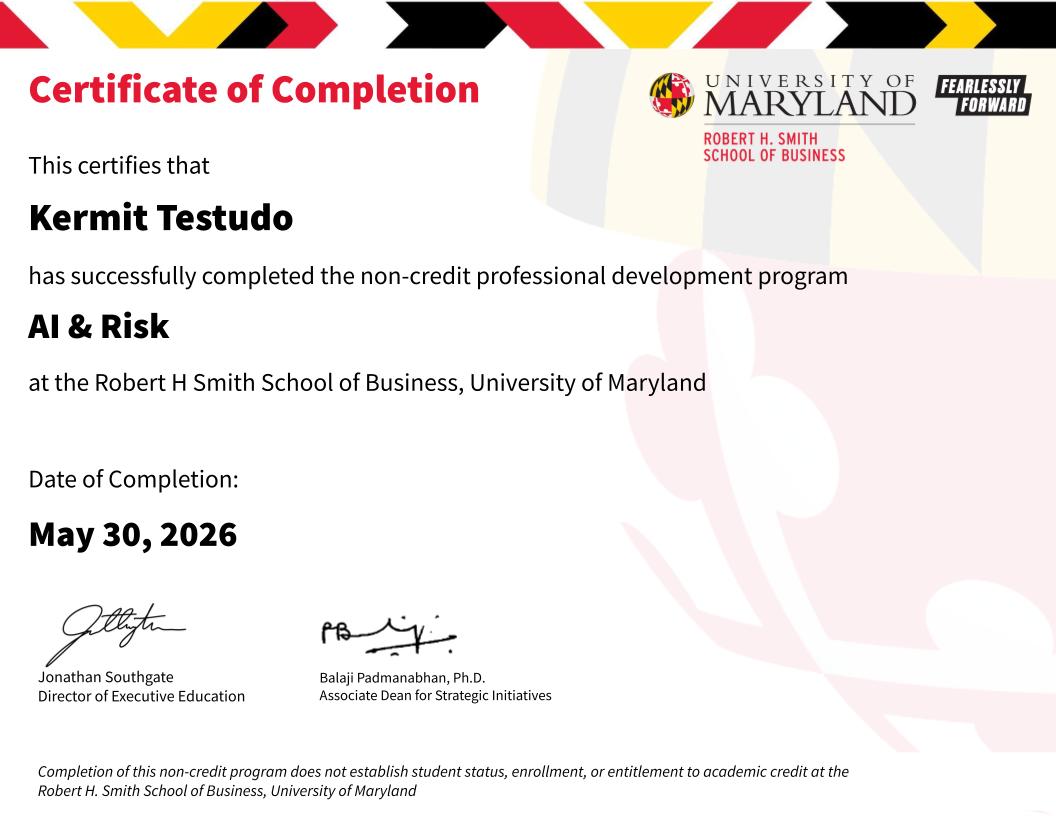
Certification: Receive a certificate of completion from the University of Maryland.
Faculty
 Balaji Padmanabhan, Ph.D.
Associate dean, strategic initiatives
Director, Center for AI in Business
 Joe Mattey, Ph.D.
SERC risk expert
Former chief model risk officer, Fannie Mae and USAA
 Evan Sekeris, Ph.D.
Senior vice president, Bank Policy Institute
Former chief model risk officer, Capital One
The AI & Risk Executive Certificate Program was valuable no matter where the professional and their companies were at in their AI journey. The course moved quickly, and the instructors connected the material to well-known recent use cases and explored the questions of tomorrow. That made the conversations feel relevant and practical to the decisions many of us will face in the next stage of our careers.
David Mayberg
Project Manager
CyLogic
Program Topics
Introduction to generative AI terminology, strategy and risk
Understand foundations of generative AI and agentic systems and what firms are doing to unlock value creation
What successful firms do to create value
Understand the building blocks needed to be successful
Prioritization considerations for generative AI initiatives
A framework for prioritizing generative AI implementation
Effective AI governance and risk management
Understand risks accentuated by AI, how to mitigate them, and how to make decisions on when to proceed
Managing through uncertainty
Discuss scope and prioritization of generative AI use cases and strategy for navigating governance structures
Case studies of generative AI risk
Understand risk in generative AI and agentic systems through case studies
AI governance tools and risk management
Understand the competitive landscape and regulatory expectations for AI
Modernized risk management and AI use cases
Predict, both technologically and from a business perspective, what is coming and the timing of capability readiness for the development of a risk management modernization strategy
Best practices for managing risk in generative AI
Understand roles in AI transformation, particularly risk management roles that are disrupted and need to be reengineered; review AI risk management frameworks to help you design your own framework
Facilitated reflections: Managing generative AI risk
Reflect on the workshop and how it might influence actions going forward, operationally and strategically
Brought to you by: Robert H. Smith School of Business Office of Executive Education and SERC (Smith Enterprise Risk Consortium)