
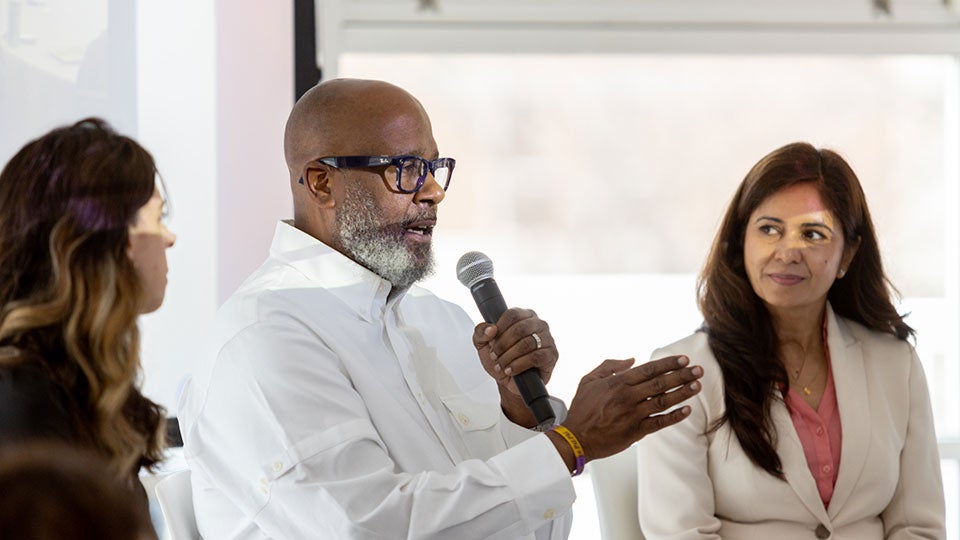
During the fall 2025 semester, University of Maryland Head Football Coach Michael Locksley extended his huddle to the classroom, welcoming students from the Robert H. Smith School of Business.
Locksley partnered with Associate Clinical Professor Sheetal Singh to co-teach a revised section of the “Leadership and Teamwork” course to roughly 60 students from the Smith School’s Master of Science in Management Studies (MiM) program. Following its successful introduction and with increased student demand, that partnership has continued with another section offered this spring.
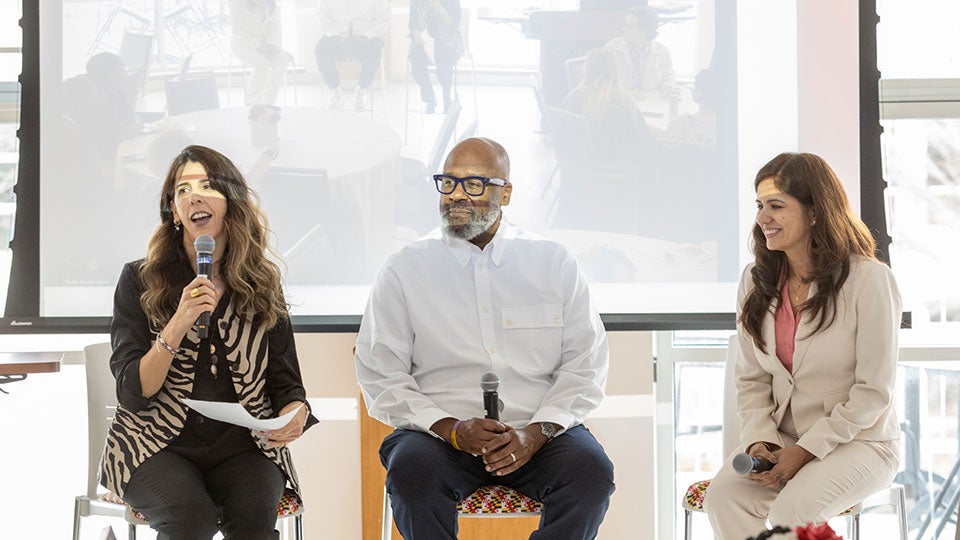
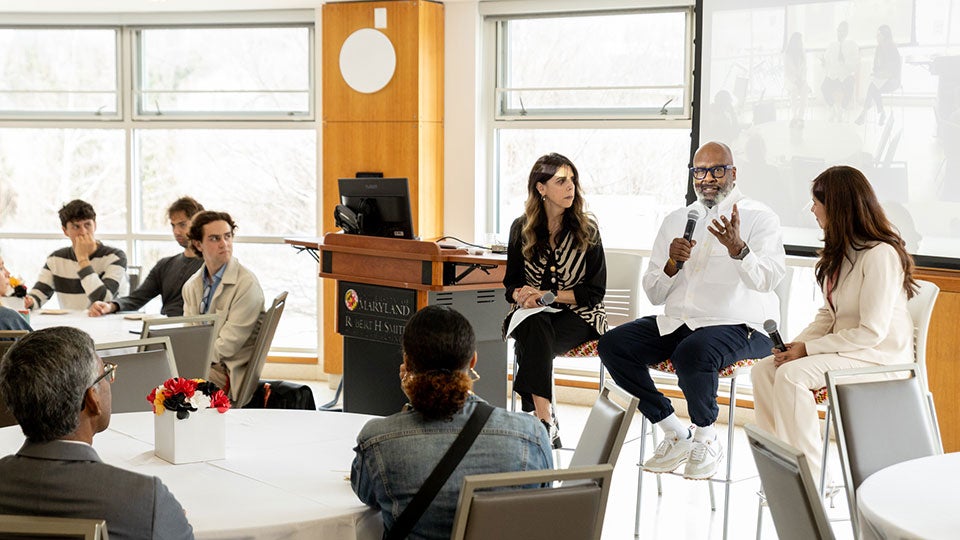
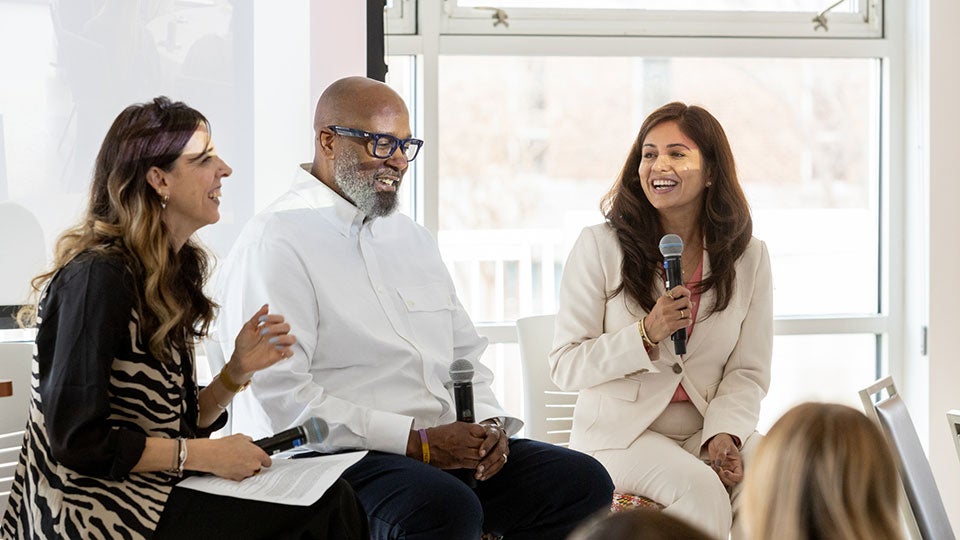
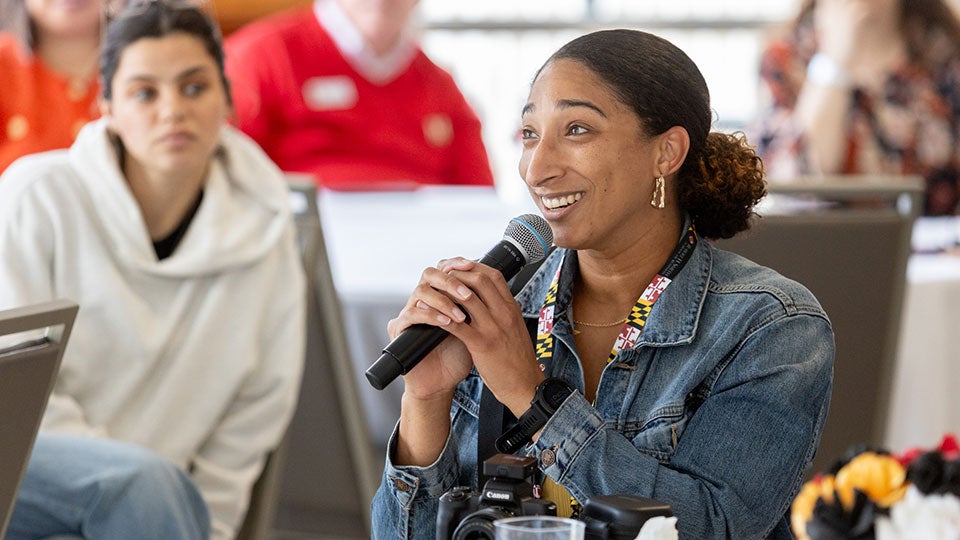
On Wednesday, March 11, 2026, Locksley sat down with Singh to discuss the course’s success and share insights from his three-decade football coaching career in a conversation moderated by Professor and MiM Academic Director Rellie Derfler-Rozin.
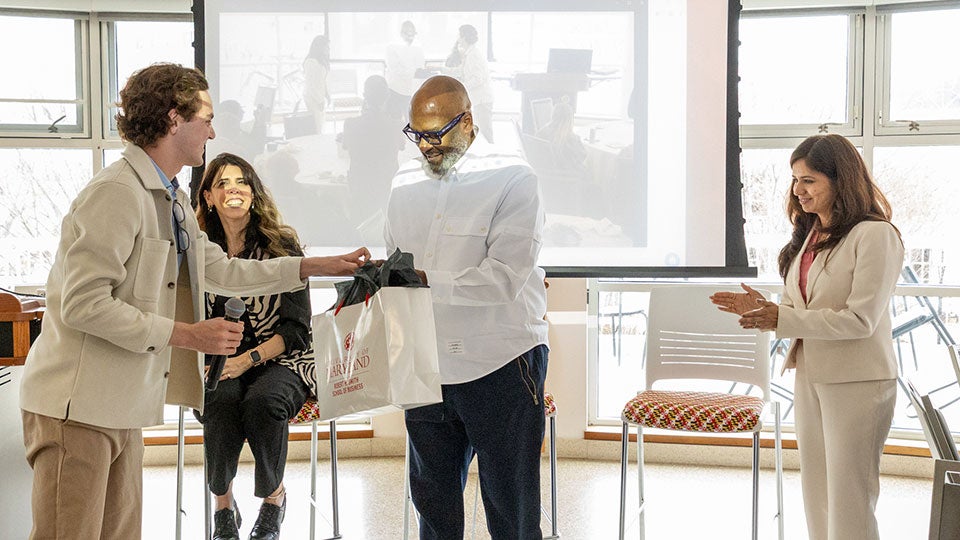
During the event, Smith School Dean Prabhudev Konana commended Derfler-Rozin and Singh on the course’s positive impact in developing leaders and expressed his gratitude to Locksley for translating his gridiron experiences into invaluable classroom lessons.
“College football is a tough business, and we have much to learn from how you manage this intensity,” said Konana. “Coach Locksley’s role on our campus extends beyond coaching. He brings high character and has established a culture of great leadership. Thank you for being with us and for partnering with our faculty.”
In her opening remarks, Derfler-Rozin recounted the process behind developing this iteration of the course and echoed Konana’s gratitude to Locksley for his commitment to supporting Smith students.
“We brainstormed how to get Coach Locksley involved and contribute by delivering his insights to our students. That was the beginning of this wonderful journey,” said Derfler-Rozin. “I know that our students are loving it. Thank you, Coach Locksley, for your amazing generosity and what you bring to our students.”
Singh expressed similar sentiments and offered three observations on Locksley’s leadership and his approach to fostering a culture of empowerment at Maryland. The habits he instills, the thematic stories that permeate his program and the decisions he makes all serve as contributing factors, she said.
“The rituals, stories and decision-making are what it boils down to for his team. Everything follows a consistent theme,” said Singh. “I’ve learned so much from Coach Locksley as well throughout this course.”
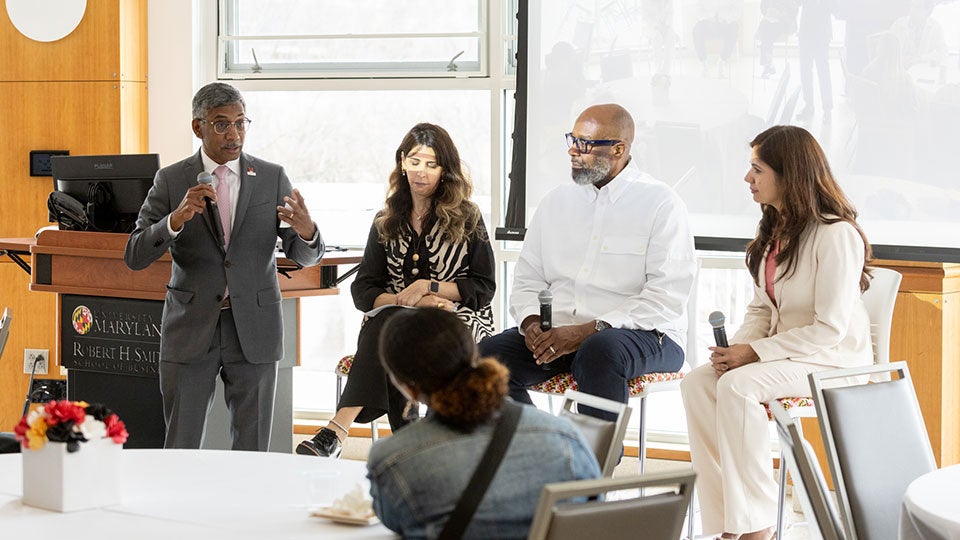
Here are five career and leadership insights that Locksley shared with attendees during the event:
Failure is never final. A mantra that Locksley often shares with his players is something he says everyone can apply to their own contexts. In sports, Locksley said that the emphasis on winning can sometimes lead to missing important lessons along the way. He talked about his journey from a student at Ballou High School in Southeast D.C. to a national champion at the University of Alabama, and how the experiences in between have contributed to the evolution of his leadership during his tenure in Maryland.
“You don't hope your way here, and so I think the biggest misconception is that you need to win six national championships like Nick Saban to be a great leader when there's still value in the lessons that come when you don't have success. The only time failure is final is when you quit,” said Locksley.
Keep TERPS top of mind. The first thing Locksley did upon accepting the Maryland coaching job was ask, “How do I want people to define Maryland football with me as its leader?” His answer: TERPS. In his program, it stands for toughness, effort, a relentless mindset, pride and success. All of which, in practice, make a profound impact on a person’s environment and often lead to success.
“If you walk into our building, you’ll see these values all over the place, along with other phrases like 'Maximize it.' It’s about understanding that time is the most valuable commodity we have, and that every minute offers value that we can’t waste,” said Locksley. “Those are all things that my players learn very early on in my program.”
Go with the terrain. With the high-profile, high-pressure nature of college football, Locksley noted that one major responsibility of coaches and leaders lies in how they define success and manage failure in the public eye. The definition of success in his program is “production being greater than or equal to” the expectations they create within their building.
“There are times in the game when you may not win on the scoreboard, but the more you can show those small successes in the battles, the more it keeps the troops going,” said Locksley. “I always say, when the map and terrain don’t meet, go with the terrain. Meet your people where they are, and then you can form a clear plan to keep moving forward.”
Quality control is critical. Locksley shared how pivotal his experience as the offensive coordinator of Alabama's 2017 national championship-winning team was to his leadership development. In particular, he referenced his meetings with coaches Nick Saban and Curt Cignetti, who emphasized the importance of quality control (QC) across all aspects of the program. Locksley said he’s maintained that approach at Maryland, and it’s served an important role in cultivating a culture of accountability and investing in other leaders.
“Great leaders coach the coaches, and the only way to do it is to quality control every part of our business,” said Locksley. “We ask questions: How did we do? Why did we achieve that result? What worked or didn’t work? When you QC every part, whether it's recruiting, offense, defense, special teams, fundraising, all the hats that you wear as a leader, you have to have mechanisms to quality control it and then make the necessary corrections.”
Teach others how to fish. The emergence of name, image and likeness opportunities for student-athletes in recent years has fundamentally transformed the college sports landscape. “Three years ago, everybody got the same paycheck when they went to the window; now everybody’s got a different one,” said Locksley. Some athletes may earn over seven figures in college, but Locksley said he is also focused on preparing the majority for life after football, where they’ll transition into other careers. That motivation, he said, contributed to his partnership with the Smith School to impart those lessons in a classroom setting.
“I’m dealing with guys who are experiencing a lot of firsts in their lives, so my job is to help them transition onto this campus, allow them to create value for themselves and empower them with knowledge to be successful with or without football,” said Locksley. “I’ve got a lot of fishing to teach, and the resources that this great university offers me give me a chance to do that.”
Media Contact
Greg Muraski
Media Relations Manager
301-405-5283
301-892-0973 Mobile
gmuraski@umd.edu
About the University of Maryland's Robert H. Smith School of Business
The Robert H. Smith School of Business is an internationally recognized leader in management education and research. One of 12 colleges and schools at the University of Maryland, College Park, the Smith School offers undergraduate, full-time and flex MBA, executive MBA, online MBA, business master’s, PhD and executive education programs, as well as outreach services to the corporate community. The school offers its degree, custom and certification programs in learning locations in North America and Asia.