
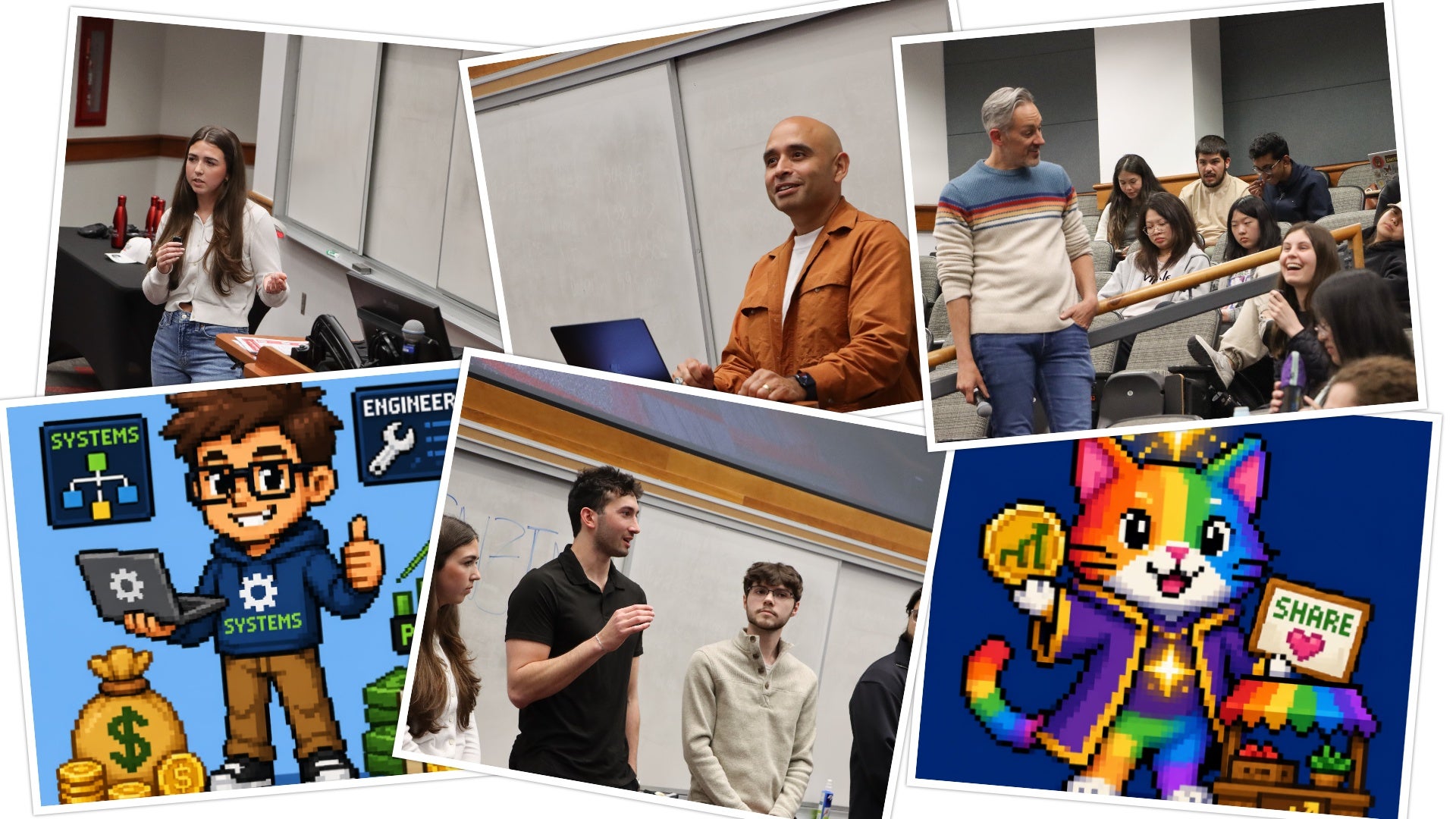
As students filled Frank Auditorium Thursday, April 30, they were given small pieces of paper with QR codes. The codes led students to an app, where they were invited to generate a username and an avatar. What seemed like a game was actually a learning exercise. Robert H. Smith School of Business Associate Clinical Professor Justín Reyna and Lecturer Brian Jefferson led participants through an interactive lesson on how to work with AI.
It was the first AI Literacy for Undergraduates workshop to help students not only increase their knowledge of AI but also increase student marketability. Faculty and staff were also invited to take part, with more events for undergraduates, graduate students, as well as faculty and staff planned for the future.
Four student speakers presented how AI has been a helpful tool for personal, academic or professional support. After each speaker, the “game” asked audience participants questions about what they just heard, and AI rated their literacy, generating a leaderboard with names such as “Luminary Market Share Unicorn” and “Systems Engineer Profit Slayer.” The avatars were built on the generated name with one word to personalize them.
AI Is Your Assistant
The first speaker, senior accounting major Gabriel Kronen ’26, offered guidance on how to use AI, specifically NotebookLM, to prepare for exams. He recommended identifying tasks that might be easier with AI assistance. “Keyword: assistance,” Kronen said. “Only put safe information into the prompt. Make sure whatever is drafted you review. It is still just an assistant.”
After Kronen finished, the first question in the game was presented. When the leaderboard appeared, one student received a score of 100.5 (extra points were awarded for speed). Asked how he got the answer, the student said he used ChatGPT. He removed himself as winner, earning laughs from the room.
AI as a Brainstorming Partner
Aiden Conner McCormick ’26, a senior accounting major, used AI to evaluate a video game he created. He turned to AI for help with marketing and product design. “ChatGPT isn’t very good at just coming up with new, excellent ideas,” he said, so he built a collaborative system, giving AI criteria and narrowing ideas to a shortlist of 10.
As he developed a trailer, he found AI feedback reflected a designer’s perspective, not a consumer’s. He combined AI input with real user feedback. The game announcement reached more than 300,000 people, with 1,000 sign-ups in the first week. “AI is a great partner but not a replacement,” he said. “It can’t replace real customer feedback.”
No Technology Background, No Problem
Sophomore Aiden Polinsky saw too many disconnected apps in student life—transportation, majors, jobs and registration. He created CampusAI to unify them into one customizable platform.
Without a tech or business background, he relied on Smith resources and AI. “With the help of Smith and AI I was able to create a real, strong team,” he said, learning from faculty and peers.
He used AI to transcribe meetings, prepare presentations, conduct market research and build the core product. Still, he emphasized human input: “Give your AI engine as much context as possible.”
CORE Framework
Accounting graduate student Brooke Holland developed a framework: CORE—Create, Organize, Research and Etiquette. She uses AI to build presentations, organize ideas and improve efficiency.
For research, she noted AI is not a source but helps find credible ones and identify gaps in logic. For etiquette, AI helped her navigate workplace communication and feedback. “It helped me go into the internship with confidence,” she said.
How AI Built the Event
Top participants scored as high as 305.9 after four rounds. Reyna and Jefferson explained how AI powered the event—from generating names and avatars to grading responses in real time.
The exercise also showed faculty how AI can support classroom work, reducing busywork. Reyna even created slides live using ChatGPT image tools. “On-the-fly slide creation helps tailor the presentation,” he said. “That’s a win when using AI.”
Media Contact
Greg Muraski
Media Relations Manager
301-405-5283
301-892-0973 Mobile
gmuraski@umd.edu
About the University of Maryland's Robert H. Smith School of Business
The Robert H. Smith School of Business is an internationally recognized leader in business education and cutting-edge research. The school’s world-class faculty facilitate experiential learning opportunities rooted in the real world. Smith students learn to think like entrepreneurs, prepared to drive positive impact. The school offers undergraduate, online and on-campus business master's, full-time, part-time, online and executive MBA, plus PhD and DBA degree programs, and non-degree and executive education programs. Where Smith leads, the future follows.