
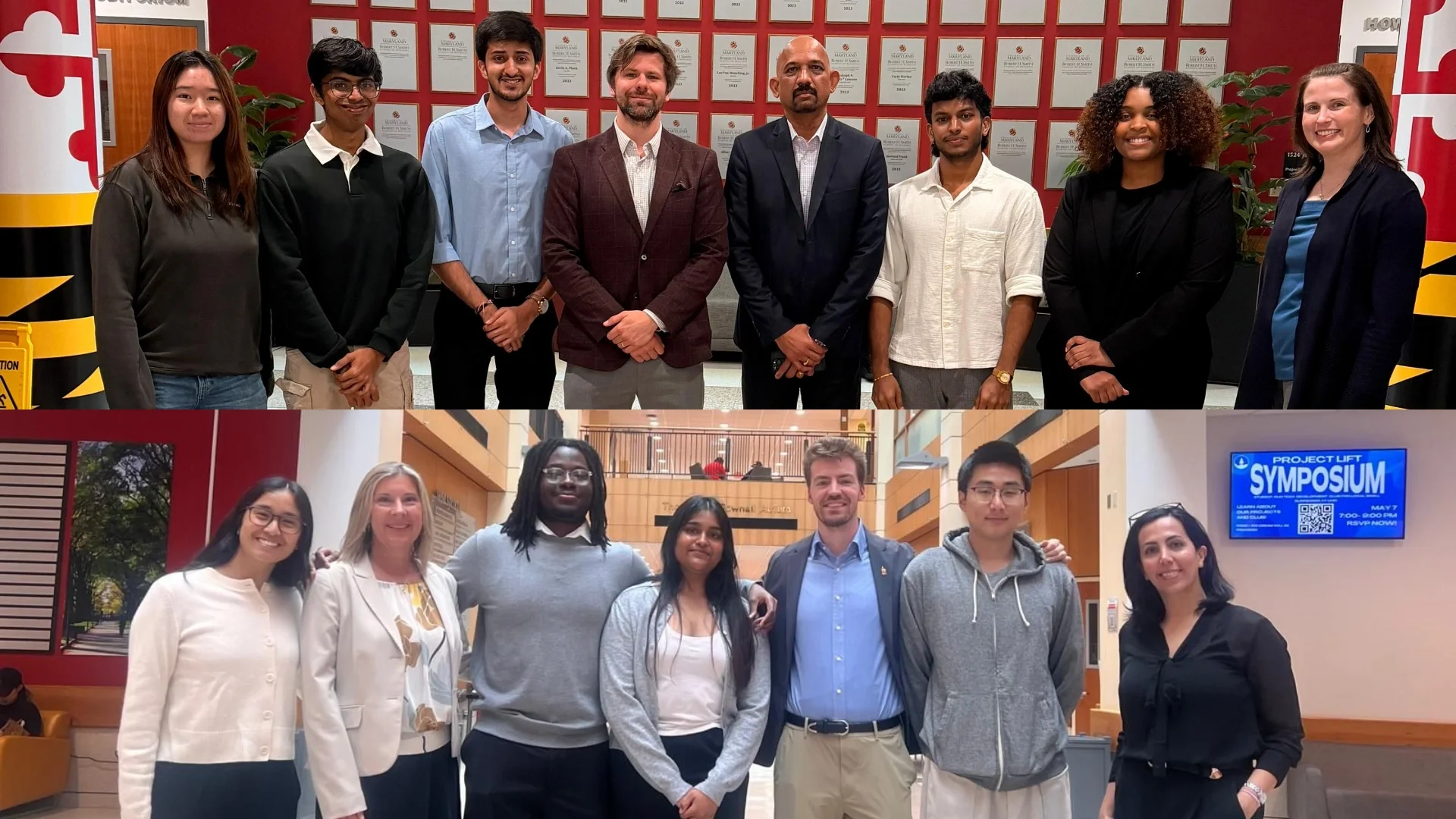
For the third consecutive year, student consulting teams in the University of Maryland’s Robert H. Smith School of Business Master of Science in Information Systems & AI (MSIS & AI) program partnered with organizations across sectors to design AI‑enabled systems that modernize complex workflows and strengthen data‑driven decision‑making.
Through the spring 2026 semester, 14 student teams completed systems analysis and design projects for partners ranging from Maryland state agencies to global firms and mission‑driven nonprofits.
Comprising this cross‑sector portfolio:
- Microsoft (Large Technology Company): A Co‑Pilot Agent (VBD) Platform for Emergency Responses and Hand‑Off
- Brookings (Think Tank): The AI Equity Lab Platform
- Aptotex (Consulting/IT Services): Third‑Party AI‑Enabled Risk‑Management System
- Cloudforce (Consulting/IT Services): A Metrics and Analytics Platform
- CTIS, Inc. (Consulting/IT Services): AI‑Enabled Clinical Research Review System
- Maryland Department of General Services (State Government): The DGS Mobile Workflow App
- Maryland Department of Veterans Affairs (State Government): The Maryland Veteran & Military Family AI Transition Assistant
- The W2 Group (Professional Services/Accounting‑Tech): The WorkOS AI‑Assisted Decision‑Support Application
- Web Traits, Inc. (Non‑Profit/Social Impact): Government Grant‑Program Management System Automation
- Web Traits, Inc. (Non‑Profit/Social Impact): AI‑Enabled Residential Home‑Sales Wizard
- LeftoverLove (Non‑Profit/Social Impact): An Educational Game
- The Super Crowd, Inc., a public benefit corporation (Non‑Profit/Social Impact): Impact‑Investing Due‑Diligence AI Tool
- SSAA — Schedule Someone Anywhere Anytime (Startup): The SSAA Mobile App
- Krama, Inc. (Startup): The AI Agent Builder
Spotlight: Mobile Workflow App for Maryland DGS
One team (Jaylah Brooks, Rishabh Lnu, Kavya Mehta, Ramanathan Muthuraman, Sarah Tang) partnered with the Maryland Department of General Services (DGS). The students worked with DGS mentors and met with stakeholders across divisions to explore how a mobile platform could make it easier for state employees to connect with DGS services—from reporting maintenance issues to reserving fleet vehicles and other day-to-day operational functions.
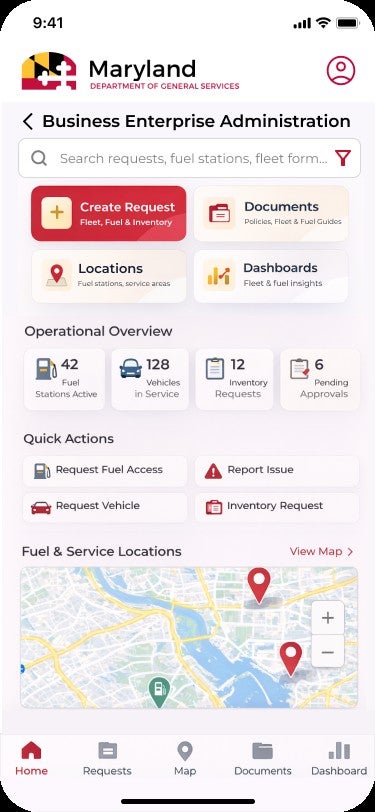
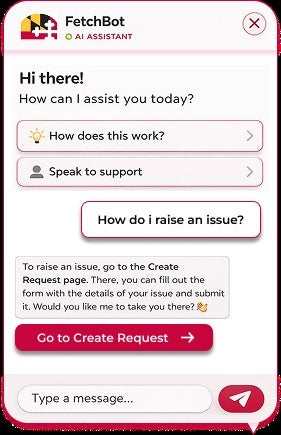
A guided maintenance-request flow lets State employees report issues, attach photos, and set severity from their phones.
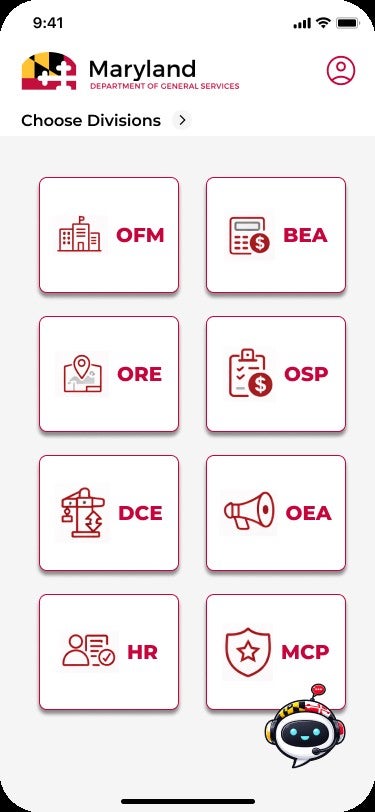
An early prototype of the DGS mobile app: a single entry point to services across the department's eight divisions.
DGS Project Delivery Manager Ram Konda commended the students for “their ability to synthesize complex requirements into a cohesive, actionable prototype supported by detailed data‑flow diagrams and Figma designs.” They have done a great job this semester and will work toward integration and implementation when they return in the Fall semester, he added. “They delivered a functional blueprint for our digital infrastructure.”
Spotlight: Impact‑Investing Due Diligence Platform
Another student team (David Binigbolo, Mahad Khan, Kayli Malone-Senea, Navya Narasimha, Weirong Peng, Sameer Saxena) in the Systems Analysis and Design course built WorkOS, a prototype diligence platform for The Super Crowd, Inc., a public benefit corporation supporting mission‑driven entrepreneurs and retail investors.
The firm’s existing process relied on manual reviews of SEC Form C filings and inconsistent access to EDGAR data. The WorkOS prototype consolidates these steps into a unified system that automates filing retrieval, enables rapid preliminary analysis, supports public-source verification, and provides centralized reporting. Students delivered system models, architecture recommendations, and implementation plans, along with performance benchmarks demonstrating faster processing and improved data accuracy.
CEO Devin Thorpe praised the team’s professionalism and noted the platform’s potential to enhance operational efficiency and investor decision-making significantly.
Student Reflections
The capstone, said several of the participants, deepened their understanding of real-world systems design, describing the system-design phase as "a valuable learning experience" and, for one student, "one of the most fulfilling experiences of my academic career."
That growth was driven by being pushed into unfamiliar territory and learning to navigate it with confidence. Fikreab Mezgebu, whose team worked with Web Traits, said he "gained many valuable skills" and grew "more comfortable in many of the areas that were unfamiliar and challenging at the beginning of the semester."
For others, the lesson was about how real systems hold together. Adith Kannan of The W2 Group came away with "a much better appreciation for why structured systems analysis exists," adding that it is "not busywork — it's the thing that keeps a complex design from falling apart."
Cloudforce's Venkata Sai Krishna found that breaking down a live analytics platform "made the theory from class actually click.”
For CTIS's Anirudh Patil, the takeaway was the teamwork itself: through regular discussion and shared ownership, his team "strengthened team cohesion and gained confidence in our ability to successfully execute the project together." The mix of client engagement, collaborative design, and structured analysis, he said, "reinforced the importance of clear requirement gathering, effective communication and cross-functional teamwork in delivering successful information systems solutions."
“These projects show how our students are translating complex organizational needs into scalable, AI‑enabled systems, said Associate Clinical Professor of Information Systems Minoo Modaresnezhad. “The partners trusted them with real problems, and the students delivered solutions that meaningfully improve how these organizations operate.”
Read more about the MSIS & AI Industry Capstone.
Media Contact
Greg Muraski
Media Relations Manager
301-405-5283
301-892-0973 Mobile
gmuraski@umd.edu
About the University of Maryland's Robert H. Smith School of Business
The Robert H. Smith School of Business is an internationally recognized leader in business education and cutting-edge research. The school’s world-class faculty facilitate experiential learning opportunities rooted in the real world. Smith students learn to think like entrepreneurs, prepared to drive positive impact. The school offers undergraduate, online and on-campus business master's, full-time, part-time, online and executive MBA, plus PhD and DBA degree programs, and non-degree and executive education programs. Where Smith leads, the future follows.