
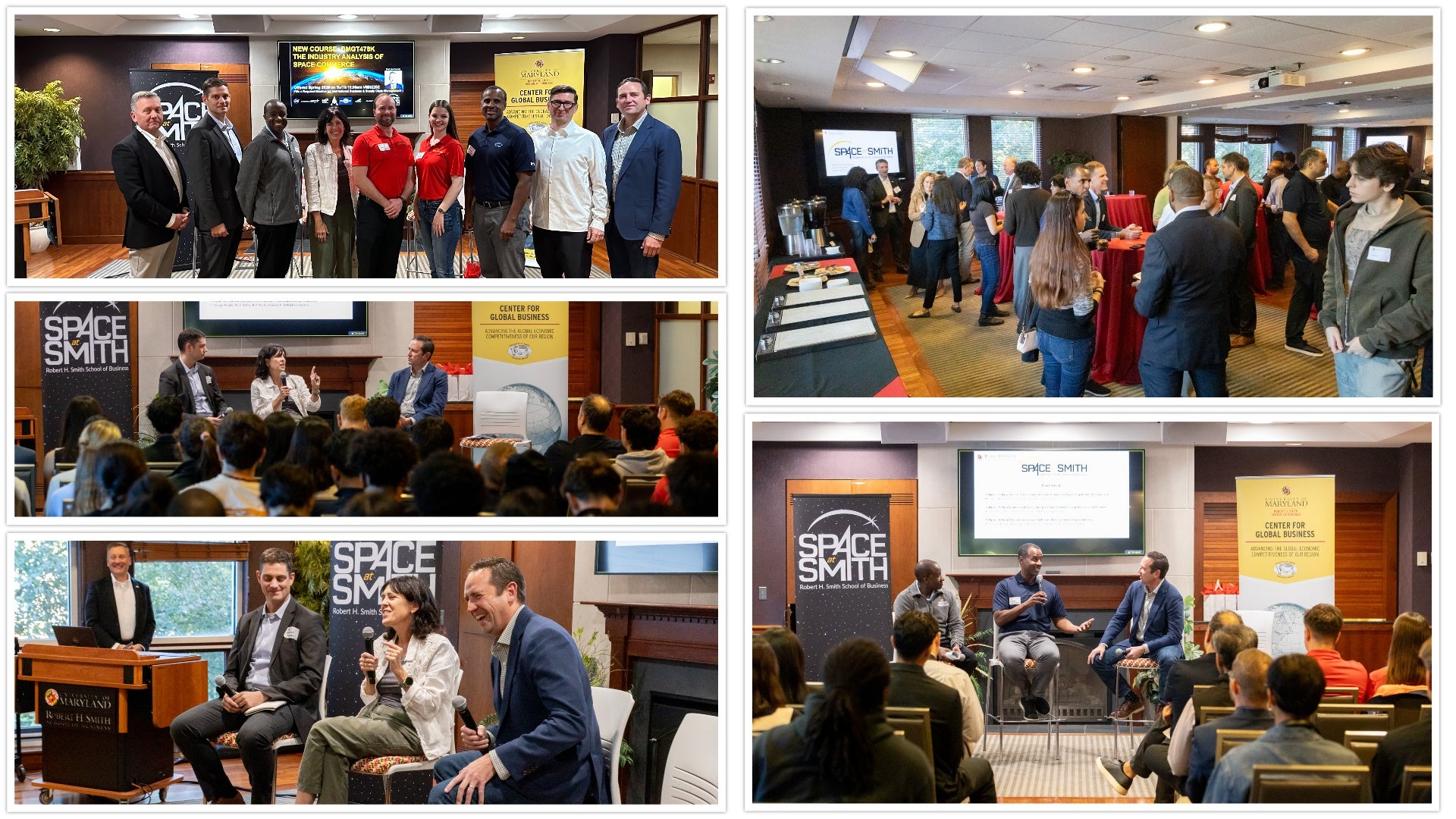
From national security to supporting the TEARP RAPTOR team’s mission to intercept the Apophis asteroid, the Space at Smith Symposium highlighted the important intersection between science and business.
The Robert H. Smith School of Business is reaching for the stars to create new learning opportunities to help students continue to differentiate themselves in the marketplace. Space at Smith is a new initiative dedicated to developing undergraduate and graduate programs focused on the commercial space industry. The inaugural Space Economy Symposium event, co-sponsored by Smith’s Center for Global Business, served as the launch pad for this new initiative.
“This is all about jobs,” said Cristian Dezso, area chair and professor in the logistics, business and public policy department (LBPP) at the Smith School. “From our research, it seems that nobody is doing anything like this at the undergrad level in a business school to have something related to space commerce. So we felt this would be a great opportunity.”
The event, held in Van Munching Hall on Oct. 16, 2025, gathered faculty, industry experts and students to share insights on applying business principles to the rapidly growing space industry. Panelists spoke to three areas in particular: National and Local Space Capabilities, Commercial Enterprises in National Competitiveness and Security, and Entrepreneurial Ventures in Space.
Maryland has a concentration of aerospace businesses throughout the state, Colter Menke, a program manager concentrating on aerospace in the Office of Strategic Industries and Entrepreneurship in the Maryland Department of Commerce.
It’s one of the reasons alumnus Georgie Brophy, MBA ’97, Co-founder of the Maryland Aerospace Alliance and Strategy and Growth Executive with Qwaltec, encouraged students in the audience to stay in Maryland after graduation. “You are students and you are bright and you have a lot of ideas and now is the time that we need that in the state of Maryland,” she said. “The Maryland Aerospace Technology Commission (MATC) is the Governor’s commission that was created to support the ecosystem of aerospace and technology in the state to ensure that we have a healthy ecosystem moving forward.”
The panel also encouraged business students to consider the space industry, as partnerships between those with technical backgrounds and business acumen are needed. “That diversity of thought is critical right now,” Brophy added.
The collaboration between government and the private sector was also highlighted, such as NASA’s role in helping to launch SpaceX and technological advances that also benefit the public. Brophy noted that things like being able to track where your DoorDash order is, that GPS technology is a byproduct of other technological initiatives.
Commercial Enterprises and National Security
With companies like SpaceX helping to lower launch costs, there are thousands of satellites in operation in orbit. Rashid Neighbors, VP of Satellite Professionals International, Mid-Atlantic Chapter, pointed out that SpaceX has launched nearly 7,000 satellites.
Neighbors said the proliferation of satellites is not a technical term, but “proliferation is what people tend to call mega constellations,” he said. “The lead in of SpaceX lowering the cost of launch really provides good context of why that term exists. Prior to people being able to launch so many satellites, proliferation wasn’t really discussed, the term came because there are so many satellites going up so rapidly prior to what was happening before.”
Moderator Rob Ruyak, MBA ’13, Founder and Global Leader, AWS Aerospace & Defense Sales and Business Development; Host, Space Insiders Show podcast, pointed out that defense and national security have been very interested in these satellites.
Dennis Woodfork II, MBA ’15, Mission Area Executive, National Security Space, Johns Hopkins University Applied Physics Laboratory, said that the Office of Space Commerce said years ago that space is congested, contested and competitive. “‘Contested’ means it is no longer what we call a benign domain. There are adversaries of this nation who mean to use space in order to further their own interests, and their interests conflict with ours, which means we have conflict,” Woodfork added. “If I have 7,000 satellites, how does an [adversary] mitigate that? There's no way to do that cost-effectively. I think that’s why we have a proliferated architecture strategy.”
The increased demand for space hardware presents its own challenges.
“Manufacturing is very important in space. You are building very complicated hardware. Space is a hardware-intensive industry in a world where you have a lot of software-driven stuff,” Neighbors said, noting that there is a need for facilities and workforce to build these devices.
Launching Innovation
University of Maryland (UMD) Ph.D. Student Adrienne Rudolph M.S. ’25 and Brent Barbee, lecturer with the UMD aerospace engineering program and lead planetary defense applications scientist and community liaison at NASA Goddard Space Flight Center, talked with panelists about how investments, startups and innovation have had an impact on the commercialization of space.
“I’ve seen a couple of different things [such as] diversification of their products and services,” Ruyak said in what he's seen in startups that have gone on to be successful. He said there is also some demonstrated interest in the government side to explore companies that sell products, not just platforms.
“It’s not easy at a small company, especially if you are building a launch vehicle. It requires a lot more capital and there is a lot more risk associated with it,” Ruyak added.
Brophy said product management is also key. “I think product managers are missing in our industry in startups. I think people need to figure out what the gaps are and what the needs are. Thinking of the customer and how [they] can use the spacecraft. Sat Comm is not a new thing. What [Elon] Musk did with Starlink is brilliant. What Project Kuiper is doing is brilliant because it has long been needed.” Brophy also added that raising the funds for projects is critical.
It’s something that Rudolph and Barbee are familiar with and why they presented an opportunity for Smith students to get involved now with an upcoming project. About a year ago, their team started a concept called TERP RAPTOR (Terrapin Engineered Rideshare Probe for Rapid-response Asteroid Apophis Profiling, Tracking, Observing, and Reconnaissance), which will send a CubeSat toward the asteroid Apophis as it closely passes by Earth in April 2029. “It is an incredibly rare event. It is not going to hit the Earth,” Rudolph said of the space event. It’s the first of its kind project for the University of Maryland. “We recently underwent two very important design studies to rapidly mature our design for this mission. We also recently selected 25 to 26 new students to join our team, so we’ve grown,” Rudolph added. “The images we get, we want to share them with the world and we need help for the stage that we are at right now.” Rudolph said. They are looking for fundraising ideas to raise the $10 million needed for the project.
“We’re hoping to get some help and collaboration with the business school, so we are putting on this case competition for those of you students who are interested to help us come up with ideas for fundraising,” she added.
This week is the sign-up period for any students interested in competing and then additional details will be provided.
“This could be an out-of-this-world bullet on your resume,” said Jon Crocker, MBA ’16, clinical professor in the LBPP department. Crocker also announced the new course BMGT478K: The Industry Analysis of Space Commerce, to be offered during the Spring 2026 semester.
This event was provided in part by CIBE, a Title VI grant from the U.S. Department of Education.
Media Contact
Greg Muraski
Media Relations Manager
301-405-5283
301-892-0973 Mobile
gmuraski@umd.edu
About the University of Maryland's Robert H. Smith School of Business
The Robert H. Smith School of Business is an internationally recognized leader in business education and cutting-edge research. The school’s world-class faculty facilitate experiential learning opportunities rooted in the real world. Smith students learn to think like entrepreneurs, prepared to drive positive impact. The school offers undergraduate, online and on-campus business master's, full-time, part-time, online and executive MBA, plus PhD and DBA degree programs, and non-degree and executive education programs. Where Smith leads, the future follows.