
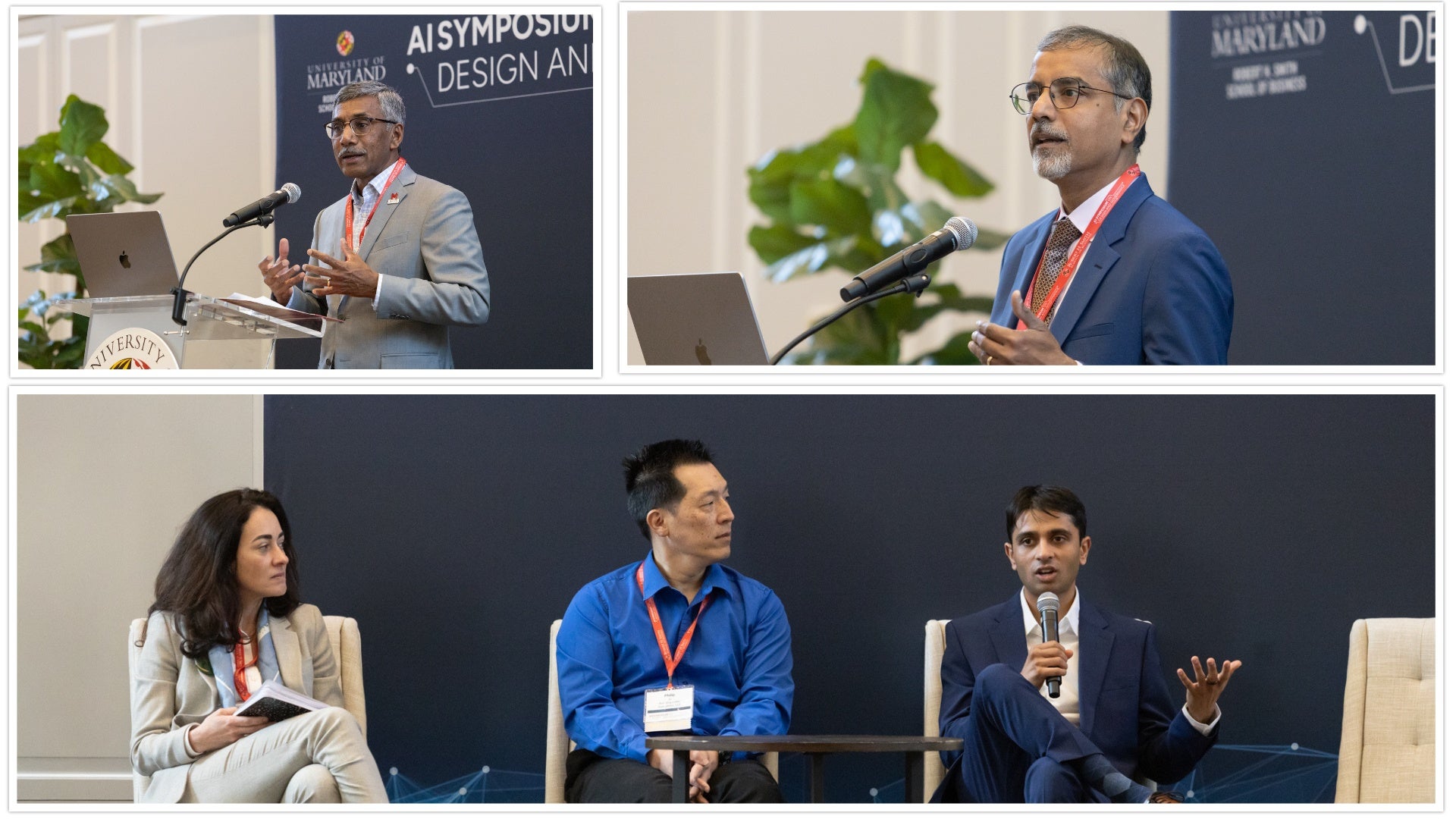
“How do you design systems, how do you govern, how do you evaluate outcomes and how does the feedback look?” Those are all questions Prabhudev Konana, Dean of the University of Maryland Robert H. Smith School of Business, posed as he welcomed the over 100 people attending the 2026 AI Symposium on Design and Governance.
On April 8 top thought leaders building real-world AI solutions spent the afternoon at the UMD Samuel Riggs Alumni Center, sharing their insight on those questions as well as how AI will likely impact the future of work, healthcare and software.
In opening remarks, Balaji Padmanabhan, the event’s host and Director of Smith’s Center for AI in Business, weighed in on growing concern that artificial intelligence is replacing people on the job. “We have agency as people building AI solutions. If we design it well, we’re not designing it to replace humans. We’re designing it to give every human in the world a unique superpower in their pockets.” He noted that the esteemed group of guest speakers at the symposium are, “designing those superpowers for us.”
First up was Philip Su ’98. He majored in computer science and neurophysiology at UMD and worked at Microsoft and OpenAI before founding Superphonic. Su joined OpenAI as their first software engineer hired at the company’s Seattle office. “If you’ve ever asked ChatGPT to create an image for you, you have me to blame,” he said.
Su thinks AI software will get to the point where being a software developer becomes a commonplace task, so the role will have to evolve. “I think software developers become much more like managers or managing agents,” and “we will have a lot more new types of jobs.”
Manon Revel, a senior research scientist at Google DeepMind, spoke about Backstory, an experimental AI tool the company has developed that helps people with a persistent problem internet users have—determining if an image is real or fake. Backstory provides “context about an image, checking whether it’s AI-generated and also gives you information about where the image originated on the internet,” said Revel, who builds mathematical and computational models to study human interactions with AI.
International Monetary Fund Senior Economist Marina Tavares provided data on AI and the future of work across the globe, and the AI skills gap that exists between younger and older workers. “One in 10 jobs in most economies require a new skill that wasn’t present in the labor market almost 15 years ago.” She said many of these skills come with wage gains. “New skills carry a wage premium for workers of around 4% and job postings that have a need for more new skills have a higher wage premium.”
Dr. Bhargav Patel of Brown University Health and former Chief Medical Officer with Sully.ai is shaping the future of health care. He remarked that “health care organizations have spent over a billion dollars on AI in the last year, and the biggest investment has been in AI Scribes.” AI Scribes records doctor-patient conversations and drafts summary notes. It reduces physician burnout significantly. Patel said, “AI adoption in health care has been pretty rapid compared to other industries. It will improve things for doctors and patients.” But he added, “We have to be wary,” because it’s not even close to being used without close supervision. However, he does believe the future is AI + Clinician, the integration of artificial intelligence tools into clinical workflows, like what’s happening with AI Scribes.
During a panel discussion that included Patel, Tavares, Su and Padmanabhan, many questions were asked of them by the symposium attendees, but one of the most memorable came from a federal government employee. She mentioned having a lot of hidden disabilities and talked about how she advocates for herself and people like her. “I’m a little bit afraid of going back to school because school was really hard for me growing up, and my undergraduate degree was almost impossible to pass.” She’d like to use AI tools to help her earn a master’s degree and asked how to broach that subject with professors without offending them or negating her schoolwork.
“I think we are having this conversation at all universities, where individual professors are very open to their students using AI. AI can be an incredible assistant and even a coach,” answered Padmanabhan. “But it should not come at the cost of humans exercising our thinking capabilities to the fullest.” He concluded, “There is most likely an equilibrium where we’re all better learners with AI than without, and we’re having those discussions that can help us move in that direction as academics and lifelong learners ourselves.”
Media Contact
Greg Muraski
Media Relations Manager
301-405-5283
301-892-0973 Mobile
gmuraski@umd.edu
About the University of Maryland's Robert H. Smith School of Business
The Robert H. Smith School of Business is an internationally recognized leader in business education and cutting-edge research. The school’s world-class faculty facilitate experiential learning opportunities rooted in the real world. Smith students learn to think like entrepreneurs, prepared to drive positive impact. The school offers undergraduate, online and on-campus business master's, full-time, part-time, online and executive MBA, plus PhD and DBA degree programs, and non-degree and executive education programs. Where Smith leads, the future follows.