
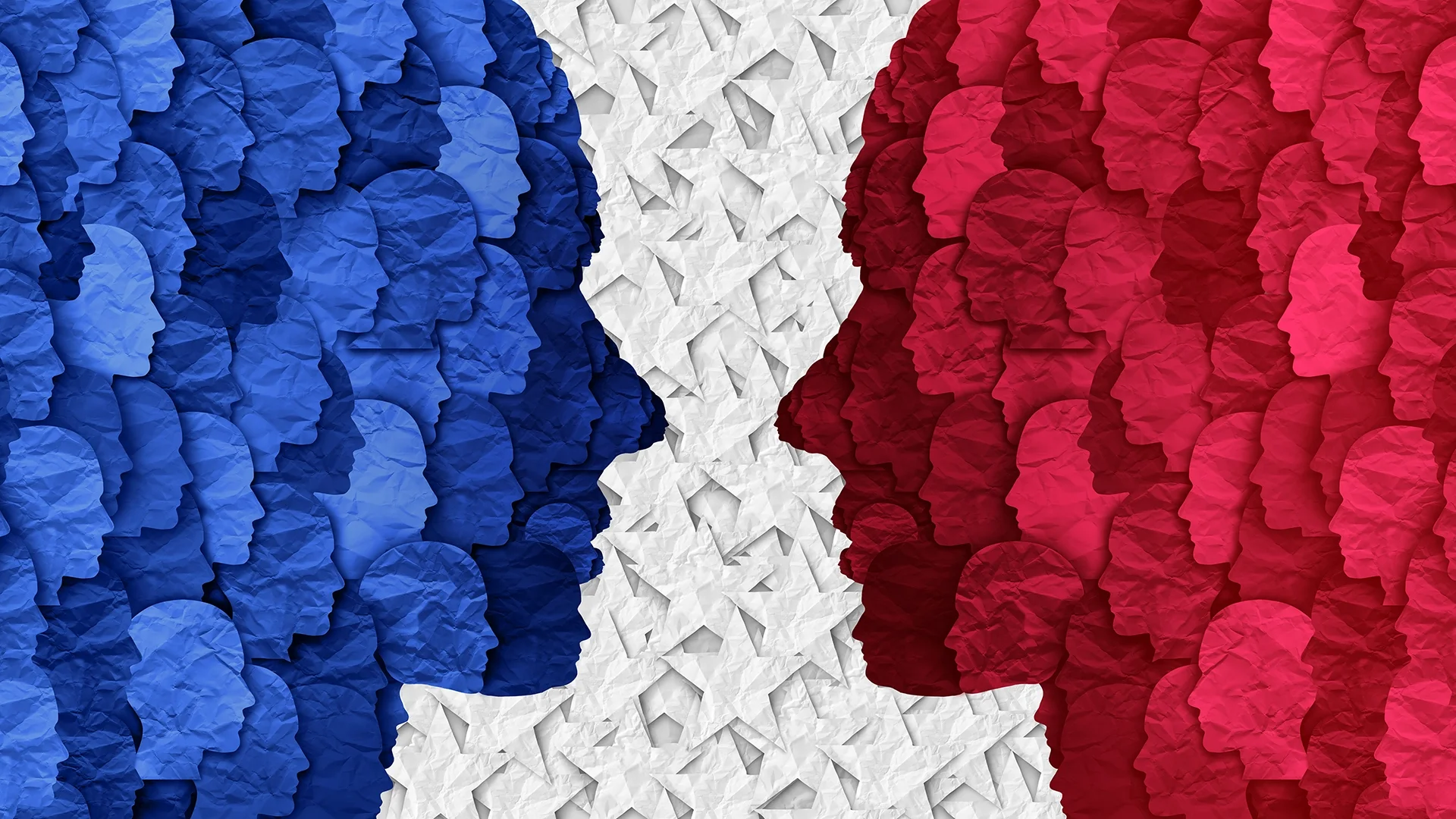
Americans increasingly organize their lives around political identity—sorting into like‑minded neighborhoods, social circles, and even religious communities. Yet one domain where people spend the majority of their waking hours has remained surprisingly understudied: the workplace. Findings recently published in Nature Human Behaviour, provide a comprehensive picture of how politically mixed—or politically divided—U.S. workplaces actually are.
The study, co-authored by Reuben Hurst, assistant professor at the University of Maryland’s Robert H. Smith School of Business; Justin Frake of the University of Michigan’s Ross School of Business; and Max Kagan of Columbia Business School, represents a methodological leap forward in understanding political composition at work. The team assembled the largest dataset ever used to study workplace partisanship, linking state voter‑registration records with more than 100 million online employment profiles.
After extensively cleaning the data and using a novel matching method that combined statistical tools with AI to identify names, the researchers identified more than 45 million U.S. workers. Their final 2024 analytical sample includes 31 million individuals across 366 metropolitan areas, spanning more than 1,000 industries and 380 occupations.
This scale allowed the team to move beyond the limitations of earlier research, which relied heavily on political donation records—a dataset that captures only a narrow, highly engaged slice of the population. By contrast, Hurst and his colleagues constructed a far broader and more representative view of American workers, enabling them to quantify political segregation with unprecedented precision.
The researchers uncovered four central patterns:
- Workplaces are politically segregated. Democrats and Republicans are significantly more likely to work alongside co‑partisans than chance would predict—even after accounting for geography, industry, and occupation. The workplace, as it turns out, is not politically neutral ground.
- Segregation is strongest among politically engaged and higher‑status workers. Employees who donate to campaigns, vote in primaries or hold senior leadership roles are especially likely to cluster in politically homogeneous workplaces. Political identity appears to be more salient—and more sorting—among those with greater organizational influence.
- Political sorting at work has grown only modestly over the past decade. New hires show a slight tendency to join firms where more coworkers share their political leanings, but overall patterns have remained stable since 2012. Even as national polarization has intensified, workplace political composition has not dramatically shifted.
- Republicans encounter more political diversity at work than Democrats. Because Democrats make up a larger share of the employed population, the average Republican works in an environment where about half of coworkers are Democrats—compared with roughly one‑third of coworkers being Republicans for the average Democrat.
Why Workplaces Matter More Than Other Social Settings
Hurst says workplaces offer a uniquely important window into cross‑partisan interaction. “People are more likely to have regular, deep interactions with their workplace peers than with their residential neighbors,” he explains. “There is classic social‑psychology research showing that cross‑group contact reduces prejudice when interactions involve cooperative problem‑solving under shared authority.
The workplace may be the only corner of modern social life where Democrats and Republicans consistently interact under these conditions.” One striking pattern, Hurst notes, is the overall partisan tilt of corporate America. “Our data shows that most companies, industries, and occupations skew Democratic,” he says. “There’s still a popular image of business and industry as Republican, but scholars have argued for years that relatively educated workers have shifted toward the Democratic Party. Our data vividly confirms that the American workplace is, in fact, quite Blue.”
At the same time, Hurst points out that senior leadership remains more Republican—a divergence the team plans to explore further. The contrast between Democratic‑leaning rank‑and‑file workers and Republican‑leaning executives raises new questions about organizational decision‑making, leadership pipelines, and political representation at the top of firms.
Implications for Managers and Organizational Culture
The findings raise important questions for employers navigating political diversity. “There is reason to believe political diversity could lead to dysfunction or conflict, which might tempt managers to cultivate politically homogeneous workplaces,” Hurst says. “But if workplaces become too politically homogeneous, society loses one of the last remaining domains for meaningful cross‑partisan interaction.”
Despite rising polarization nationwide, the researchers found that workplace political segregation has remained relatively stable. For Hurst, that stability underscores the importance of understanding how workplace interactions might shape political attitudes—and whether they can serve as a counterweight to broader societal division. “It’s equally accurate to interpret our findings as showing persistent, significant levels of cross‑partisan contact at work,” he notes. “The workplace may be one of the few places where Americans still regularly collaborate across political lines.”
By providing a comprehensive, scalable dataset, Hurst says the study opens the door to future research on how political diversity—or the lack thereof—shapes organizational culture, employee experiences, and democratic norms. For scholars and managers alike, he adds, the findings highlight the workplace as a critical site for understanding—and potentially mitigating—America’s deepening political divides.
Read the research, “Political segregation in the US workplace,” at Nature Human Behaviour.
Media Contact
Greg Muraski
Media Relations Manager
301-405-5283
301-892-0973 Mobile
gmuraski@umd.edu
About the University of Maryland's Robert H. Smith School of Business
The Robert H. Smith School of Business is an internationally recognized leader in business education and cutting-edge research. The school’s world-class faculty facilitate experiential learning opportunities rooted in the real world. Smith students learn to think like entrepreneurs, prepared to drive positive impact. The school offers undergraduate, online and on-campus business master's, full-time, part-time, online and executive MBA, plus PhD and DBA degree programs, and non-degree and executive education programs. Where Smith leads, the future follows.