
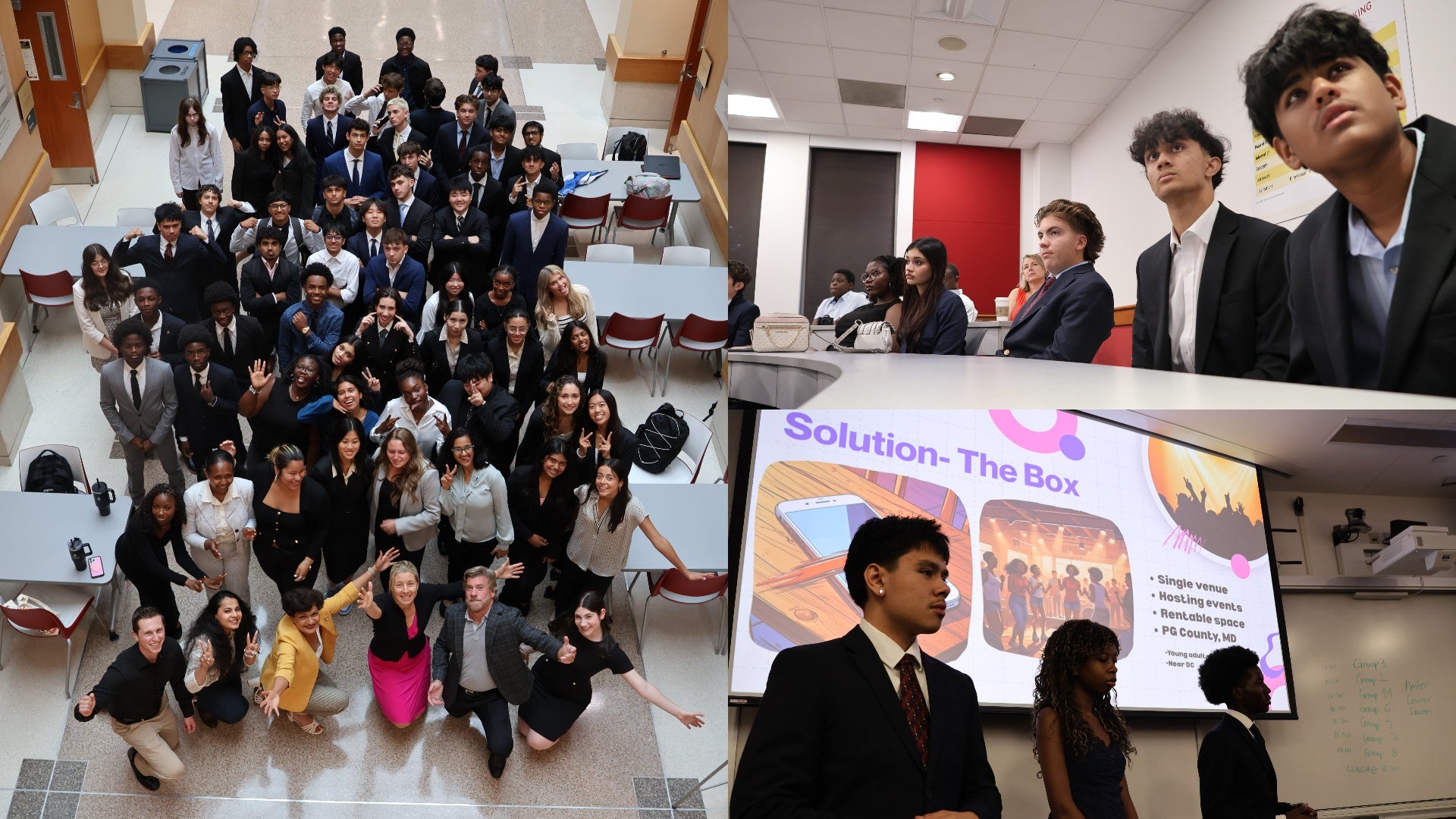
The Snider Enterprise and Leadership Fellows (SELF) Experience has always been about more than teaching business skills—it’s about self-discovery, entrepreneurship and a transformative college experience for high school students.
Named after Ed Snider, the late entrepreneur and founder of the Philadelphia Flyers, the program reflects his belief that young people should be empowered to dream big and lead with confidence. Launched in 2013 at the University of Maryland’s Robert H. Smith School of Business, it began as a one-week commuter camp before growing into a two-week, college-credit experience through the university’s Terp Young Scholars program.
This summer, as the program officially celebrated its 10th year, it also marked a turning point — students returned to campus housing for the first time since the COVID-19 pandemic, reigniting what organizers describe as the “magic” of living and learning together.
That milestone was reflected in the numbers: 68 in-person students, including 15 residing in Prince Frederick Hall, located just outside Van Munching Hall, and 22 online participants. That’s double the in-person count from last summer.
Students traveled from across the country this year, including as far as California; past years have seen international attendees from as far as Ireland.
“What SELF was at the beginning was a bunch of high school kids who got dropped off by their parents, lived in a dorm, learned about themselves and being entrepreneurs and solving problems and then pitched at the end in front of judges,” says Jacqueline C. Manger, Managing Director of the Ed Snider Center. “We were determined to figure out how to make the residential experience happen again.”
Over the years, it has adapted to hybrid formats, weathered the pandemic, and introduced both in-person and online cohorts.
Rajshree Agarwal, academic director and founding director of the Ed Snider Center, had long advocated for reviving the program’s in-person, residential experience. She believed this would be the year to finally bring it back.
“I was motivated to bring back the residential option because it expands access for students who might not otherwise be able to participate,” says Agarwal. “Boarding created more diversity in the cohort — not just socio-economic, but geographic as well.”
Kristen Erdman, Programs Coordinator at the Ed Snider Center, took on the challenge of rebuilding the residential component.
“I think we definitely proved Rajshree’s point that it’s time to bring back residential, because from the people I’ve talked to, they’ve had just a great experience and are even more interested in applying to Smith because of it,” Erdman says.
As a student in the program, Jalen Starr saw that impact firsthand. He says the program gave him early exposure to both college life and career readiness — a head start before stepping onto campus as a full-time student.
“I enjoyed living on campus a lot,” says Starr, a high school student from Wallingford, Pennsylvania. “Whether it was meeting new people, walking around campus, doing different activities, or just eating in the dining hall, I enjoyed it all.”
Throughout the three weeks, students engaged in coursework designed by Agarwal, combining personal development, entrepreneurship training and team-based problem-solving.
The students worked in teams to develop business ventures and pitch their solutions in a competition-style presentation. Ideas ranged from tech-enabled hydration tracking devices inspired by the tragic death of former Maryland football player Jordan McNair to scholarship search platforms and mental health support tools for college students.
Alumni across industries judged the competition, from senior leaders at Salesforce to founders of multi-million dollar companies.
For Erdman, the most rewarding moments came from watching bonds form among the residential students.
“They really got the college experience,” says Erdman. “One of the moms came up to me earlier, and she said, ‘My son was telling me he’s been all over campus and he knows how to get everywhere.’ They just saw parts of Maryland that they wouldn’t have seen otherwise if they hadn’t done the program.”
Both Manger and Erdman see this year’s momentum as a springboard for the future.
“To me, the story is this little engine that could, and this summer it just exploded,” Manger says. “Who knows where the next 10 years will take us?”
For students like Jalen Starr, the impact is already clear. That sense of belonging instilled by SELF may be its most powerful outcome — a living continuation of Ed Snider’s vision to spark confidence in young leaders and prepare the next generation of Terps.
“University of Maryland is my dream school to attend,” says Starr. “I’ve scouted out different colleges and UMD was the only school to make me feel like I truly belonged — or as I should say, family.”
Media Contact
Greg Muraski
Media Relations Manager
301-405-5283
301-892-0973 Mobile
gmuraski@umd.edu
About the University of Maryland's Robert H. Smith School of Business
The Robert H. Smith School of Business is an internationally recognized leader in management education and research. One of 12 colleges and schools at the University of Maryland, College Park, the Smith School offers undergraduate, full-time and flex MBA, executive MBA, online MBA, business master’s, PhD and executive education programs, as well as outreach services to the corporate community. The school offers its degree, custom and certification programs in learning locations in North America and Asia.