
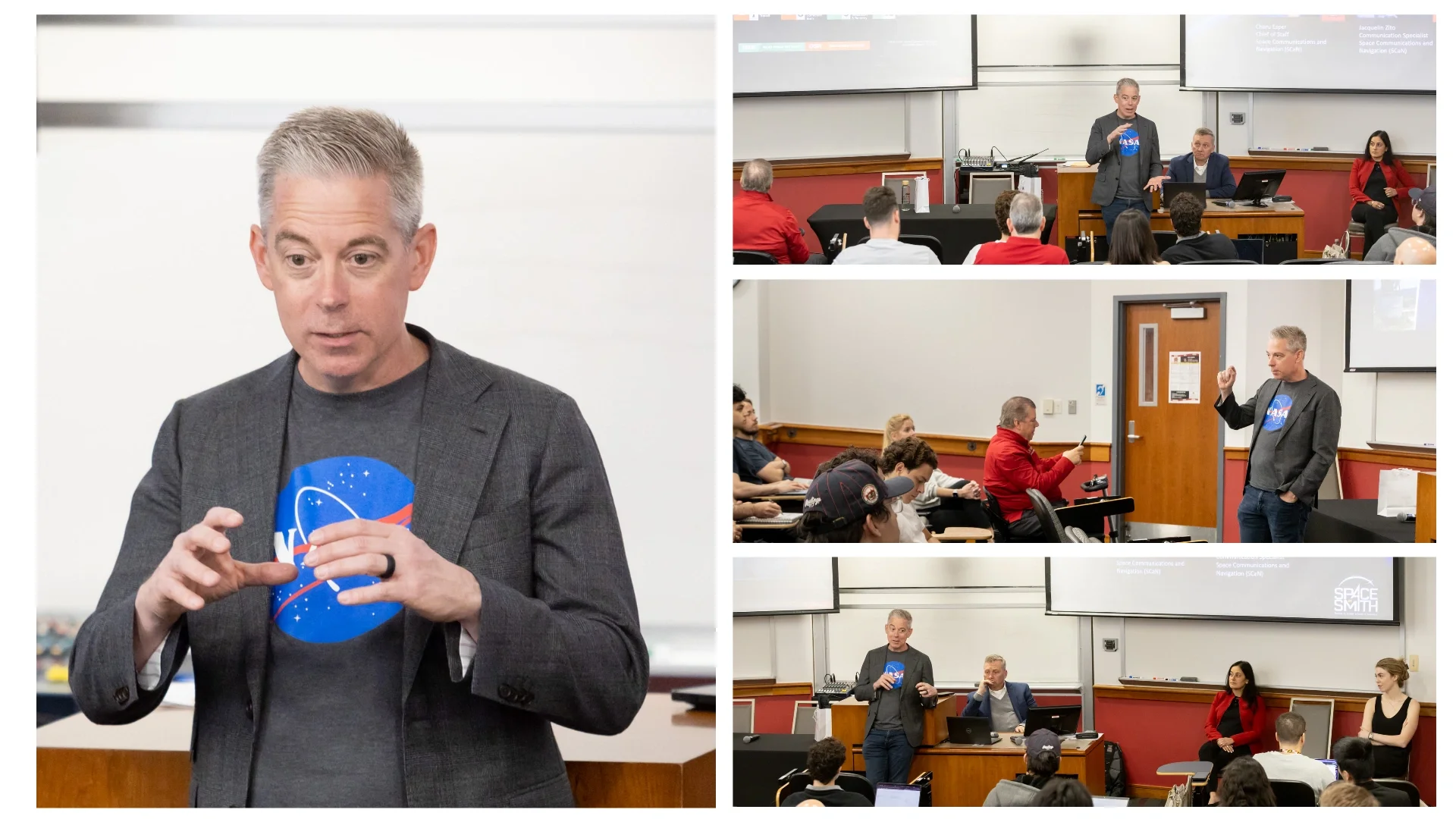
With its splashdown in April, the Artemis II mission is complete. However, the next great space endeavors are already well underway for NASA and its partners.
Students at the University of Maryland’s Robert H. Smith School of Business heard directly from the source as representatives from NASA’s Space Communications and Navigation (SCaN) Program dropped into Van Munching Hall on Thursday, April 30, to share how they’re approaching the next phases of the Artemis campaign, the impossible challenges ahead and how business education fits into the picture.
Hosted by Logistics, Business and Public Policy Professor Jon Crocker, the event saw SCaN Deputy Associate Administrator Kevin Coggins speak to a classroom of students in BMGT478K: The Industry Analysis of Space Commerce on the hurdles of space communications. The event was part of a week of Space at Smith programming, which also saw representatives from Amazon Leo engage with students earlier in the week.
At the event, Coggins was joined by his SCaN colleagues, Caitlin O’Neill, assistant program manager for Mission and Stakeholder Engagement; Charu Esper ’01, MBA ’09, Chief of Staff; and Jacqueline Zito ’23, communications specialist.
SCaN ensures that mission data, including voice, image and telemetry, is successfully transmitted to mission control on Earth from the deepest explored regions of space. It’s also responsible for overseeing the organization’s deep space and ground networks, as well as its Tracking and Data Relay satellite system in support of the Artemis campaign.
In his role, Coggins is helping usher in a major transition for NASA from government-owned communication assets to commercial, private sector partnerships that will aid SCaN in future missions involving astronauts on the International Space Station, rovers on Mars and Artemis missions to the Moon. He noted, in particular, the importance of their work as a “lifeline” for astronauts and a source of pivotal moments that resonate throughout history.
He contrasted Neil Armstrong’s famous ‘One small step for man’ quote from Apollo 11 with Artemis II Commander Reid Wiseman’s "I have two Microsoft Outlooks, and neither one of those are working," to demonstrate the ever-changing demands and subsequent technological advancements in space communications in just the last 50 years.
“We're now in an era where it's not just old computers; they're using modern technology, like iPhones up there,” said Coggins. “Connecting them to networks will require a lot of innovation. It may require some commercial partners to develop new ways to deliver high-speed optical to these moving spacecraft, which we don't have today.”
With manned missions on the horizon to establish a lunar base and build out permanent communications infrastructure in space, Coggins expressed his excitement about how “there’s so much innovation and opportunity” that are also “changing the fabric” of NASA and how it operates.
Coggins recounted the lack of commercially available communications infrastructure during the Apollo missions, which forced NASA at the time to invest heavily in building it out itself. The emergence of a robust space commerce industry with companies to partner with, such as Amazon Leo, SpaceX and Blue Origin, offers the government agency more pathways to innovative solutions. However, these new partnerships also require a shift on NASA’s part to continue navigating traditional government regulatory barriers while aligning with its partners' priorities.
“As we work with our partners to achieve amazing things, we’re also trying to change our thinking to be better partners too. To do that, we have to respect and support their path to profitability,” said Coggins. “They’re trying to innovate and create value, and we want these companies to work with us not just because it’s cool, but because working with us is also good for their business.”
One way NASA has already begun its organizational-level transformation is through its NASA Force hiring initiative. Developed in partnership with the U.S. Office of Personnel Management, the initiative recruits highly skilled, early-to-mid-career professionals for one- to two-year appointments in which they contribute to mission objectives and eventually take what they’ve learned from their experience back into industry. To Coggins, the initiative is pivotal to broadening the agency’s skill portfolio and enabling it to work more effectively with commercial companies.
“Most people in NASA aren't engineers. There are certainly a lot who are, but we have people from every discipline you can imagine,” said Coggins. “For as many people we have with PhDs in astrophysics and engineering, we also have a lot of people who understand business, economics and contracting, and those skills are also helpful for achieving all of the things NASA does around the world.”
Space commerce curriculum, much like that of Crocker’s course and the school’s broader plans for Space at Smith, can also benefit NASA and its partner companies. Coggins recognized the importance of establishing familiarity with the commercial space industry and enabling students to understand how their skills can translate to organizational success even before they enter the workforce.
He especially honed in on the notion that business students can hit the ground running by leveraging their understanding of the business world and helping NASA cultivate and manage their corporate partnerships more effectively moving forward.
“For government, in general, and NASA, in particular, we can get stuck in our thinking and the ways we’ve always done things. We need people coming into our industry who can challenge our way of thinking and give new perspectives on how to solve problems,” said Coggins. “It’s hard, and we’ll need every type of talent to be successful, but there are so many opportunities for you all to come and help us.”
Media Contact
Greg Muraski
Media Relations Manager
301-405-5283
301-892-0973 Mobile
gmuraski@umd.edu
About the University of Maryland's Robert H. Smith School of Business
The Robert H. Smith School of Business is an internationally recognized leader in business education and cutting-edge research. The school’s world-class faculty facilitate experiential learning opportunities rooted in the real world. Smith students learn to think like entrepreneurs, prepared to drive positive impact. The school offers undergraduate, online and on-campus business master's, full-time, part-time, online and executive MBA, plus PhD and DBA degree programs, and non-degree and executive education programs. Where Smith leads, the future follows.