
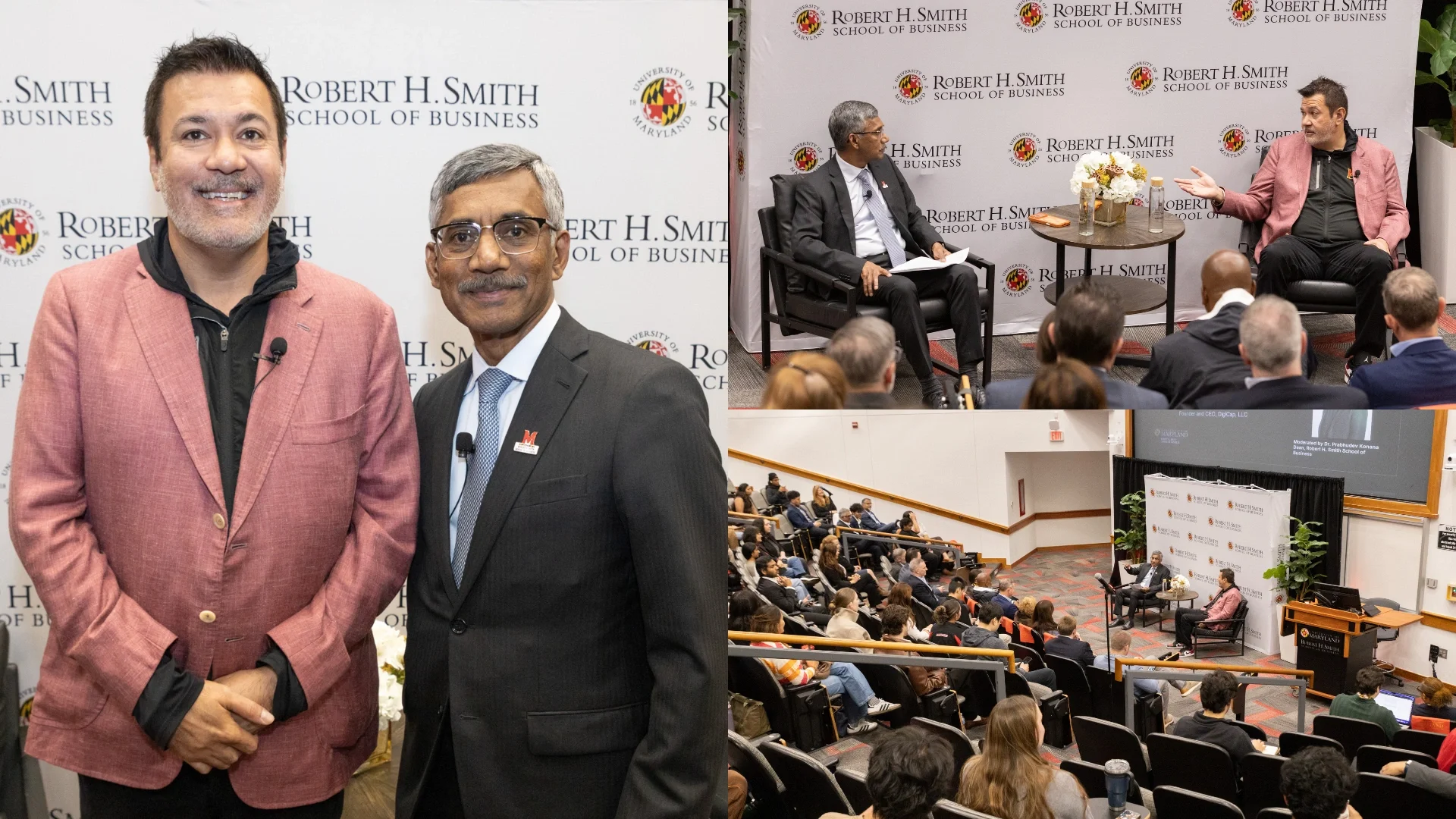
With more than 20 years in the business game, leading over 15 mergers and acquisitions and selling his company, Digital Management Inc. (DMI), in 2021 as it approached $500 million in revenue, Jay Sunny Bajaj, UMD ’99, knows what it takes to succeed as an entrepreneur.
With DMI, Bajaj pioneered mobile-first digital transformation for some of the world’s most complex organizations. Along the way, he built a culture that earned him a spot as a Smart100 CEO and a place in the Inc. 5000 Hall of Fame.
Bajaj sat down with Robert H. Smith School of Business Dean Prabhudev Konana during the latest installment of the CEO at Smith series on Tuesday, April 29, to share how he’s “running it back” in entrepreneurship as the founder and CEO of Digital Capital LLC (DigiCap), which he launched in 2023 with a vision to reshape capital investment by blending finance, entrepreneurship and purpose-driven principles.
In his opening remarks, Konana noted Bajaj’s business roots, hailing from an entrepreneurial family. He also touched on the bond that Bajaj held with the late Rudolph P. Lamone, professor emeritus of management science and former Smith School dean. That bond, he said, was the catalyst for Bajaj’s continued support of the University of Maryland and the Smith School, and has been a contributing factor in his serving as a longtime member of its Board of Advisors.
“I’ve had the pleasure of getting to know Sunny over the last five years. Even before I knew him, I knew of the successful companies he started,” said Konana. “Sunny is a huge alum. He’s a culture builder, a winner and one of the most highly respected CEOs in our region. Above all of those things, he’s a wonderful person, and we thank him for being here.”
During the hour-and-a-half-long conversation, Bajaj reflected on his entrepreneurial journey, which began as an economics undergraduate student at the University of Maryland, and imparted lessons learned that were critical to his career success.
Here are five of those lessons that Bajaj shared during the event:
Entrepreneurship is a calling. There are no prerequisites to taking an entrepreneurial path, Bajaj said. He recounted how people in his circles have expressed a desire to become one, but don’t know how or believe they lack the qualifications. In reality, someone becomes an entrepreneur because they identify a problem they want to solve or see an opportunity to engage the market, he said. In support of his point about how entrepreneurs are proactive by nature, Bajaj drew inspiration from rapper Pooh Shiesty: “If you don’t choose the game, the game chooses you.”
“You shouldn’t want to be an entrepreneur just to be one. I think a lot of it is innate,” said Bajaj. “So much of entrepreneurship is on-the-job training. Nobody knows all of the answers from day one. You figure it out as you go. Stick with it, keep coming up with ideas, and it’ll find you.”
Figure out the endpoint. Entrepreneurs, when partnering with private equity, will ultimately have to decide the future of their business and their level of involvement in it, Bajaj said. Some entrepreneurs may want to cash in their chips after years of hard work and move on. Others will either partner with private equity to continue executing their vision in some capacity or reinvest that money toward their next big idea. “There’s no right answer,” Bajaj said.
“What is your objective or intent as an entrepreneur, and what are you trying to accomplish? There’s nothing wrong with having a great idea, hitting certain metrics or milestones and deciding at one point that you’re done,” said Bajaj. “That’s the game. As long as you do right by your voice and your customers, you’re good.”
Help others ascend. Mentioning that he bleeds Maryland red, Bajaj credited Lamone for engaging him early on as an alum and for ensuring he continued to provide his industry perspectives. Now, fatherhood has given Bajaj an even greater appreciation for and motivation to support future generations. Parents “want to set their kids’ generation up for success” in ways better than they had it, Bajaj said. All leaders, including CEOs and managers, bear responsibility for supporting their people, too, and how they do it will vary.
“There are three ways of giving back: time, treasure or talent. You can’t take any of those things with you when your time on this planet is done,” said Bajaj. “While you’re here, and you have the ability to do that, you should take advantage of any or all of those things. I hope that everyone in this room is 100 times more successful than I’ve ever been.”
Take emotion out of the equation. Reflecting on his UMD undergraduate experience, Bajaj said it was “formative” for his life, instilling confidence in his identity, building lifelong relationships and teaching him to navigate group settings. Given the nature of his work, oriented around networking and consistently meeting new people, Bajaj said that the people who come out on top are those “who can succeed in group environments.” Equally important was a lesson his parents taught him during his upbringing: “Take emotion out of your work.” That lesson holds especially true for leaders, who need to maintain poise and demonstrate measured decision-making.
“Treat people with dignity and respect. Just because it’s business, it doesn’t mean you don’t have to practice those things,” said Bajaj. “Learning that and massaging that into your technical parts of your career is so important.”
AI can’t innovate like you. Bajaj labeled the emergence of artificial intelligence (AI) as the “next paradigm shift,” much like agricultural, industrial and information revolutions. He likened AI’s impact to that of Chrysler and Ford introducing automation in their production lines. “Those factory jobs didn’t go away,” he said, but they shifted in nature because “someone had to maintain the robots that built the cars.” A similar effect is taking place with today’s graduates taking their first steps into the workforce.
“You will have the knowledge to understand its practical applications and the ability to dream about how you can translate its impact across the finance, healthcare, talent and government sectors,” said Bajaj. “AI is not an entrepreneur, and in that sense, AI is not an innovator like you. Think about how you can use its tools and capabilities to create game-changing solutions.”
Media Contact
Greg Muraski
Media Relations Manager
301-405-5283
301-892-0973 Mobile
gmuraski@umd.edu
About the University of Maryland's Robert H. Smith School of Business
The Robert H. Smith School of Business is an internationally recognized leader in management education and research. One of 12 colleges and schools at the University of Maryland, College Park, the Smith School offers undergraduate, full-time and flex MBA, executive MBA, online MBA, business master’s, PhD and executive education programs, as well as outreach services to the corporate community. The school offers its degree, custom and certification programs in learning locations in North America and Asia.