
Space Commerce
Program of Study
The Logistics, Business and Public Policy (LBPP) Department spearheads the Space Commerce program at the Robert H. Smith School of Business.
We envision offering a variety of academic distinctions for those students across the UMD campus who would like to add a business credential to their transcripts.
Coming soon…
- Space Commerce Notation (9 credits)
- Space Commerce Certificate (12 credits)
- Space Commerce Minor in Business (15 credits)
- Space Commerce Major in Business (18 credits)
- Space Commerce Master of Science (30 credits)
Why Space?
“The space economy is forecast to soar to $1.8 trillion by 2035 in an increasingly connected and mobile world, impacting and creating value for nearly all industries on Earth and providing solutions to many of the world’s greatest challenges.” (April 2024)
McKinsey & Company
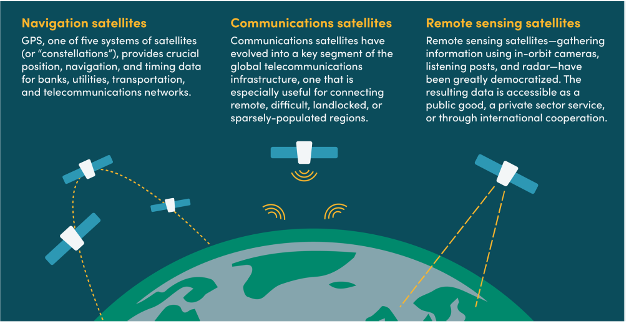
Communications satellites: Communications satellites have evolved into a key segment of the global telecommunications infrastructure, one that is especially useful for connecting remote, difficult, landlocked, or sparsely-populated regions.
Remote sensing satellites: Remote sensing satellites—gathering information using in-orbit cameras, listening posts, and radar—have been greatly democratized. The resulting data is accessible as a public good, a private sector service, or through international cooperation.
“In short, satellites underpin telecommunications, utilities, financial institutions, and other elements of global daily life. If leveraged fully, satellites (Figure 1) can also accelerate economic growth, build resilience against natural and human-made disasters, and enable every one of the United Nations’ Sustainable Development Goals, among other uses.”
Rose Croshier, Handbook for Space Capability Development
Non-resident Fellow, Center for Global Development
International Relations Specialist
Office of Space Commerce
U.S. Department of Commerce
Washington, D.C.
Undergraduate Level Courses
The current undergraduate catalog includes these choices:
- BMGT 478K – Industry Analysis of Space Commerce (3 credits, Spring)
This introductory course surveys space commerce through a review of aerospace history and the transition from government monopoly to private enterprise. - BMGT 478X – Special Topics in Supply Chain Management; Space Logistics and Manufacturing (3 credits, Fall)
This course focuses on the supply chain, manufacturing, and logistics systems that support the modern commercial space economy, with emphasis on terrestrial and extra-terrestrial production, launch integration, orbital logistics, and return flows. - BMGT ### – Space Leadership in Society (3 credits)
Not yet published. - BMGT ### – Space Acquisitions at NASA (3 credits)
Not yet published. - BMGT ### – Space Law and Policy (3 credits)
Not yet published.
Graduate Level Courses
The current graduate catalog includes electives cross-listed between the Master of Science in Management Studies (MiM) program and the MS in Supply Chain Management (SCM) program.
- BMGT 758P – Strategy Beyond Markets: A Space Commerce Perspective (2 credits)
This course examines strategic actions firms take beyond market-based competition, with a focus on innovation and leadership in the private space commerce industry as it matures. - BULM758B – Space Policy and Commercial Economics (2 credits), cross-listed with BUMO758P
This course explores the history of civilian and military space activity, debates their future roles, and studies the economics of a sector defined by deep public-private linkages. - BUMO758B – Space Policy and Commercial Economics (2 credits), cross-listed with BULM758P
This course examines the evolution of space policy, economics and public-private partnerships shaping the industry.
 Students can get involved through the Space at Smith student organization (IBSO).
Contact Club President Bryan D. Baires at baires@terpmail.umd.edu.
In addition to private companies, there are also a large number of other private foundations that offer scholarships to students interested in business, legal and policy aspects of commercial space:
- Amazon Scholars: STEM Scholars
- Blue Origin: Club for the Future
- Boeing | Thurgood Marshall College Fund: TMCF
- Boeing | Military and Veterans: Vets at Boeing
- Lockheed Martin: STEM Scholarships
- SpaceX: Honor Society
Several scholarships and fellowship programs are available for students focusing on the business, legal, and policy aspects of the commercial space industry:
- Matthew Isakowitz Commercial Space Scholarship (MCSS): A highly competitive program for current college juniors, seniors, or graduate students pursuing a career in the commercial space industry. It provides a $1,000 award, mentoring, and potential summer internship opportunities.
- Institute of Space Commerce Scholars Program: Provides stipends for undergraduate coursework related to space business, law, or policy, often matching students with industry leaders.
- Kalpana Chawla & Ilan Ramon Scholarships: Administered by the Institute of Space Commerce, these focus on supporting post-graduate Indian women with backgrounds in science or engineering, including space-related disciplines.
- National Space Club & Foundation Keynote Scholarship: A $20,000 scholarship for high school seniors through graduate students planning to pursue a career in STEM with a preference for space-related fields.
- Space Force Association Future Space Professionals Scholarship: Offers $2,500 to undergraduate STEM students in their junior or senior year interested in spacepower, including industry applications.
- RGi Scholarship (NSSA): A $10,000 award from the National Security Space Association for undergraduate or graduate students studying STEM with an interest in national security space.
- Maryland Space Grant Consortium (MDSGC) Scholarships: Provides funding for students at affiliated institutions studying math, science, or engineering, often leading to NASA-relevant or aerospace careers.
Check Space Commerce course announcements for new opportunities or contact Professor Crocker at jcrocker@umd.edu.
Plus One (+1) Program
Start your master’s degree before you graduate by combining your bachelor’s and master’s course of study into one program, saving both time and money.
Learn more about the Plus One (+1) Program.
Career Opportunities
Students should begin their career search with the Smith School Office of Career Services (OCS).