
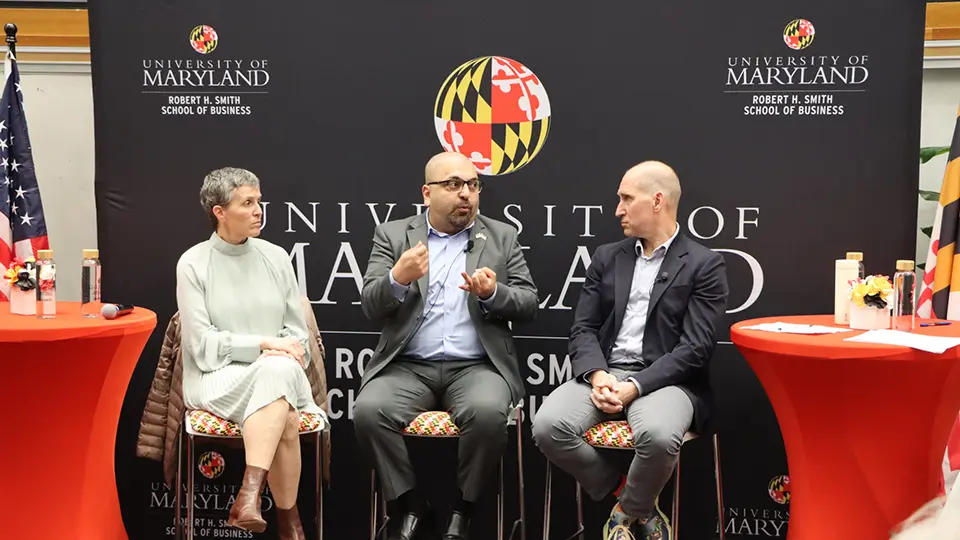
The Ed Snider Center For Enterprise and Markets at the Robert H. Smith School of Business held a panel discussion April 21 on bridging political divides and fostering dialogue among different viewpoints.
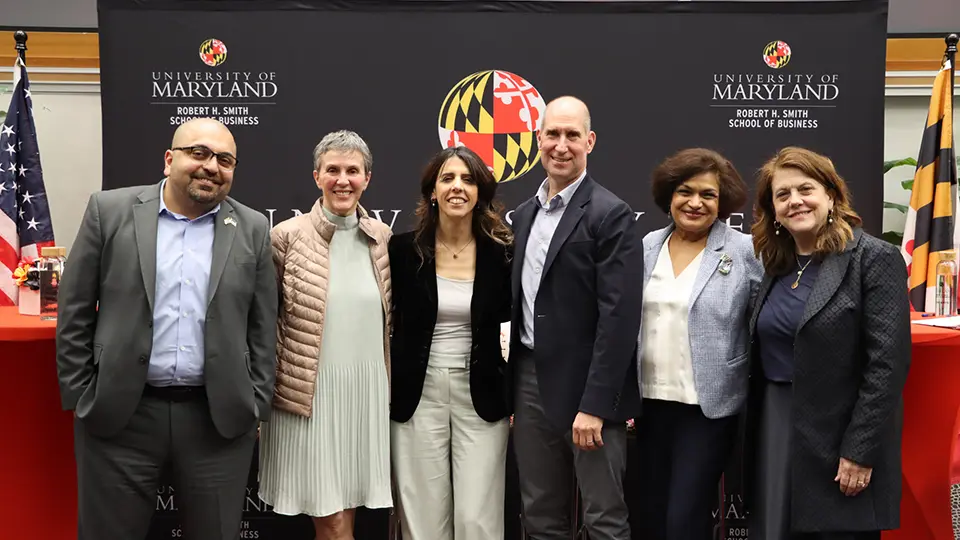
The discussion, titled “Working Across the Divide: Bridging the Divide Through Common Ground, Uncommon Courage,” featured five panelists, including Van Jones, CNN host and founder of Dream Machine Innovation Lab and RAPPORT.co, and Nas Daily content creator Nuseir Yassin, who has been using his platform to promote peace and understanding, focusing on stories that highlight shared humanity that transcends political conflict. Smith professor Rellie Derfler-Rozin moderated the discussion, which took place in Van Munching Hall in front of an audience of nearly 150.
The event was part of the Snider Center’s Fact-Based Discourse Initiative, an ongoing series to encourage civil debate. Those conversations are the best way to understand differences and bridge polarized views, said Snider Center director Rajshree Agarwal.
“What we stand for at the Ed Snider Center is diversity of opinions, diverse perspectives, and the belief that rather than thinking about ourselves in a versus mindset—you against me, us against them—it is better for us to understand and appreciate other people's perspectives, so long as it's done with reasonable, respectful discourse,” Agarwal said.
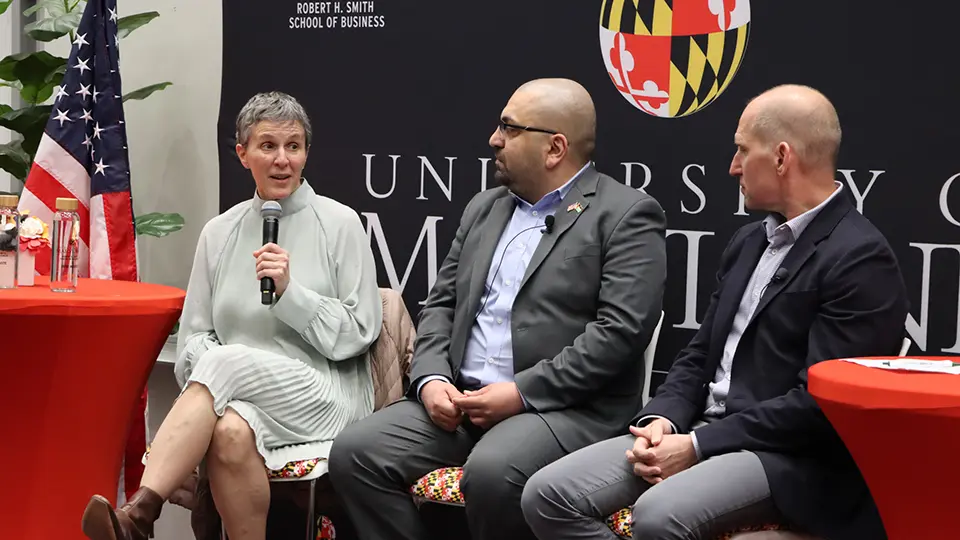
Also on the panel were Ilana Redstone, an associate professor of sociology at the University of Illinois at Urbana-Champaign and the author of the book: “The Certainty Trap: Why We Need to Question Ourselves More- and How We Can Judge Others Less”; Simon Greer, a social entrepreneur and community organizer and the creator of Courageous Conversations at The Nantucket Project and Bridging the Gap at Interfaith America; and Ahmed Fouad Alkhatib, a peace activist and a senior fellow at Atlantic Council and director of Realign For Palestine.
Derfler-Rozin noted in the beginning of the event that the aim was not to fantasize a “kumbaya” moment, but to move from simplicity to complexity, from slogans and hate to a shared understanding and solutions. Yassin discussed how difficult it is to bring people together on social media because the algorithms are inherently designed to be superlative and extremist. He emphasized the differentiation between builders and destroyers and said: “If we can maybe make the destroyers destroy a little bit less and make the builders have a bit more dialogue, I think we can have a much better bridge building.”
Alkhatib, who lost many family members in the war in Gaza, emphasized the need to hold multiple truths. While one can speak out against government policies in Israel, he has emphasized the need to condemn radical Islamism and the atrocities of terror, and the need to promote radical pragmatism with regards to the Israeli Palestinian conflict, recognize the right of the Jewish people to self determination and a Jewish state, while advocating for a Palestinian state alongside Israel. In his words: “We need to move forward. Not to forget, we can go through the healing, we can go through a process. Radical pragmatism says that there is no ‘river to the sea’…advanced radical pragmatism would say, no, this is actually an opportunity for us to achieve statehood, achieve progress and prosperity.”
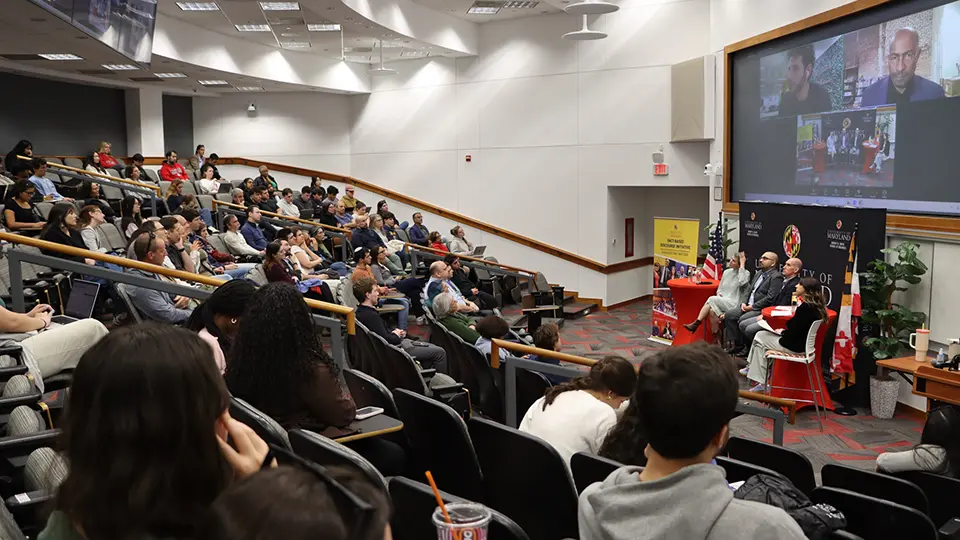
Redstone talked about her book, about questioning assumptions, and how people need to clarify and question their own thinking and create space for other viewpoints. “That loss of a space for a reasonable, informed person who disagrees with me is catastrophic for democracy and for democratic trust,” she said.
Greer emphasized the ability to stay with one’s own convictions while still being open for dialogue. “The set of solutions that I used to be fixated on, because that's what we progressives believe, I just let go of them as the only solution set, and became much more curious about maybe people I disagree with have a piece of the picture that's going help solve this,” he said.
Jones talked about focusing on how to make progress on issues and working with the right people to do so, rather than only aligning with people who share your ideologies and politics. He discussed how the lack of dialogue and the blame game in politics has only hurt black people who keep encountering discrimination and bias, and emphasized the need for broad coalitions to inflict change. He encouraged students in the audience to be courageous and not be afraid about being named a “bridge builder” and to “work with people “who you would never think you could work with.” He urged students to keep asking themselves: “Can I help someone today?” because “there’s no better way to live your life.”
Derfler-Rozin, who guided the conversation with the speakers and moderated questions from the audience. Summarized the discussion: “We are not solving all the problems today, but all of you are examples of shining stars for this bridging dialogue.”
After the event, she said that she was proud to be part of a business school that serves as a beacon of hope to work toward solutions of very difficult societal problems. “These are the voices we have the responsibility to elevate in academia.”
Media Contact
Greg Muraski
Media Relations Manager
301-405-5283
301-892-0973 Mobile
gmuraski@umd.edu
About the University of Maryland's Robert H. Smith School of Business
The Robert H. Smith School of Business is an internationally recognized leader in business education and cutting-edge research. The school’s world-class faculty facilitate experiential learning opportunities rooted in the real world. Smith students learn to think like entrepreneurs, prepared to drive positive impact. The school offers undergraduate, online and on-campus business master's, full-time, part-time, online and executive MBA, plus PhD and DBA degree programs, and non-degree and executive education programs. Where Smith leads, the future follows.