
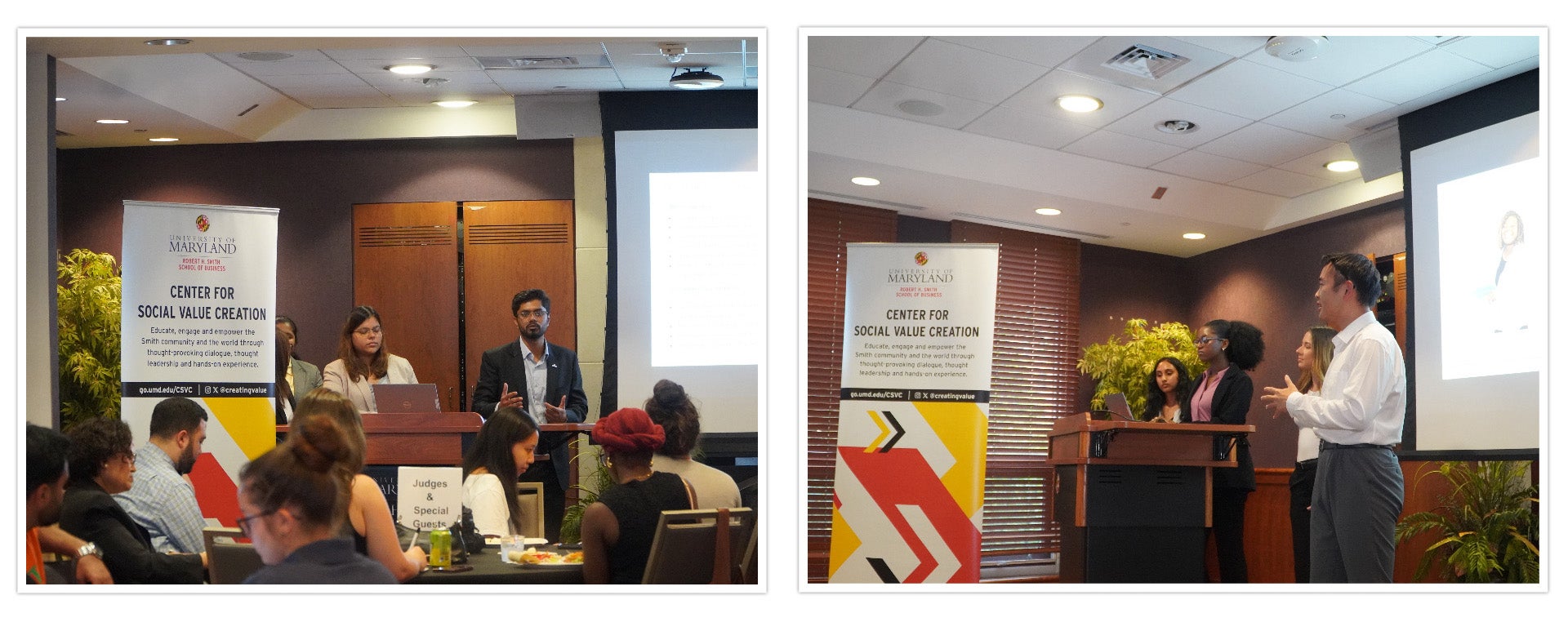
Experiential learning opportunities are one of the many ways students at the Robert H. Smith School of Business stay busy over the summer and throughout the year.
Graduate students and undergraduates have the opportunity to flex their intellectual muscle consulting for a variety of companies, from start-ups to established organizations, through the Center for Social Value Creation’s (CSVC) Impact Consulting Fellowship program and the MBA Practicum projects, part of the Flex MBA curriculum.
“What I found really compelling about the MBA Practicum Project is the fact that it’s really bringing together people from across campus,” said Nicole M. Coomber, assistant dean of experiential learning and clinical professor of management and organization, who co-teaches the course with Associate Professor Toby Egan. “We have folks that are investing in really avant-garde technology,” Coomber said, and these experts, she added, are often looking for business consulting, which is where the Flex MBA students in her course can be of support while gaining invaluable experience.
For Haroon Pasha, MBA ’25, working as the team lead for MBlue Labs, a skin care company that evolved from the University of Maryland, it was more than just a project. “It's something we have in our core as Terps. We want to support the school, we want to support the initiative,” he said. “It was a shared benefit. As students, we’re benefiting from the consulting aspect. For the CEO and the founder, they were benefiting from our expertise.”
Egan said students develop an array of competencies, from critical thinking and functional aspects of different expertise, that allows students to think about an organizational problem more holistically. “These are things we need from executives and managers, and they get that experience and they can move it into goal sets they currently have as well as what they aspire to have,” he said.
Josh Doying, MBA ’23, program manager at UM Ventures, agrees that working with talented and skilled students, especially during a venture’s early stage, can help to figure out what kind of potential a new company or product has. “We have a lot of really talented and awesome faculty and graduate students who are deeply skilled scientists but have never put together a business plan, worried about financials, or made a pitch for an investor or done a market analysis,” he said, adding that it’s a great benefit to the students because it presents a real opportunity rather than a case study. Doying has worked with Coomber to pair students with organizations through UM Ventures. UM Ventures manages the intellectual property developed on campus by researchers because anything developed by researchers is jointly owned by the researchers themselves and the university. Doying works specifically with the research that goes into startups. MBlue Labs, which Pasha worked with, was connected to the MBA Practicum through Doying.
“They are getting an insight into industries that they may have never been exposed to,” Coomber added, which is a benefit and emulates what many business leaders face. She said business leaders may not always be the experts in that specific industry, but still have to figure out how to translate the knowledge of the experts they work with to determine the company or product’s market value and how it will serve customers and generate revenue. “It’s a very real opportunity for the students to develop expertise that I think is pretty amazing.”
Doying said clients provided positive feedback about working with the students, highlighting thorough and well-structured reports, relevant and credible references supporting arguments and conclusions and that students exceeded expectations and delivered strong analysis.
For undergraduate students looking for experiential learning opportunities, the CSVC’s Impact Consulting Fellows program offers undergrads opportunities to partner with graduate students. The program gives MBAs direct management experience and opportunities to be team leads as they supervise the MS students and the undergrads. Each team is made up of one MBA or doctoral student, three master's students and three undergraduate students. The program is open to all MBA students and all MS programs, but some masters students as well as some of the undergraduate students come from other programs across the university as well.
Nima Farshchi, CSVC director, executive director of the Office of Experiential Learning and lecturer in management and organization, said the program launched in 2020 and has since given students the opportunity to work on over 200 total projects that span a variety of industries. The teams have some outside guidance as well. “Each team has an alumni consultant advisor. Most of them are in the consulting industry; some might just be in a space relevant to the project they’re working on,” Farshchi said, and added that it is not just alumni who sign up to support the student teams but friends of Smith who are looking to get involved in helping the next generation of business leaders. The program provides hands-on, pro-bono consulting work for B-Corporations, non-profit organizations and for-profit impact-driven organizations in various industries.
It’s a program that helps students build experience, but for consulting alumna Anne Zappas ’21, a senior consultant at Protiviti, it provides valuable insights by being able to hear from students as well. “The beginner’s mindset is so important,” she said, adding that it can give a new perspective to someone who has been working in the field for a while. Zappas also thinks staying connected to Smith is important to help people “through whatever career journey they find themselves on.”
“The projects are with a variety of types of companies, so we have everything from a smaller startup to a larger B-corp,” Farshchi said, adding that local organizations such as the College Park Aviation Museum and the Olney Theatre Center have been clients. The connections students make with each other, alumni and the companies they are serving create great networking opportunities, Farshchi said.
For alumni looking to get involved or who are interested in getting support from Smith students for experiential learning or coaching teams, Farshchi suggests visiting the CSVC website for more information.
Media Contact
Greg Muraski
Media Relations Manager
301-405-5283
301-892-0973 Mobile
gmuraski@umd.edu
About the University of Maryland's Robert H. Smith School of Business
The Robert H. Smith School of Business is an internationally recognized leader in business education and cutting-edge research. The school’s world-class faculty facilitate experiential learning opportunities rooted in the real world. Smith students learn to think like entrepreneurs, prepared to drive positive impact. The school offers undergraduate, online and on-campus business master's, full-time, part-time, online and executive MBA, plus PhD and DBA degree programs, and non-degree and executive education programs. Where Smith leads, the future follows.