
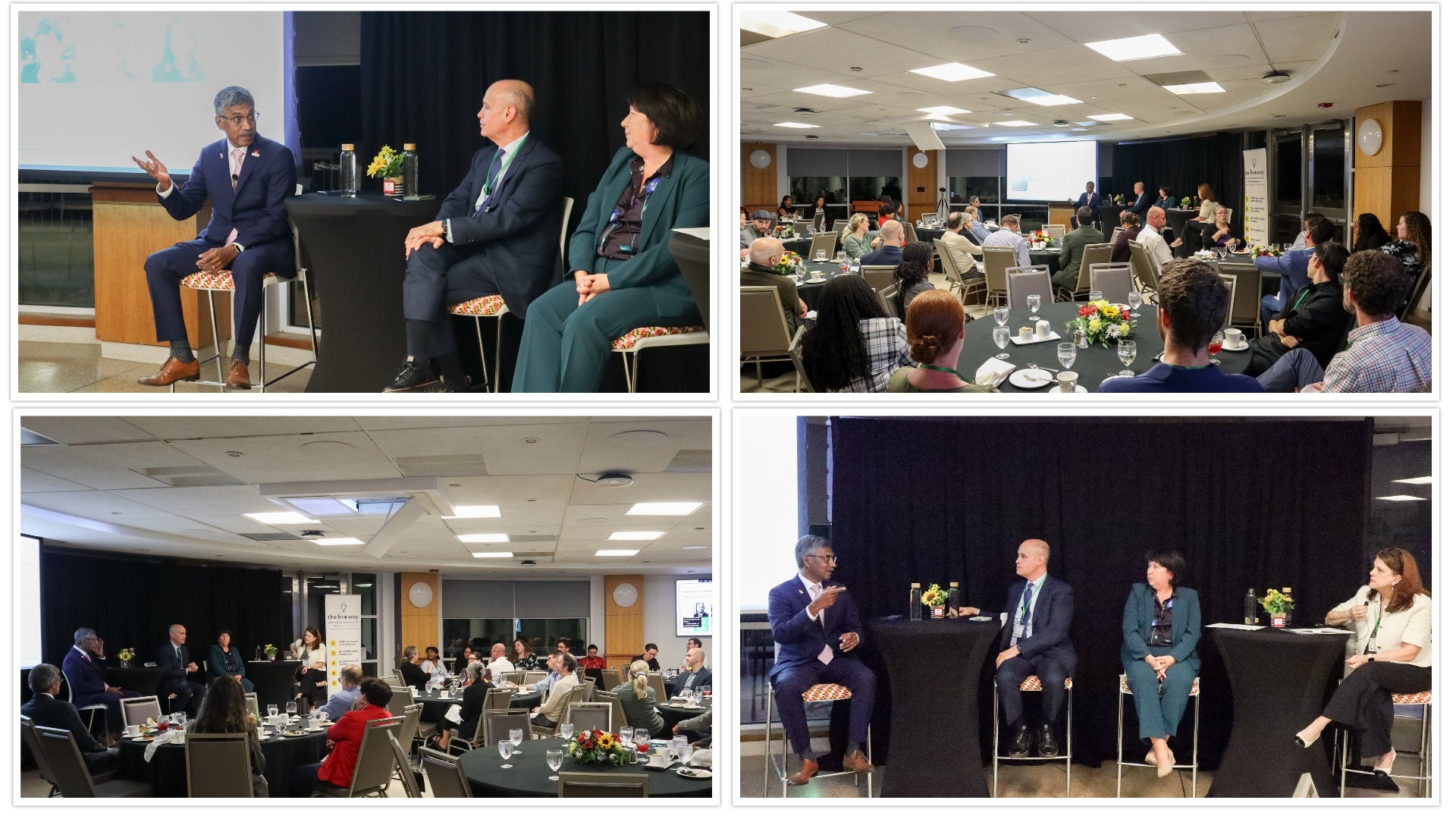
On Friday, Sept. 26, 2025, the University of Maryland’s Robert H. Smith School of Business served as the venue for the Heterodox Academy (HxA) Mid-Atlantic Regional Conference, where academic leaders discussed the path forward for open inquiry on college campuses.
The conference, which ran through Saturday, Sept. 27, saw representation from HxA Campus Communities across Maryland, Virginia, and North Carolina, including its co-organizers, Virginia Tech, the University of Virginia, UNC Chapel Hill, and NC State University, among others.
Following a welcome reception and dinner, the event’s opening night concluded with its marquee panel discussion “Navigating Challenges to Open Inquiry on Campus.” Academic leaders Chris Celenza, Dean of Arts & Sciences, Johns Hopkins University; Susan Rivera, Dean of Behavioral and Social Sciences, University of Maryland; and the Smith School's Dean Prabhudev Konana offered insights on the way forward for nurturing intellectual curiosity and encouraging spirited, but grounded, debate in and out of the classroom. Jacqueline Manger, Managing Director of the Ed Snider Center for Enterprise and Markets, served as the moderator for the panel.
During the discussion, the academic administrators emphasized the importance of treating others with dignity, discerning between threats and discomfort, and finding common ground as essential keys to navigating obstacles to open inquiry on college campuses nationwide.
Here are three highlights the panelists shared during the event:
Be receptive to all information. Across disciplines and industries, people are susceptible to succumbing to their own biases by seeking out information to confirm rather than inform them, said Konana. One example can be found in the markets, where individuals may seek out information that supports their investment while ignoring opposing viewpoints. Those who feed into their biases are more likely to be worse off, he said.
“What we should be doing is showing evidence and providing rationale to be more careful with the data that we consume because the human mind consumes what it wants to see,” said Konana. Breaking that cycle is difficult, and “sending a human to the moon might even be easier.”
Identify threat versus discomfort. To Rivera, discomfort is a crucial component of education. Threat, however, is not. Discerning between the two requires a set of ground rules that help students navigate situations where they interpret their belief systems as being challenged, she said.
“We educate differently, but it all comes down to the same formula in the end: bringing people together and recognizing the dignity of everyone who comes to the table,” said Rivera. “You try to find common ground, not necessarily agreement, and you pull in all of the people who can help you do that.”
Adapt to a new information landscape. The core missions of discovery and research in higher education are more essential than ever, considering this is an “unprecedented moment in the way that information circulates among people,” said Celenza. The outside world will perceive everything an institution produces in some way, and schools should be aware that specialized knowledge or research may not be immediately legible to the public, he said.
“I’ve found that the public has a great curiosity, but not for watered-down knowledge. They want to hear what’s new, but we can’t just speak in footnotes,” said Celenza. “Any university, whether it's a public or private university, is still a nonprofit. In that sense, I think we definitely owe the public explanations of what we're doing.”
The Heterodox Academy Mid-Atlantic Regional Conference is one of several events sponsored by the Heterodox Academy Campus Community at the University of Maryland. The group is co-chaired by Jacqueline Manger, managing director of the Ed Snider Center for Enterprise and Markets; Rellie Derfler-Rozin, academic director of the Master’s in Management Studies and Online Master of Management Studies programs; Rajshree Agarwal, Rudolph Lamone Chair of Strategy and Entrepreneurship and director of the Ed Snider Center; and Sebastian Galiani, Mancur Olson Professor, from the College of Behavioral and Social Sciences. They will plan additional programming throughout the year, including panel discussions and speaker events to promote open inquiry and viewpoint diversity.
Media Contact
Greg Muraski
Media Relations Manager
301-405-5283
301-892-0973 Mobile
gmuraski@umd.edu
About the University of Maryland's Robert H. Smith School of Business
The Robert H. Smith School of Business is an internationally recognized leader in business education and cutting-edge research. The school’s world-class faculty facilitate experiential learning opportunities rooted in the real world. Smith students learn to think like entrepreneurs, prepared to drive positive impact. The school offers undergraduate, online and on-campus business master's, full-time, part-time, online and executive MBA, plus PhD and DBA degree programs, and non-degree and executive education programs. Where Smith leads, the future follows.