
Mid-Atlantic Business School Leaders Convene to Address Market Shifts, AI
Higher education is rapidly evolving. With global uncertainty, budget woes, changing student demographics and expectations, AI, and new learning models, business school leaders have a lot to navigate. The University of Maryland’s Robert H. Smith School of Business welcomed deans, faculty and administrators to talk about the way forward through so much change.
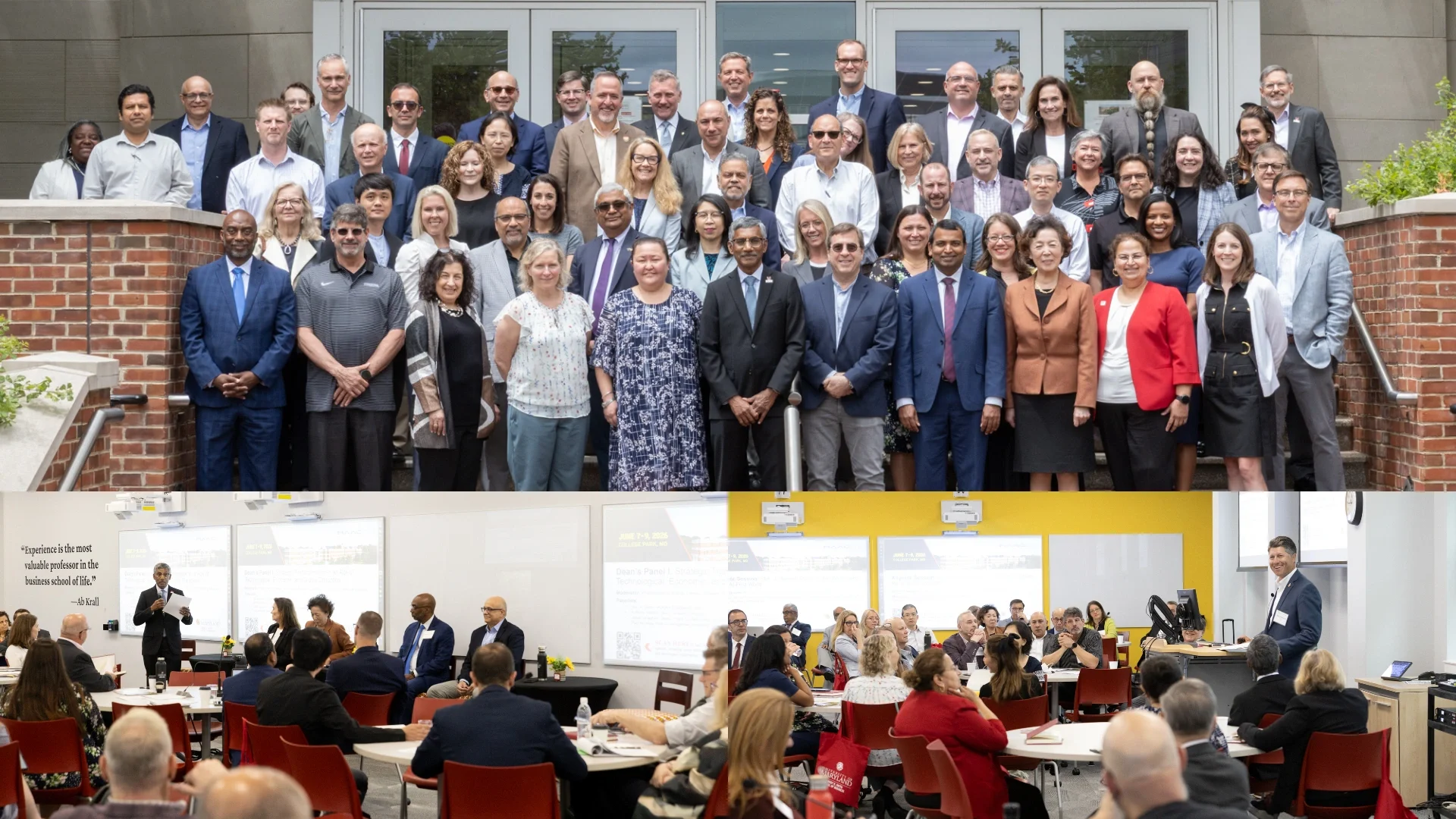
The Smith School hosted the Mid-Atlantic Association of Colleges of Business Administration (MAACBA) Conference, June 7-9, in College Park, Md. The annual conference brings together leaders from the association’s network of more than 150 business schools that work together to advance collegiate business education.
“We’re all facing the changing landscape of higher education, so it’s critical to have these meaningful conversations with other deans,” said Smith School Dean Prabhudev Konana. “We’re so pleased to be able to host our colleagues to problem-solve solutions and embrace innovation as we navigate the future of business education.”
The conference opened with a reception and dinner on Sunday, June 7, followed by a full day of programming. Smith alumnus Mark Urbanczyk ’02, principal at Deloitte Consulting, who leads the firm’s government AI & Data Engineering practice, delivered a keynote address on June 8.
Urbanczyk said companies are looking for students who are AI fluent and can use the technology to build solutions to solve problems. He pointed to a 144% increase in AI job postings as compared to a 1% increase in all job postings.
He said students don’t have to be coders, they just have to be curious and critical thinkers. He said universities need to inspire leaders who are comfortable with ambiguity and continuously learning, because “the AI tools of today will be different in six months,” he said. At Deloitte, they expect students they hire to be able to hit the ground running on the first day, even with a traditional training period.
Business school deans from Rutgers, Howard, Hofstra and Georgetown universities took part in the first of two main panel discussions about strategic transformation, moderated by Konana. They talked about how business schools are dealing with disruption from new technologies, economic changes, global realignment and demographic shifts. They covered curriculum reinvention, the value proposition for business degrees, AI’s roles in business education, geopolitical factors in enrollments, and managing student expectations.
“There is consensus that demand for undergraduate education is very strong and growing, but the market for graduate business education has changed,” said Konana. “There is a need to adjust the business school business model itself to align with changing market conditions.”
“What we teach and how we teach should also change,” he continued. “Education should be human-centered, amplified by AI around experiential learning. Students need more hands-on opportunities to build prototypes — rather than PowerPoint slides — and fine-tune their technical competencies in AI while learning to be great communicators.”
A second dean’s panel took place on June 9 and covered the challenges and opportunities business schools face for the future. Deans from Niagara, Towson, Rowan and Stevenson universities joined Joyce Russell, dean emeritus of Villanova School of Business, to talk about how business schools can ensure long-term sustainability and societal impact.
Other panel discussions included concurrent sessions on innovations in undergraduate and graduate education; AACSB changes; and experiential learning and community impact.
Thank you to all the speakers who gave their time at this conference:
- Paul Almeida, Dean, McDonough School of Business, Georgetown University
- Joe Bailey, Associate Dean of Undergraduate Programs, Robert H. Smith School of Business, University of Maryland
- Sudipta Dasmohapatra, Senior Associate Dean of MBA Programs, McDonough School of Business, Georgetown University
- Wedad Elmaghraby, Senior Associate Dean for Faculty, Robert H. Smith School of Business, University of Maryland
- Casey Evans, Interim Dean, Kogod School of Business, American University
- Rosie Ferraro, Associate Dean of MBA Programs, Robert H. Smith School of Business, University of Maryland
- Mark Frascatore, Dean, Holzschuh College of Business Administration, Niagara University
- Patricia Grant, Senior Associate Dean of the Undergraduate Program, McDonough School of Business, Georgetown University
- Brian Horick, Senior Assistant Dean of Undergraduate Programs, Robert H. Smith School of Business, University of Maryland
- Prabhudev Konana, Dean, Robert H. Smith School of Business, University of Maryland
- Prabakar Kothandaraman, Dean, College of Business and Economics, Towson University
- Robert M. Kurland, Senior Associate Dean for Undergraduate Programs, Rutgers Business School
- Lei Lei, Dean, Rutgers Business School
- Janet Lenaghan, Dean, Frank G. Zarb School of Business, Hofstra University
- Mark McNeilly, Professor of the Practice Marketing & Organizational Behavior, UNC Kenan-Flagler Business School
- Tim Mescon, VP, Americas Growth & Engagement, AACSB International
- Supriya Munshaw, Associate Dean of Academic Programs, Carey School of Business, Johns Hopkins University
- Brian Rothschild, Assistant Dean of Graduate Studies, School of Business, Stevens Institute of Technology
- Joyce Russell, Dean of Emeritus and Professor of Management, Villanova School of Business
- Matthew Sarkees, Dean, William G. Rohrer College of Business, Rowan University
- Zamira Simkins, Dean, Brown School of Business and Leadership, Stevenson University
- Mark Urbanczyk, Principal, Deloitte Consulting
- Anthony Wilbon, Dean, Howard University School of Business
- Emanuel Zur, Associate Dean of MS Programs, Robert H. Smith School of Business, University of Maryland
Media Contact
Greg Muraski
Media Relations Manager
301-405-5283
301-892-0973 Mobile
gmuraski@umd.edu
About the University of Maryland's Robert H. Smith School of Business
The Robert H. Smith School of Business is an internationally recognized leader in business education and cutting-edge research. The school’s world-class faculty facilitate experiential learning opportunities rooted in the real world. Smith students learn to think like entrepreneurs, prepared to drive positive impact. The school offers undergraduate, online and on-campus business master's, full-time, part-time, online and executive MBA, plus PhD and DBA degree programs, and non-degree and executive education programs. Where Smith leads, the future follows.