
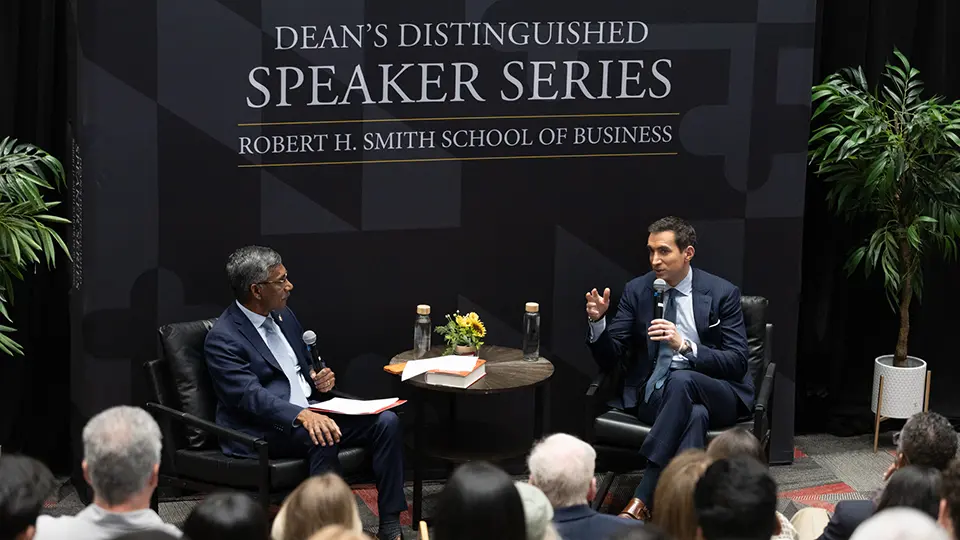
In his latest book, "1929: The Inside Story of the Greatest Crash in Wall Street History", Andrew Ross Sorkin couldn’t help but notice some modern parallels.
“It just so happened that along the way, as I was writing this book and also reporting on the news every day in the Times and on television, that I kept saying to myself, ‘Oh, goodness, look at that, that actually looks a lot like what was happening in 1929.”
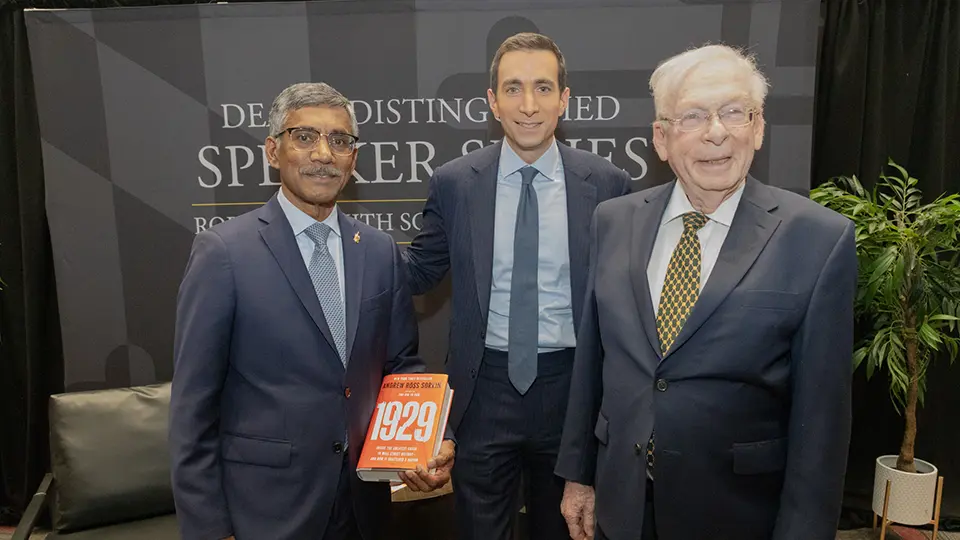
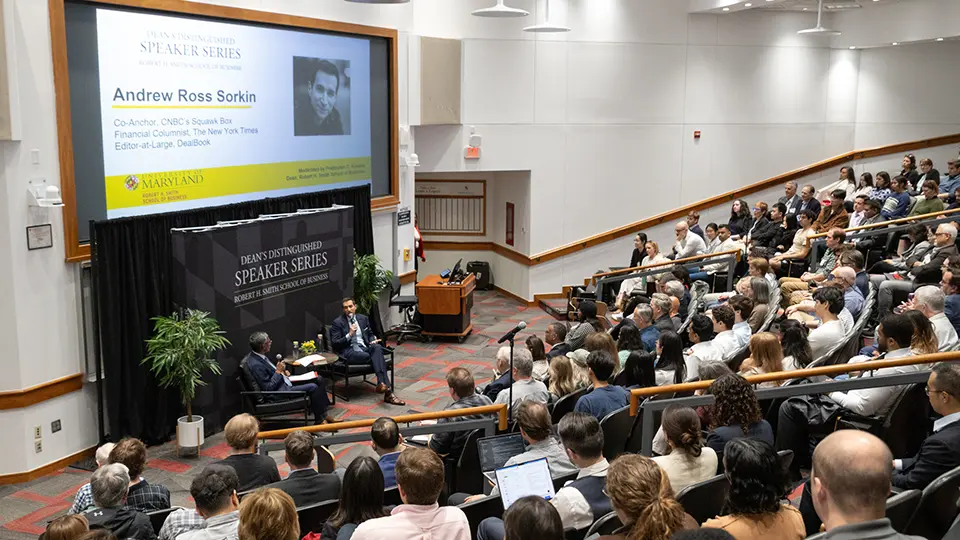
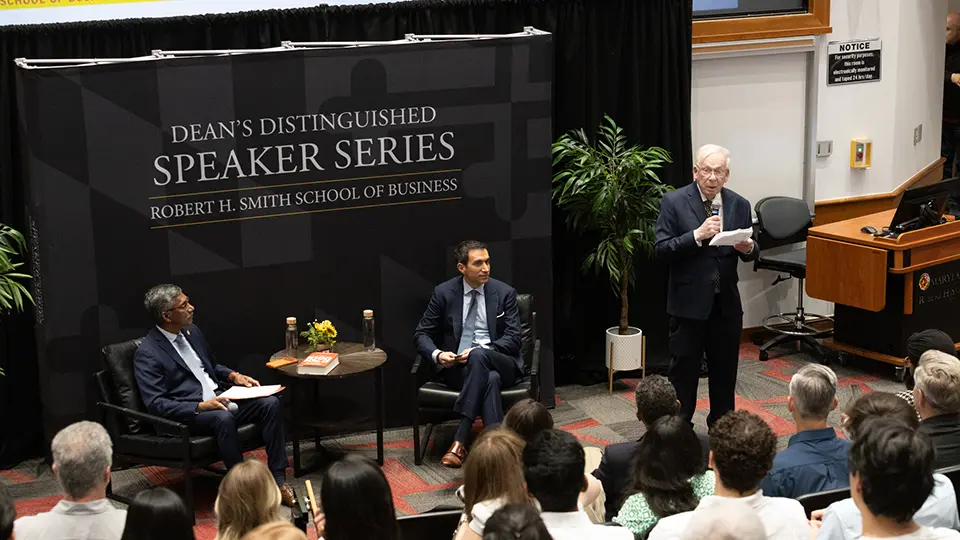
Sorkin, who is co-anchor of CNBC’s Squawk Box, a financial columnist with The New York Times and editor at large at DealBook, addressed a packed Frank Auditorium at the Robert H. Smith School of Business on Friday, May 8, 2026, as part of the Dean’s Distinguished Speaker Series. He was introduced by Clinical Professor of Finance David Kass. (Kass helped bring Sorkin to the Smith School, drawing on previous interactions with him, including Sorkin’s October 23, 2025, talk at Politics and Prose in Washington and earlier exchanges at the 2009 and 2012 Berkshire Hathaway annual meetings.)
Dean Prabhudev Konana moderated the event as Sorkin talked about how his fascination with the 1929 crash drove him to learn more about the subject and how he wanted to put readers “in the room.”
“We often talk about these things in the context of economic cycles and economic theory. But to me, it's people who ultimately make decisions, which ultimately drive those cycles in that theory,” Sorkin said. “And so, I went on a journey, really, over an eight-year period. I thought I'd be able to write this book in two or three years but that was not the case.”
By focusing on the key players of the time as the main characters of the book, Sorkin said he thought he could reach a wider audience rather than just those who are versed in economic issues.
“Debt in America, which is basically the grease of our entire economy, almost didn't exist,” Sorkin explained. “But in 1919, most consumers in America had never taken on debt. Taking on a mortgage was almost considered amoral in this country. It was not what people did in polite society.” Sorkin said.
But John Raskob, who was running General Motors and looking to sell more cars at the time, came up with the auto loan. “That totally changed and shifted the culture of the whole country, because all of a sudden, people were willing to take on debt,” Sorkin said, adding that credit and debt have played an enormously important role in our society. “The issue is the debt can also become the match that lights the fire,” he said. “[That’s] If there's too much debt in the system, and I think that's what was happening unfortunately in 1929.”
While on a trip to Harvard University, Sorkin went into Baker Library to look at the records from 1929 donated by the family of Thomas Lamont, CEO of J.P. Morgan. “I start opening these boxes and opening these folders, and all of a sudden, [I was] realizing that his secretary had kept transcripts of his phone calls with Roosevelt, and all of his letters with Hoover.” At this point, Sorkin said he realized he may be able to find the material he needed to tell the story in the way he wanted to.
As the discussion centered more around the events surrounding 1929, Konana asked Sorkin what role the Federal Reserve should play in identifying such excesses as the market increase between 1921 and 1929? If the crash had never happened, could the financial crisis of 2008 have been avoided?
Sorkin: “In 1929, interestingly, if you read the diaries of the board members of the Federal Reserve, they knew there was a problem. They saw it. They knew that the speculation was out of hand.” Sorkin added that many on the board wanted to raise interest rates to try to tamp down all of the speculation. But one issue at the time was the Federal Reserve – which was started in 1913 – was still considered an experiment. They feared the wrong decision would not only send them to answer to Congress but could dissolve the Federal Reserve completely.
“So there are certain things you could have done on the front end to try to prevent the crisis, which people did not do, and there are a whole bunch of things you could do on the back end, which I think we learned from Ben Bernanke,” Sorkin said. “What do you do in a crash? It’s not politically popular but you throw money at the problem.” Sorkin added that this was also done during the Covid 19 pandemic. “There are things to be done that can prevent some of this, not all of it.”
In thinking about what would happen if there was another financial crisis, Sorkin said he worries about resilience “just because of how politically polarized the country is, and I think the country was more polarized today than I believe it was in 1929,” he said, adding that the country is also more polarized today than it was in 2008. “One of the reasons that I am anxious is, if, in fact, we have another crisis, I don't know politically what we would ultimately do.”
On AI, Sorkin had some thoughts and advice for students. He pointed to one of the first-use cases of AI – with mammograms – where “we thought it did a better job than humans.” It was thought, he said, that AI might have an impact on radiologists losing their jobs, but the cost of the procedure has come down, prompting more women to get them, and now there are more radiologists than ever. “So it is possible there is going to be an age of abundance here where there is a human factor that is going to be necessary. And maybe it actually creates jobs in the end,” he said.
“What I do worry about is people's own agency. I think that's the thing that I think about more than anything,” he said. While on vacation, Sorkin said he was working with Anthropic’s Claude to build an app. Following four days of “talking with Claude,” he returned to his day job at the New York Times, where they do not use AI for writing, and said that it was hard to write on his first day back. “I desperately wanted to go back to Claude, I wanted to talk to Claude, I wanted it to ‘do it for me,’” he said. But he added that because he is a professional writer, he was able to “power through.” Moving forward – when he is using AI for other purposes – he said he hopes he can read through and identify when AI has something incorrect and can push back. But he worries about that not being the case potentially for others.
Sorkin said matching expertise in AI with doing things on your own will be important skills, such as being able to sit with a piece of paper and a pen and “actually use your head and write.”
One student in the audience asked about the Wall Street high achievers, world leaders and business leaders Sorkin interviewed, and what was the difference between the ambition that sustains them versus the ambition that leaves them in ruins. Sorkin said it was a great question. “The one commonality among people who I think are super high achievers is actually that they are typically driven by a remarkable amount of insecurity. They are trying to prove something to somebody,” he said.
When asked about Bitcoin, Sorkin said he has mixed views. He said he could see it becoming some form of digital gold. “And so maybe that's what it is. I don't know if it unto itself can become a genuine currency,” he added, noting that it isn’t going to be used to “buy a cup of coffee” anytime soon. “I do think there actually is a value proposition – oddly enough to the Federal Reserve. So I'm not suggesting Bitcoin is not a thing, or shouldn't be a thing, and it may very well be worth a million dollars one day. I don't know.”
But he added that he is crypto curious. “I’m fascinated by it all, but I haven’t convinced myself fully that it's going to be a game changer.”
Media Contact
Greg Muraski
Media Relations Manager
301-405-5283
301-892-0973 Mobile
gmuraski@umd.edu
About the University of Maryland's Robert H. Smith School of Business
The Robert H. Smith School of Business is an internationally recognized leader in business education and cutting-edge research. The school’s world-class faculty facilitate experiential learning opportunities rooted in the real world. Smith students learn to think like entrepreneurs, prepared to drive positive impact. The school offers undergraduate, online and on-campus business master's, full-time, part-time, online and executive MBA, plus PhD and DBA degree programs, and non-degree and executive education programs. Where Smith leads, the future follows.