
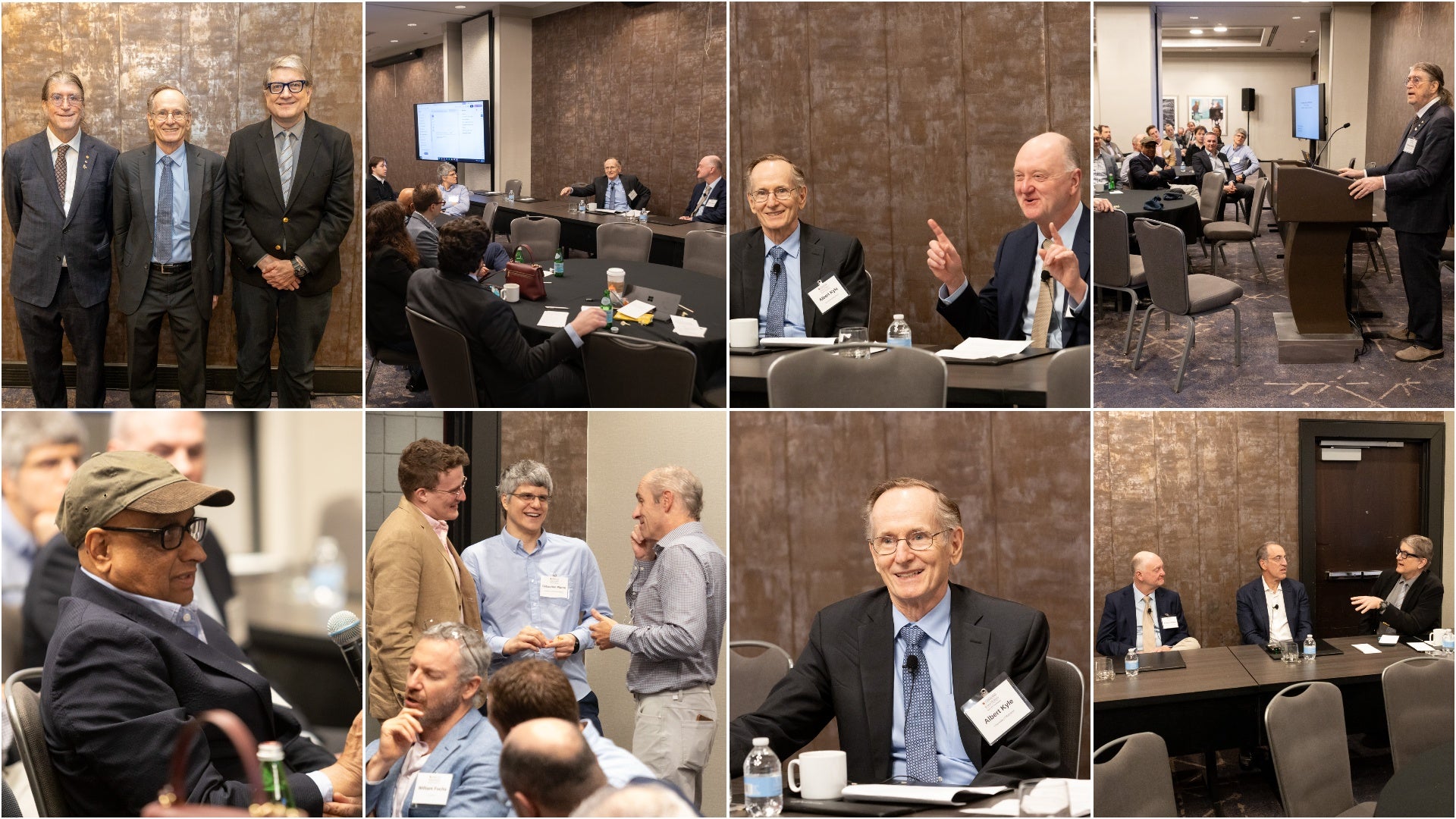
In 1985, a landmark paper was published that remains influential more than four decades later. Distinguished University Professor and Charles E. Smith Chair in Finance Albert “Pete” Kyle and his seminal paper, known as “Kyle ’85,” “Continuous Auctions and Insider Trading”, were celebrated at the “Kyle ’85 Conference: Market Structure, Liquidity, and Asset Pricing.” The Robert H. Smith School of Business’s Center for Financial Policy partnered with UBS to host the two-day event March 26–27 at the JW Marriott in Washington, D.C., during peak cherry blossom season. Key donors included Stephen Wallenstein, the Roger M. Low Foundation, and Neal and Jacqueline Shear. In addition to honoring Kyle’s work, scholars and industry experts discussed new research and trends.
Dean Prabhudev Konana said Kyle is not only a “brilliant scholar. He is a remarkable human being,” adding that events like this highlight the impact of his work.
MIT’s Haoxiang Zhu served as a keynote speaker and discussed the evolution of U.S. markets over the past 50 years and the impact of Kyle’s contributions. He said Kyle’s paper captures “the essence of where the market is going” and highlighted not only the 1985 paper but other areas of Kyle’s research. “Pete is usually ahead of the curve,” he said, noting Kyle’s work influenced “a generation of economists.”
Kyle’s paper explores a dynamic model of insider trading focusing on three types of traders: a single risk-neutral “insider” (e.g., a hedge fund), random noise traders (e.g., individual investors), and market makers (e.g., NYSE specialists). During the event, Kyle reflected on his work and early interest in futures, noting he once considered pursuing agricultural economics because his father was a cotton trader. After studying at Oxford as a Rhodes Scholar and while pursuing a Ph.D. at the University of Chicago, he spent a year at the Chicago Board of Trade, which helped shape his dissertation.
“I was just standing there watching people in the ocean of trading and trying to map that into a dissertation topic,” he said. “There were hedgers, there were speculators, and somewhere in there, there were market makers.”
Kyle highlighted aspects of his paper he believes worked well, including assumptions that made it “easy” and illustrated how prices aggregate information. He also noted areas he would approach differently, calling them food for thought and opportunities for further research.
2022 Nobel laureate Phil Dybvig, Boatmen’s Bancshares Professor of Banking and Finance at the Olin School of Business at Washington University, also delivered a keynote address. Topics presented during the conference included “Emerging Technologies in Asset Management and Security,” “Crowding, Liquidity and Network Effects,” and “Trading Against Expert Dealers Under Limited Information Spillovers.” Zhu also highlighted his work, “A Model of the Administrative State.”
Kyle thanked attendees and said he has enjoyed his 20 years at the University of Maryland. “I come to work and I teach classes that I enjoy teaching, I do research that I enjoy doing, and I interact with colleagues that are great,” he said.
Media Contact
Greg Muraski
Media Relations Manager
301-405-5283
301-892-0973 Mobile
gmuraski@umd.edu
About the University of Maryland's Robert H. Smith School of Business
The Robert H. Smith School of Business is an internationally recognized leader in management education and research. One of 12 colleges and schools at the University of Maryland, College Park, the Smith School offers undergraduate, full-time and flex MBA, executive MBA, online MBA, business master’s, PhD and executive education programs, as well as outreach services to the corporate community. The school offers its degree, custom and certification programs in learning locations in North America and Asia.