
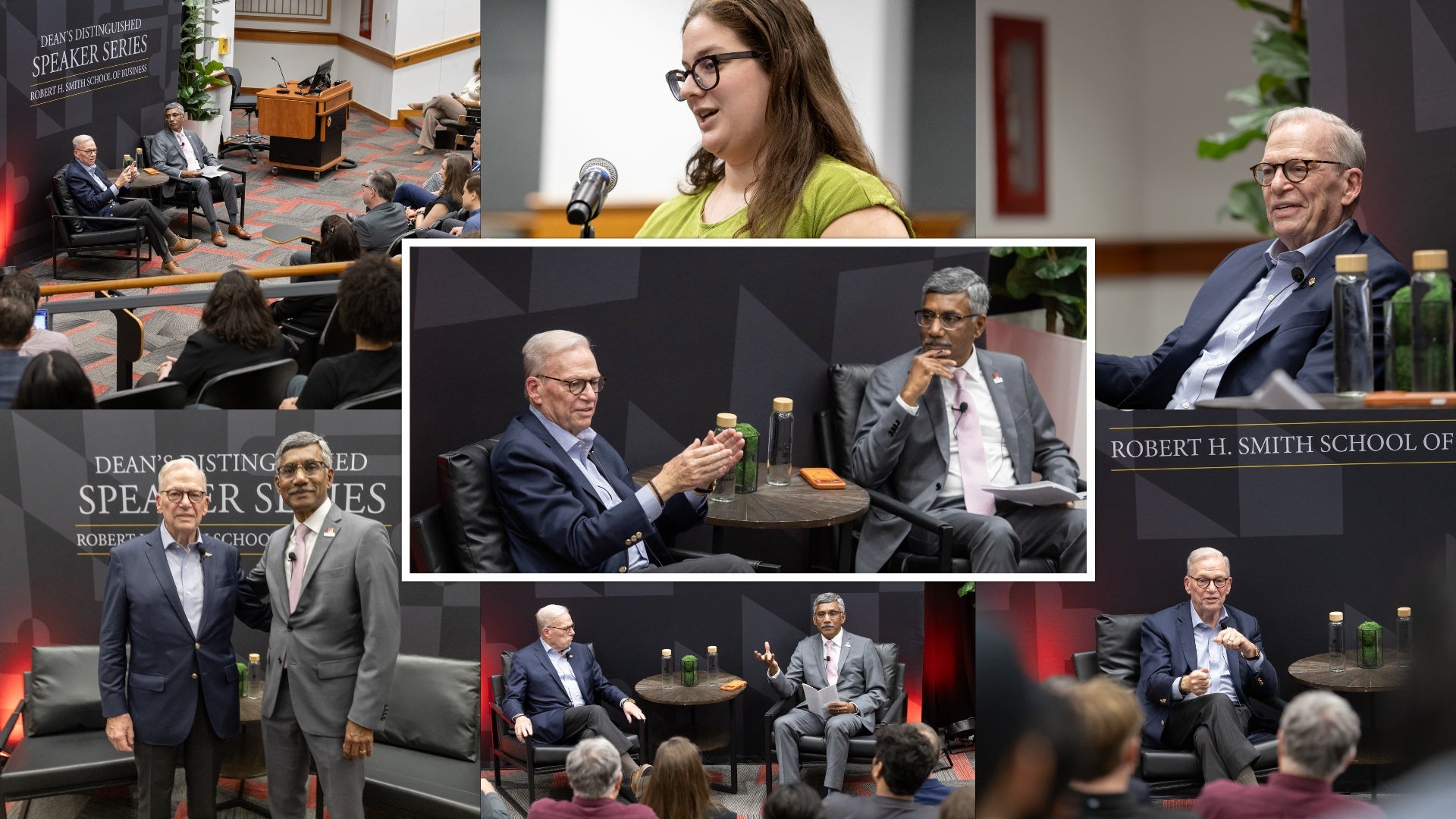
Dealing with risk is something William J. “Bill” Fishlinger ’71 has no problem with.
Fishlinger, Chief Executive Officer and Chairman of Gramercy Risk Holdings, spoke extensively about the hurdles he encountered and the knowledge he gained along the way to becoming a transformational figure in public-sector risk financing during the latest Dean’s Distinguished Speaker Series event on Wednesday, March 11, 2026, at the University of Maryland’s Robert H. Smith School of Business.
Throughout the evening’s conversation with Dean Prabhudev Konana, Fishlinger recounted his upbringing and path to the C-suite and presented his thoughts on leadership and the keys to success in the business world.
During the event’s opening remarks, Konana extended his gratitude to the UMD alum for his generosity to the Smith School over the years. The longtime benefactor and his son, Matthew ’07, through their family foundation, endowed a Smith School entrepreneurship fund, a scholarship, a student opportunities fund and a lecture series in the Center for Business Ethics, Regulation and Crime.
Konana also praised Fishlinger’s support for Smith students at this event, noting the significance of his time and invaluable lessons imparted.
“This is an incredibly exciting guest, who I’ve had the pleasure to interact with over the last five years. After every meeting, I come back impressed by his humility, insights and his reputation as a wonderful human being who looks after the best in this world,” said Konana.
Here are five insights that Fishlinger shared with attendees:
Take care of your people. Those with an entrepreneurial ambition to found their own businesses and organizations may feel liberated by the freedom to make their own decisions. However, Fishlinger reminded those same people that with that power comes great responsibility. It’s true, he said, that founders may feel they answer to no one, but ultimately, they have an obligation to do right by the people and families who support their mission.
“I caution people who want to take the entrepreneurial track. You’re responsible for your employees and their families. When you form your own company, you must think about making payroll as only you have that responsibility, and think about the people you put at risk. If you have an inclination to take that route, do it, but be mindful of the responsibilities and challenges that come with it.”
Ask more questions. As a member of the New York state and federal bars and senior partner at Congdon, Flaherty, O’Callaghan, Fishlinger & Pavlides, a New York-based law firm focused on insurance and complex civil litigation, Fishlinger credits his law school education for instilling the importance of being more curious and inquisitive. The Socratic method employed in law school, he said, is a different way of learning that forces students to challenge assumptions and beliefs. That approach has played a pivotal role in his business success.
“The biggest business failures I have seen, especially in acquisitions or mergers, are due to not asking enough questions,” said Fishlinger. “My principle of acquiring a company is like a three-legged stool. Ask yourself these questions: Is what you’re acquiring a high-level product or service? Is there a need for that product or service? Can management execute on the business plan?”
Lead through words. Throughout his career, Fishlinger has appreciated firsthand the importance of effective communication skills for successful leadership. It’s even more imperative in the financial risk business, he said, given the foundation of trust needed in transactions that involve selling off risk to reinsurers. However, as important as those communication skills are, there is also an element of action required to supplement them and demonstrate trust to others.
“It may sound frivolous in a way, but you lead by words. However, those words have to be believed. You don't necessarily lead by deeds, but if those words can't be backed up by deeds, then you can't lead,” said Fishlinger. “It’s all about your ability to communicate and get people to believe you.”
Don’t let success be the enemy of progress. To Fishlinger, success can sometimes stifle creativity and innovation. He presented the idea of left-brain logic and right-brain creativity. There’s a point in a person’s life, he said, when those sides work in harmony, and they possess “the knowledge to execute on their creativity.” Over time, though, success overwhelms the creativity because that person “has something to lose” after experiencing success. It’s why he recommended that people continue to strive to be part of environments that encourage innovation and creative output.
“I tell my executive staff, to this day, that success is the worst drug in the world because it dulls your senses. If you're successful, you say, ‘We’re successful because we know how to do this, right?’” said Fishlinger. “The first thing I would say to all of you is to look for a corporation or organization where capital supports creativity at this stage of your career.”
Sit in other seats, see through others’ eyes. When selling his holding company, Fishlinger noted that his insurance companies had maintained a 98% retention rate among insureds over a quarter-century. Reflecting on that milestone, he attributed it, in part, to “putting ourselves where others are sitting.” He likened it to a metaphor he once heard about a young child sitting in the back seat of a car, staring out the window. The child, he said, believes the whole world is in the car, but as they mature, they understand that “the world outside is really looking in.” However, no matter what, we “always see the world through our own eyes.” That understanding is why Fishlinger challenged attendees to approach every situation from different perspectives.
“To be an effective leader, you should try to the best of your ability to see the world through others’ eyes — the eyes of your competitors, clients, employees or partners,” said Fishlinger. “The ability to do that will help you to a great degree.”
The Dean’s Distinguished Speaker Series offers the Smith community an opportunity to engage with influential leaders from business, government and academia. Each event features candid conversations and expert perspectives on the ideas, challenges and innovations shaping today’s world.
Media Contact
Greg Muraski
Media Relations Manager
301-405-5283
301-892-0973 Mobile
gmuraski@umd.edu
About the University of Maryland's Robert H. Smith School of Business
The Robert H. Smith School of Business is an internationally recognized leader in business education and cutting-edge research. The school’s world-class faculty facilitate experiential learning opportunities rooted in the real world. Smith students learn to think like entrepreneurs, prepared to drive positive impact. The school offers undergraduate, online and on-campus business master's, full-time, part-time, online and executive MBA, plus PhD and DBA degree programs, and non-degree and executive education programs. Where Smith leads, the future follows.