
Annual Event Also Celebrates the Gordon Loeb Model as a Seminal Benchmark for Cybersecurity Budgeting
Six years ago, Smith faculty member Samuel Handwerger made a mistake that he says still makes him “cringe.” He received an urgent text message from what appeared to be his department chair. “He needed help,” recounted Handwerger. “Could I pick up some gift cards? It was important. Time-sensitive. I lost $500 before I realized I'd been had.”
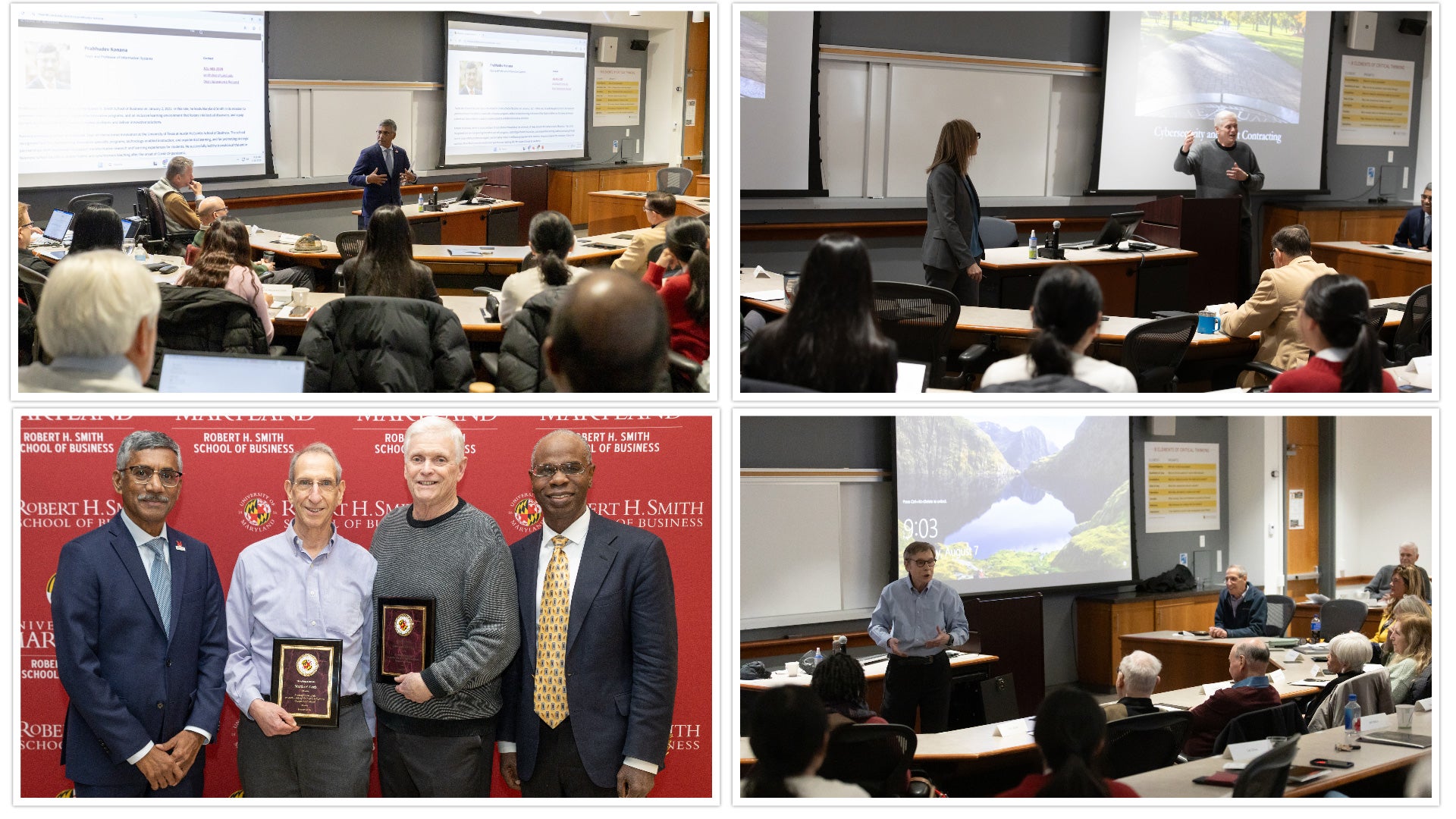
Handwerger, senior lecturer in accounting and information assurance at the University of Maryland's Robert H. Smith School of Business, shared this anecdote in an “Evolving Cyber Fraud Threats” presentation — the Ira Shapiro Memorial Lecture—as part of the 21st Financial Information Systems and Cybersecurity Forum: A Public Policy Perspective on January 16, 2026.
Co-hosted by the Smith School and School of Public Policy, the Van Munching Hall gathering of academics, and industry and policy leaders, was organized by professors Lawrence A. Gordon, Charles Harry, Martin P. Loeb and William Lucyshyn. The program included special recognition of Gordon and Loeb’s groundbreaking and now-25-year-old Gordon Loeb Model for significantly impacting cybersecurity economics and information security investment as a widely applied, extended benchmark for rational cybersecurity budgeting.
‘Fraud-as-a-Service’ Reemerges
Handwerger, in his lecture, noted that card impersonation scams, once thought to have faded, have resurfaced within the broader fraud-as-a-service (FaaS) ecosystem. FaaS groups, he explained, maintain rotating libraries of old and new scam scripts, re-deploying tactics like gift-card fraud when victims are less familiar with them. These operations support scammers—who act as affiliates—and take a share of the proceeds. The scam’s power lies in psychology: urgency, authority and the desire to help.
Even educated victims, including university communities, are vulnerable, added Handwerger, who authors the blog Tax Insights & Fraud Awareness. As AI voice cloning, caller-ID spoofing and deepfake video make impersonation easier, the core defense becomes simple but essential: always verify the requester through trusted channels.
Handwerger also advises students serving in UMD-affiliated nonprofit organizations, Justice for Fraud Victims and TerpTax. He described both student-operated enterprises and highlighted their recent accomplishments to close out the forum.
Earlier in the day, Smith leadership—Dean Prabhudev Konana and Professor and Chair of Accounting and Information Assurance Michael Kimbrough—gave welcoming remarks to the gathering.
Integrating GDELT
The forum’s morning activity also involved Harry discussing the implications of the recently integrated Global Database of Events, Language, and Tone (GDELT) project in UMD’s Center for Governance of Technology and Systems (GoTech) under Harry’s direction, and in coordination with the school’s Center for International and Security Studies at Maryland (CISSM).
GDELT, a service run by Google Jigsaw, enhances the GoTech/CISSM-maintained Cyber Events Database by integrating its global news monitoring capabilities. This integration expands event coverage through:
- Access to news in 60-plus languages for better non-English source inclusion
- Monitoring a vastly broader array of web sources
- Improved identification and depth of global cyber incidents from 2014 onward
More broadly, it increases the database's comprehensiveness, sample size and insights into cyber threats worldwide.
The remaining presentations were:
- “Cybersecurity and Debt Contracting” by Amy Sheneman, assistant professor of accounting and management information systems, Fisher College of Business (The Ohio State University)
- “Risk Assessments in SBOM” by L. Jean Camp, Bank of America Distinguished Professorship in Security Analysis (University of North Carolina at Charlotte)
- “Auditors’ Ethical Framework for Generative AI Cybersecurity” by Waymond Rodgers, professor of accounting and information systems (University of Texas, El Paso)
- Luncheon speaker: Travis Nelson, director of the Governor’s Office of Homeland Security (introduced by Yueming (Lucy) Qiu, School of Public Policy associate dean for research and faculty affairs)
- “Corporate Transparency and Cybersecurity Risks” by David Kim, assistant professor of accounting, Carroll School of Management (Boston College)
- “The Ransomware Decade: The Creation of a Fine-Grained Dataset and a Longitudinal Study” by Mingyan Liu, Alice L. Hunt Collegiate Professor of Engineering (University of Michigan)
Gordon-Loeb Model: 25 Years and Still Vital
Amid the presentations, a special tribute focused on the Gordon Loeb Model (here, via whiteboard animation). In a nutshell, it provides a foundational economic framework showing that the optimal cybersecurity investment level for protecting information and information networks typically should not exceed ~37% of the expected cyber losses.
But the model—with more than 2,100 Google Scholar citations, including 160-plus since 2025—“has taken on a life of its own,” Gordon noted just before the forum.
“When Marty Loeb and I first published the Model (via ACM Transactions on Information and System Security) in 2002, we believed that cybersecurity was important, but we underestimated the astonishing breadth, depth and velocity with which the computer-based interconnected digital world would grow,” Gordon went on to say. “Now more than ever, I strongly believe that cybersecurity is a necessary, though not sufficient, condition for a smoothly functioning computer-based digital world—including one increasingly dominated by AI.”
The model was an impetus more than 20 years ago to the Financial Information Systems and Cybersecurity Forum, which, as Loeb has noted, has “positioned the Smith School and the School of Public Policy to lead the university in increasing cross-disciplinary research on challenges associated with financial and public policy aspects of cybersecurity.”
Media Contact
Greg Muraski
Media Relations Manager
301-405-5283
301-892-0973 Mobile
gmuraski@umd.edu
About the University of Maryland's Robert H. Smith School of Business
The Robert H. Smith School of Business is an internationally recognized leader in business education and cutting-edge research. The school’s world-class faculty facilitate experiential learning opportunities rooted in the real world. Smith students learn to think like entrepreneurs, prepared to drive positive impact. The school offers undergraduate, online and on-campus business master's, full-time, part-time, online and executive MBA, plus PhD and DBA degree programs, and non-degree and executive education programs. Where Smith leads, the future follows.