
AI Token Economics, Algorithmic Pricing and Antitrust: What Business Leaders Need to Know
Executive Certificate Program
Program Overview
Artificial Intelligence (AI) is transforming how businesses price their products, structure their costs, and compete. Yet the economics of AI itself — and the legal boundaries around algorithmic pricing — remain poorly understood in most executive suites. This executive-level program equips business leaders, counsel, and policy professionals to understand how AI models are priced, how algorithmic pricing creates value and risk, and how antitrust enforcement is responding in both product and labor markets. Over seven interactive, expert-led sessions — including a live conversation with OpenAI on token economics, the macro-finance perspective of a former Deputy Secretary of the U.S. Treasury, and the enforcement perspective of a former Director of the FTC’s Bureau of Economics — participants will learn to manage AI cost structures, evaluate pricing strategies, and navigate a fast-moving legal landscape.
Program Details
- Location: 100% online, synchronous (live interactive sessions with a variety of leading experts)
- Audience: Business leaders, pricing and product executives, in-house counsel, economic consultants, and policy professionals
- Tuition: $2,000
- Frequency: Offered quarterly
Contact: rhsmith-execed@umd.edu
Who Is This For?
This quarterly program is for anyone asking any of the following questions:
- How are AI models priced, and what will AI adoption at scale actually cost my organization?
- How can algorithmic pricing create value for my business, and when does it create legal risk?
- What are antitrust enforcers focused on today, and what do cases like RealPage mean for my company?
- Could our hiring, compensation, and talent practices create antitrust exposure in labor markets?
Program Goals
Participants will leave equipped with the knowledge and tools to:
- Understand the economics of AI: how models are priced, what token economics means, and how AI cost structures change with scale.
- Evaluate algorithmic pricing strategies and the value they create across products, platforms, and markets.
- Recognize where algorithmic pricing crosses into antitrust risk, and understand how enforcement agencies investigate and act.
- Understand the emerging antitrust frontier in labor markets, from wage-setting algorithms to noncompete agreements.
- Apply these lessons by mapping their own organization’s AI cost exposure, pricing opportunities, and compliance risks.
Program Outline
Session One: AI Today: Setting the Stage for Economics, Pricing, and Policy
This session provides the foundation for the program: what modern AI systems are, how the AI industry is organized, and why the economics of AI — from model costs to pricing strategy to competition policy — has become a board-level concern. Participants will build a shared vocabulary and a map of the issues the program explores in depth.
Topics:
- Overview of modern AI: foundation models, agents, and the AI value chain
- The business landscape: model providers, cloud platforms, and application builders
- Why AI economics, pricing, and antitrust now intersect for business leaders
- A roadmap of the questions each session in the program will address
Session Two: AI Token Economics
Cost is the piece of AI adoption most companies have not thought carefully about. This session opens with a short framing of why AI cost structures matter strategically, then moves into a live interview with OpenAI covering how token-based pricing actually works — input, cached, output, and reasoning tokens — how pricing varies across models and why, and what changes when organizations adopt AI at scale.
Topics:
- Why AI cost structures are a strategic blind spot for most companies
- Input, cached, output, and reasoning tokens: how token pricing works and why it varies across models
- How costs change with scale and with the nature of the task
- Live Q&A: participants ask OpenAI directly
Session Three: The Macro-Finance of the AI Boom: Capital, Policy, and What Washington Sees
Token prices are the visible tip of the largest capital investment cycle in modern history. This session examines the financial and policy forces beneath AI pricing: how the AI infrastructure buildout is being financed, how capital costs and energy constraints flow through to what firms pay for AI, whether the current investment wave resembles past technology booms, and how economic policymakers in Washington weigh AI competitiveness against its risks — from a scholar who recently served at the highest levels of the U.S. Treasury.
Topics:
- The economics of the AI infrastructure buildout — and how it flows through to token prices
- Financing structures, capital markets, and systemic-risk questions in the AI boom
- Industrial policy, chips, and energy: the constraints shaping AI’s cost curve
- How Washington thinks: reading economic policy signals on AI investment and competition
Session Four: Algorithmic Pricing: Strategy, Platforms, and Value
Algorithms now set prices for airlines, retailers, ride-sharing platforms, and a growing share of the economy. This session examines how algorithmic pricing works as a business strategy: where it creates genuine value, how platforms deploy it, and how competitive dynamics change when firms on both sides of a market price algorithmically. The session sets up the legal questions the following two sessions address.
Topics:
- How firms use algorithms to set and optimize prices
- Platform pricing, self-preferencing, and competition among algorithms
- Where algorithmic pricing creates value — and where it invites scrutiny
- Case examples from retail, travel, and online platforms
Session Five: Algorithmic Pricing Meets Antitrust: The View from the Agencies
When does algorithmic pricing cross from smart strategy into illegal coordination? Led by a former Director of the FTC’s Bureau of Economics, this session traces how enforcers think about pricing algorithms — from early cases involving computerized fare systems and e-commerce sellers to today’s litigation over shared pricing software — and examines how competition questions are now reaching AI markets themselves.
Topics:
- A brief history of algorithmic coordination: from airline fare systems to e-commerce
- RealPage and the current enforcement landscape for shared pricing algorithms
- How agencies investigate: evidence, economics, and the limits of current law
- Competition in AI markets: concentration, partnerships, and what enforcers watch
Session Six: The Other Antitrust Frontier: Algorithms, Labor Markets, and Talent
Everything algorithms are doing to product prices is now happening to wages. This session examines the rapid expansion of antitrust into labor markets — no-poach and wage-fixing enforcement, the national battle over noncompete agreements, and the rise of algorithmic wage-setting and compensation benchmarking tools. Because every participant is also an employer, this session addresses the antitrust exposure organizations most often overlook.
Topics:
- Antitrust comes to labor markets: no-poach, wage-fixing, and monopsony power
- Noncompete agreements: the evidence and the policy battle
- Algorithmic wage-setting and compensation benchmarking: the RealPage question, mirrored
- Practical steps to assess labor-market antitrust exposure
Session Seven: Reflections and Presentations
In the closing session, participants synthesize the program by presenting short “exposure and opportunity maps” of their own organizations: where they use or plan algorithmic pricing, what their AI cost structure looks like, and where pricing or talent practices may carry antitrust risk. Program faculty provide live feedback, and the group reflects on lessons learned and next steps.
Topics:
- Participant presentations: AI cost, pricing opportunity, and risk maps
- Live faculty feedback and discussion
- Synthesis: connecting token economics, pricing strategy, and antitrust
- Program feedback and continuing the conversation
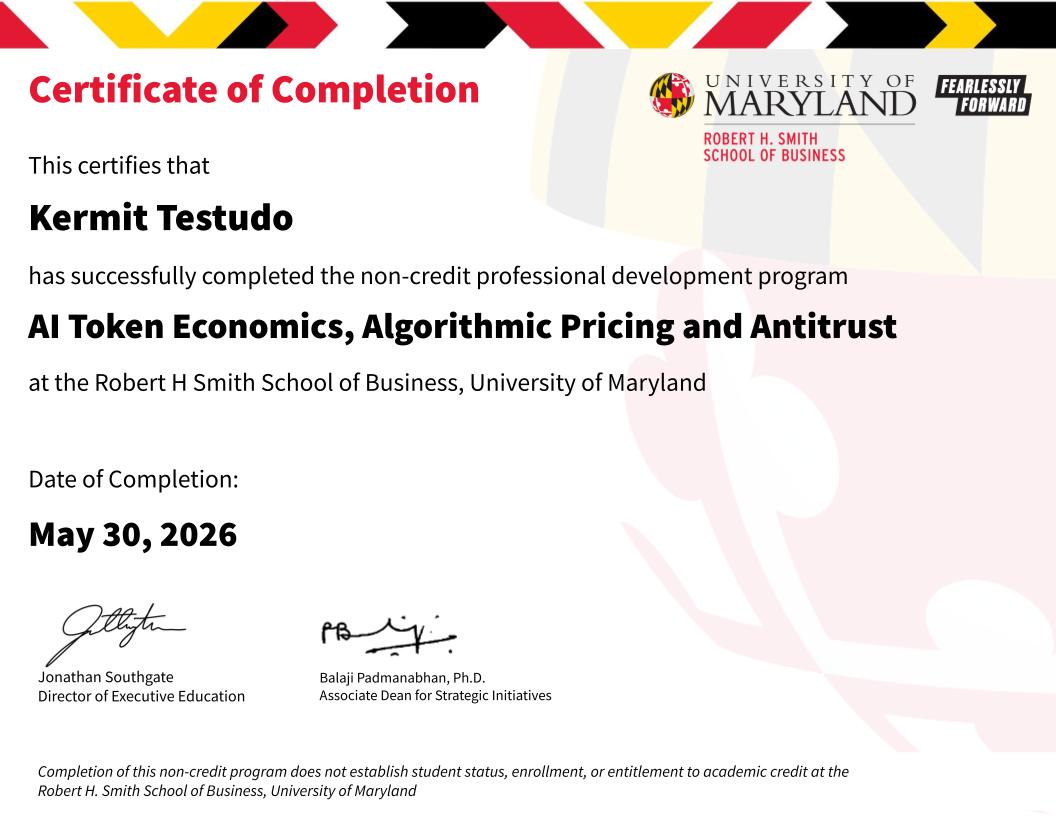
Certificate
(with the option to earn Continuing Education Credits):
The Power of the Smith Network
 Andrew Sweeting, PhD
Dr. Sweeting is Professor and Chair of the Department of Economics at the University of Maryland and served as Director of the Bureau of Economics at the Federal Trade Commission. A leading industrial organization economist recognized among the world’s most influential antitrust academics, he studies competition, pricing, and market dynamics, and founded the annual DC Industrial Organization Conference.
Smith Faculty

Balaji Padmanabhan


Michael Faulkender

