
In recent months, policies related to diversity, equity and inclusion (DEI) across the public and private sectors have been under scrutiny, with critics calling for greater emphasis on merit while supporters maintain that the policies help provide opportunities for marginalized groups.
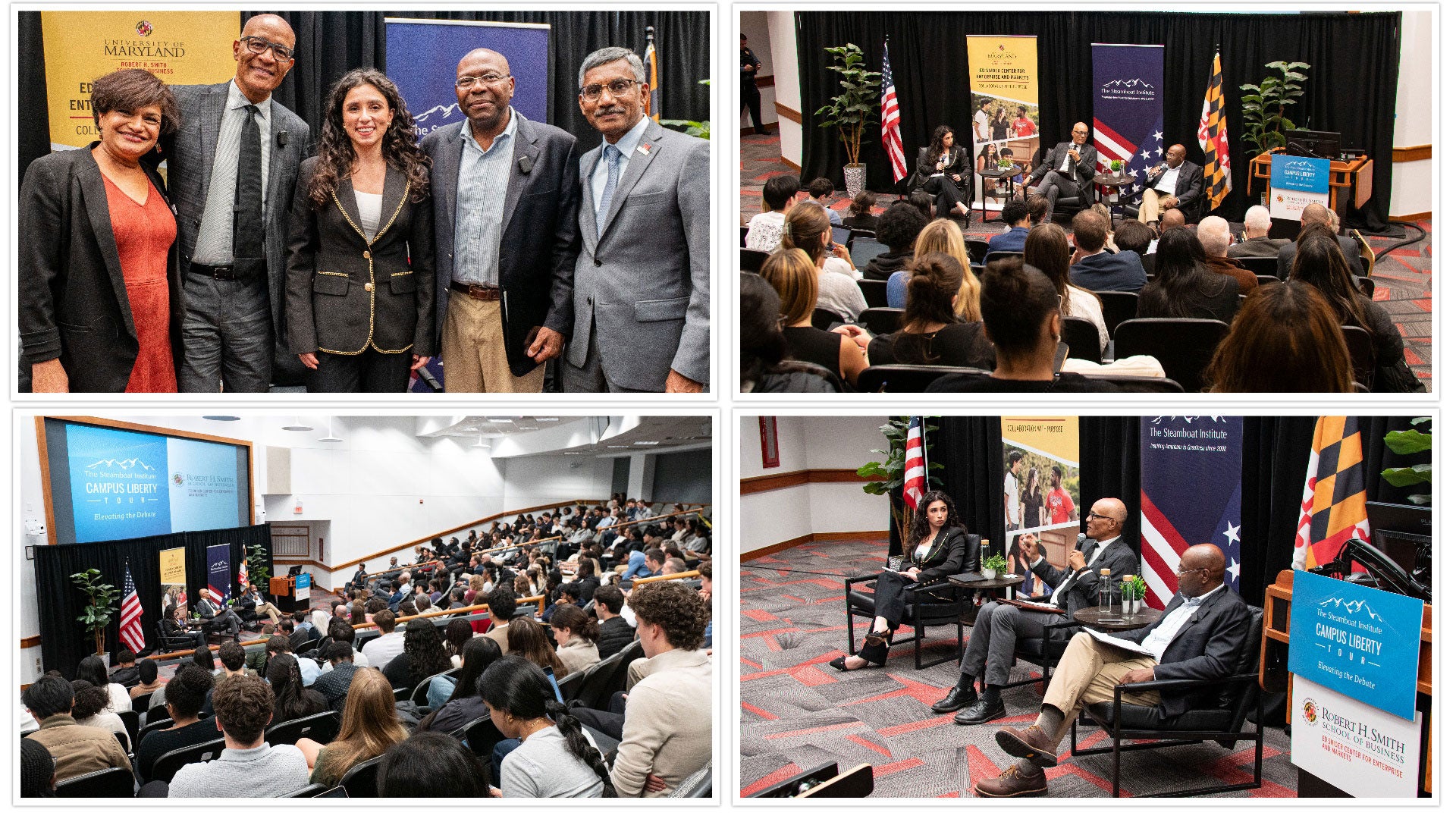
On Tuesday, October 28, 2025, the salient debate continued at the University of Maryland’s Robert H. Smith School of Business as experts addressed whether the government should ban all DEI programs during the latest stop in the Steamboat Institute Campus Liberty Tour Debate Series.
The event, hosted by the Ed Snider Center for Enterprise and Markets as part of its Fact-Based Discourse Initiative, marked the Steamboat Institute’s seventh time bringing the series to the College Park campus. This iteration featured Ralph Richard “Rick” Banks, Professor of Law at Stanford and Faculty Director of the Stanford Center for Racial Justice, and Jason Riley, senior fellow at the Manhattan Institute and Wall Street Journal columnist, as they explored the nuances of the DEI debate at the federal level.
Smith School Dean Prabhudev Konana welcomed an audience of students, faculty, and alumni to the event and noted that it is part of the school’s initiative to nurture intellectual curiosity.
“Few issues have sparked as many conversations as DEI with its implications for law, the workplace and almost everything in our lives,” said Konana. “Here at the Smith School, we don’t just preach critical thinking; our strategy is to give students the intellectual freedom, tools and ability to engage in these types of conversations with civility and openness.”
Rajshree Agarwal, Director of the Ed Snider Center and the Rudolph Lamone Chair of Strategy and Entrepreneurship, echoed Konana’s sentiments and expressed the importance of spirited debate toward developing future business leaders, while maintaining that they should be approached “with both reason and empathy.”
“These are not one-and-done debates; they are woven into the fabric of our curriculum,” said Agarwal. “It’s not about teaching you what to think, but how to think. Thinking through underlying assumptions, cause and effect relationships and rethinking positions.”
During the debate, moderated by Carine Hajjar, Boston Globe Opinion Writer and Steamboat Institute Public Policy Fellow, Banks and Riley answered a variety of questions related to DEI, including its definition and whether it’s well-intentioned, the federal government’s involvement in eliminating DEI policies on college campuses and the effect of DEI policies on fostering diversity and addressing inequalities.
Here are excerpts from each speaker’s closing remarks from the event:
Riley, arguing the affirmative: “We heard a lot tonight about how controversial this topic of DEI is, and I agree that it’s controversial on college campuses and among people who follow politics closely. However, most of the public doesn’t find this controversial,” said Riley. “The Supreme Court decision [on Harvard admissions] was supported by 70% of the public. DEI and affirmative action may be controversial among a subset of Americans, but there is an abiding belief in color blindness policies as the way forward.”
Banks, arguing the negative: “DEI is much broader than racial preferences. Even if you believe DEI is unequal, you should still oppose a categorical prohibition because it would eliminate all sorts of practices in which employers, universities and medical researchers take into account group status, not to favor one group but because they seek solutions that favor everyone,” said Banks. “It should be important to preserve the autonomy of decision makers to promote the useful forms of DEI while eliminating those that are counterproductive to that.”
The Fact-Based Discourse Initiative is one of several sponsored by the Heterodox Academy Campus Community at the University of Maryland. The group is co-chaired by Jacqueline Manger, managing director of the Ed Snider Center for Enterprise and Markets; Rellie Derfler-Rozin, academic director of the Master’s in Management Studies and Online Master of Management Studies programs; Rajshree Agarwal, Rudolph Lamone Chair of Strategy and Entrepreneurship and director of the Ed Snider Center; and Sebastian Galiani, Mancur Olson Professor, from the College of Behavioral and Social Sciences. They will plan additional programming throughout the year, including panel discussions and speaker events to promote open inquiry and viewpoint diversity.
Media Contact
Greg Muraski
Media Relations Manager
301-405-5283
301-892-0973 Mobile
gmuraski@umd.edu
About the University of Maryland's Robert H. Smith School of Business
The Robert H. Smith School of Business is an internationally recognized leader in business education and cutting-edge research. The school’s world-class faculty facilitate experiential learning opportunities rooted in the real world. Smith students learn to think like entrepreneurs, prepared to drive positive impact. The school offers undergraduate, online and on-campus business master's, full-time, part-time, online and executive MBA, plus PhD and DBA degree programs, and non-degree and executive education programs. Where Smith leads, the future follows.