
How Smith is influencing the future of finance
H. Kent Baker, MBA ’69, DBA ’72, M.Ed. ’74, was finishing his MBA at the University of Maryland and set to enter a PhD program at the University of Wisconsin when the phone rang.
“It’s literally the telephone call that changed the direction of my life,” Baker told Smith Business in September 2025, before his death in January 2026.

Charles Taff, then-head of the Department of Business Administration, was calling to ask, “Kent, what can we do to keep you at Maryland?”
Taff arranged a meeting with former Dean Donald W. O’Connell, who offered Baker a full-time position as his assistant with tuition and other benefits—an opportunity Baker couldn’t refuse.
Baker completed his DBA and a master’s degree in education as a Terp, then became assistant dean at Georgetown University’s School of Business. He moved to American University’s Kogod School of Business, where he was a University Professor of Finance and a leading scholar in the field of behavioral finance for the past 50 years.
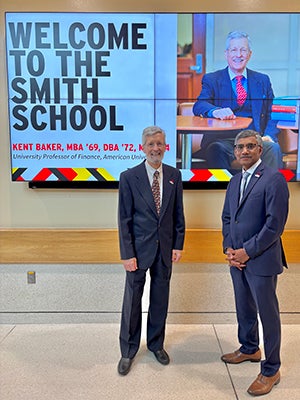
In total, Baker earned eight post-secondary and post-graduate degrees in education and finance, along with his CFA and CMA designations. Stanford University ranked him among the top 2% of scientists worldwide, and the Journal of Finance Literature recognized him among the top 1% of the most prolific authors in finance during the past 50 years. He has published 46 books, 38 book chapters, more than 225 academic journal articles and 130 other works, and done consulting and training at more than 100 organizations.
Baker’s research reshaped modern finance and fundamentally changed how scholars, practitioners, and policymakers understand market behavior. Most notably, he helped pioneer and advance behavioral finance, which he studied and published work on “before there was the name of behavioral finance,” he said.
Decades later, Baker made his own transformative call—to the business school that played such a formative role in his career. In September 2025, he pledged a generous gift to establish the H. Kent Baker Center for Behavioral Finance and support finance research faculty at the Smith School.
“Paying it forward to help others really is my motive with this gift,” said Baker. “One of the greatest things to me is education, and the University of Maryland has been one of the most influential institutions in my life.”
The Influence of Smith Finance
The Smith School’s finance department has had tremendous influence on many people.
From crafting policy at the highest echelons of state and federal governments, creating novel models and managing millions of dollars in funds, to shaping an entirely new subsector of finance and sharing insights spanning decades of field experience, the department continues to analyze and redefine how the world does business. Baker’s contributions will extend that impact.
The faculty—many of whom are among the world’s top-ranked researchers—are thought leaders and industry veterans who help shape the field of finance and financial policy. They lead students in meaningful educational experiences, connecting them with a vast alumni network and real-world opportunities to learn finance—both in and beyond the classroom.
Undergraduate and graduate finance students have no shortage of opportunities to learn by doing, taking part in projects that let them feel the stakes of decision-making or of enacting change long before they enter the workforce.
Influencing Assets
Smith’s three student-led investment funds—The Mayer, Senbet and Global Equity funds—are an example of that learning. Undergraduate, MBA and MS students apply for limited spots to manage the nearly $13 million in assets across the three funds. Collectively, it’s the 14th-largest student-run investment fund program in the country, according to the Center for Investment Research, providing students with practical investment experience as they develop strategies to outperform the S&P 500 and the MSCI All Country ex-US Index. In the past two years, the students’ investing success allowed the Smith School Foundation, which hosts the funds, to return almost $1 million in cash dividends to the school.
“These students sink or swim in some ways regarding making actionable recommendations that we can invest in,” says Sarah Kroncke, senior lecturer and advisor to the MBA-managed Mayer Fund and undergrad-run Senbet Fund. “It’s meaningful to watch them grapple with the decision-making process even when they feel strongly about something. When it comes time to pull the trigger and make the investment, you see hesitation because they know it's real money with consequences to their decisions.”
The experience yields dividends for students, with fund participants getting job offers from top companies in financial services and corporate finance, including J.P. Morgan, Capital One, Goldman Sachs, Ernst & Young and Deloitte.

Ryan Baumbach ’25 benefited from his experience managing the energy and utilities sector for the Senbet Fund, ultimately securing an analyst position at J.P. Morgan Private Bank.
“Everyone came in with different backgrounds—some had investment banking experience, some didn’t. But we helped each other grow,” says Baumbach. “It was the most rewarding experience I’ve had at Smith.”
Undergraduate students can also participate in the Wall Street Fellows program, with co-curricular experiences designed to prepare them for jobs in fields like investment banking, mergers and acquisitions, and asset management.
Influencing Government
In addition to investing, finance students at Smith work closely with Maryland state officials to enact positive change in state policies and drive economic development.
Over the last year, Liu Yang, associate professor of finance and executive director of UMD’s Federal Statistical Research Data Center, teamed up with Vojislav Maksimovic, the William A. Longbrake Chair in Finance, and Kislaya Prasad, academic director of Smith’s Center for Global Business, to develop partnerships with state offices.
According to Yang, these projects represent an effort by Smith administrators to develop a more permanent connection between the school and the state, while demonstrating to students the potential of finance in public service. They could also ultimately deliver solutions to issues impacting state residents.
“This is one effort under Dean Konana’s leadership to bring our expertise to help our state answer real, pressing questions,” says Yang. “Smith has so much talent across so many areas, and these projects open doors for new collaborations moving forward.”
One notable project involved eight Master of Finance students and two of Smith’s PhD candidates, who assisted the Comptroller’s Office in two joint reports identifying critical patterns in federal spending in Maryland and examining the repercussions of significant reductions in that spending.
Another, carried out in partnership with the state Labor Department, saw a team of Master of Finance and MQF students analyze and provide recommendations for its earned wage access (EWA) regulations, a service similar to a payday loan program—allowing workers to connect their bank account to a money lending service to get advances on future paychecks.
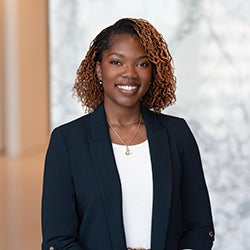
Yentell James, Master of Finance ’25, appreciated working on the EWA project because it enhanced what she learned in the classroom while applying it in a consequential setting.
“When I think about my learning journey, the things that I usually appreciate the most are the real-life experiences,” says James. “It helped me to understand the content so much more, and I loved pulling knowledge from all the classes that I have taken to produce something.”
Influencing Student Experiences
Finance students also get to work on projects that impact industry. MQF students worked with the Smith Enterprise Risk Consortium (SERC) to map out financial industry risk from natural disasters, such as floods, storms or heatwaves. In October 2025, a student team launched the Mortgage Natural Hazard Analyzer, a dashboard that allows users to assess mortgage risk by natural hazard type for every U.S. county and view figures on borrower characteristics such as race, age and income. In December, another team launched the Natural Hazard Bank Branch Analyzer for banks to see how natural disasters could affect their assets and branch locations.
Another recent experiential learning project had students team up with Google Analytics specialists to leverage the company’s suite of AI tools in building a groundbreaking approach to credit risk evaluation, essentially “recreating a financial analyst agent” using AI models.
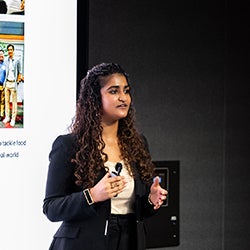
The students’ efforts culminated in Krisha Chheda, MQF ’25 and SERC student intern, showcasing the project during Google’s Higher Ed Leader Series Conference held in New York City in July 2025.
In an interview after the event, Chheda expressed gratitude for the opportunity to represent the Smith School and share the efforts of her and her peers.
“It reaffirmed that students can and should have a seat at the table when it comes to shaping the future of education and technology,” she said.
Preparing Students for the Modern Workforce
Understanding how to use technology—particularly AI—will be critical to thrive in the workplace going forward, so Smith finance faculty are weaving those skills into all classes and experiential learning projects.
Russ Wermers, Paul J. Cinquegrana ’63 Endowed Chair in Finance and director of the Center for Financial Policy, has observed that the field has become “a much more quantitative field,” driven by big data and requiring AI skills and an understanding of coding languages like Python.
“We’re focused on leveraging artificial intelligence and machine learning tools to harvest insights from big data. We know from our experience and hearing from alumni on our Finance Advisory Council that students who learn these skills will land great jobs,” says Wermers.
It’s all part of a larger effort to address the shifting industry landscape and ensure that Smith students are not just prepared, but that they maintain an edge in the workforce.
That emphasis on maintaining a cutting-edge curriculum and on providing support to students from day one on campus through graduation and beyond helped shape Baker’s career and reflects what made him want to give back to Smith and pay it forward.
“His work on behavioral finance and the legacy he leaves with the Baker Center for Behavioral Finance will continue to inspire future generations of students and researchers to do impactful work in the field,” said Geoffrey Tate, center director and Dean’s Professor of Finance.
Baker implored others to contribute—through giving, mentorship or offering jobs and internships—to build on the Smith School’s strong approach to finance education and focus on AI. “The future is more challenging than it has been in decades, but it’s also bright,” he said.
He hoped countless other students would experience the same type of influence the Smith School’s finance department had on him.
“Maryland created that experience and knowledge base that have left the opportunities up to me to conquer, and it provided me with the kinds of skills to be able to achieve those objectives and realize my dreams.”
Demonstrating Faculty Excellence Across Industry, Government and Academia
Other superstar Smith finance faculty include:
- Tania Babina, associate professor; organized the AI in Finance Conference and produced an AI in financial services module for Smith’s Free Online Certificate in Artificial Intelligence and Career Empowerment.
- Michael Faulkender, the William E. Longbrake Chair of Finance; served as the 16th Deputy Secretary of the U.S. Treasury, where he was in charge of operations and helped shape policy.
- Steve Heston, professor; thought-leader in derivatives and creator of the Heston model in finance of asset prices for pricing options.
- Vojislav "Max" Maksimovic, William A. Longbrake Chair in Finance; expert in corporate finance, investment and firm organization.
- Lemma W. Senbet, the Dean’s Chaired Professor of Finance; expert in corporate finance and international finance.
- Geoffrey Tate, Dean's Professor of Finance and chair of the department; director of the Baker Center of Behavioral Finance.
- Haluk Ünal, professor; special Advisor to the Center for Financial Research of the FDIC, and senior fellow at the Wharton Financial Institutions Center.
- David Kass, clinical professor; expert on Warren Buffett and Berkshire Hathaway, who has taken students to Omaha for private meetings with the legendary investor.
For over 10 years, Financial Times has ranked the Smith School’s finance department among the best in intellectual capital in the United States, a testament to the collective expertise of its faculty members across the public, private and academic sectors.
“The breadth of our expertise is what sets us apart from our peers, and why I consider us to be a top 15 finance department in the world,” says Russ Wermers, the Paul J. Cinquegrana ’63 Endowed Chair in Finance and director of the Center for Financial Policy, himself renowned for research in mutual funds and asset management. “That broad research expertise is what helps us continue to innovate our programs and evolve to prepare our students for the modern workforce.”
Wermers points to Albert “Pete” Kyle, Distinguished University Professor and Charles E. Smith Chair Professor of Finance. Kyle is globally known for his groundbreaking research on market microstructure has garnered significant distinctions and awards since its publication in 1985. His contributions will be celebrated at a Center for Financial Policy event this year.
“Pete has completely changed our department for the better. He’s our franchise and MVP,” says Wermers. “It’s a privilege and the right time to honor him for his work, which started an entire literature itself.”
Media Contact
Greg Muraski
Media Relations Manager
301-405-5283
301-892-0973 Mobile
gmuraski@umd.edu
About the University of Maryland's Robert H. Smith School of Business
The Robert H. Smith School of Business is an internationally recognized leader in management education and research. One of 12 colleges and schools at the University of Maryland, College Park, the Smith School offers undergraduate, full-time and flex MBA, executive MBA, online MBA, business master’s, PhD and executive education programs, as well as outreach services to the corporate community. The school offers its degree, custom and certification programs in learning locations in North America and Asia.