
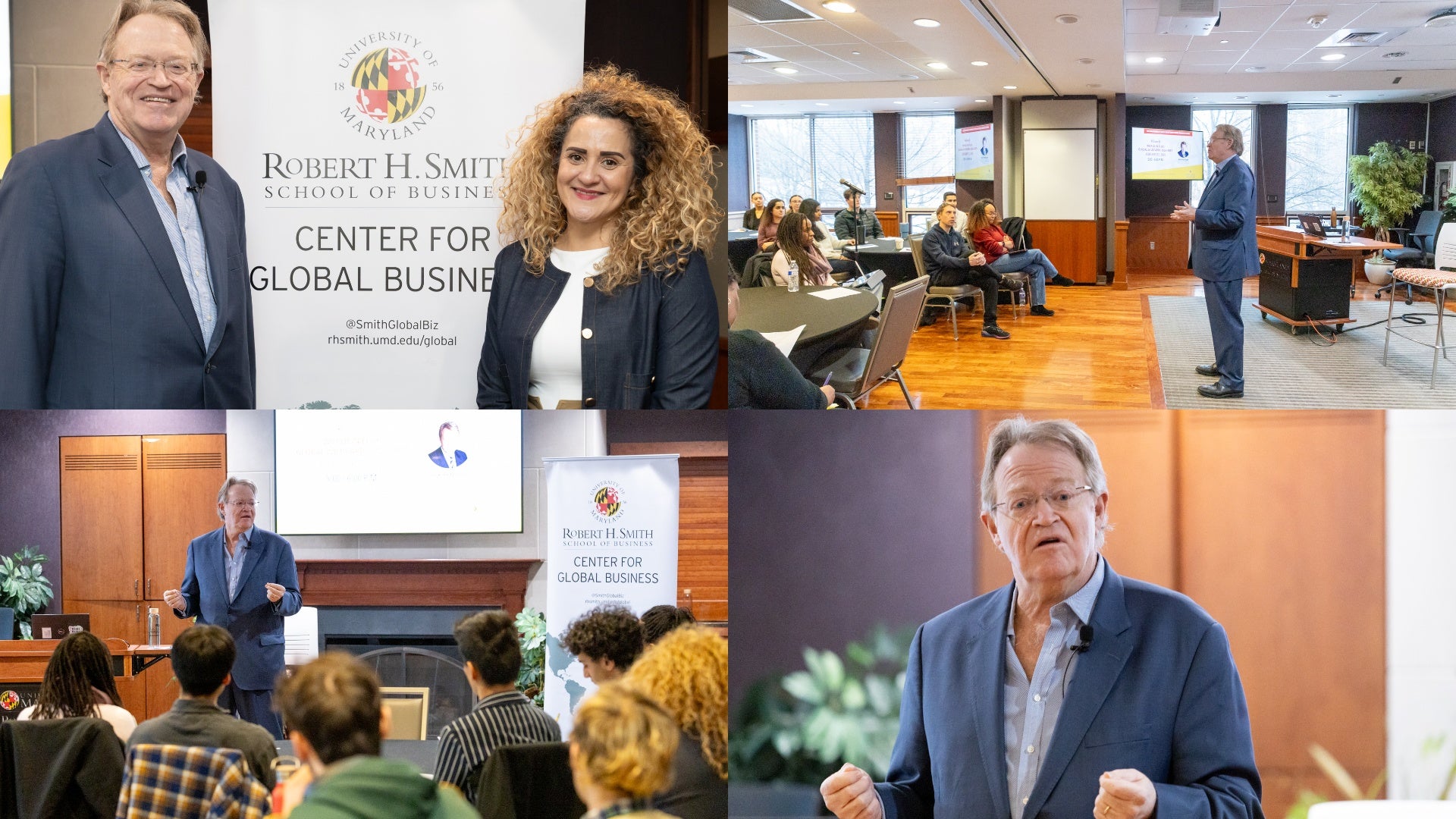
“World in flux is a supreme understatement for the world in which you live,” said Erik Peterson, partner and managing director of Kearney’s Global Business Policy Council. “You are going to be moving into the workforce and thinking about leaving your imprints on the world at a time of remarkable, simultaneous redefinition in a number of areas,” Peterson said as he addressed students and staff at the Center for Global Business (CGB) Distinguished Speakers in International Business Series, Feb. 12, 2026 in Van Munching Hall. Though it sounds like a daunting proposition, he said it is an opportunity for students.
For the last nine years, Peterson, also a member of CGB’s board of advisors, has come to the Robert H. Smith School of Business to share the five major trends expected to shape the global economic landscape in what his team views as the “Global Wildcards” from 2026 through 2031.
“I think that there are probably five key elements that you need to be thinking about right now if you look at the changing environments in the world and what it implies for business and what it implies for your future,” Peterson began by identifying the elements that influence what he and his team predict. Heightened geopolitical instability, macroeconomic output, tariffs and fragmentation, artificial intelligence and what's happening in terms of the broader societies behind these factors. He thinks they are all individually significant but as a collection of observations, he said it will force us to learn what he calls “a new language” or in other words, shifting how we navigate these realities.
Government in the Business of Business
Economic security is one of the five wildcards Peterson’s team identified. He said governments are rapidly getting into business. “We are seeing the lines of demarcation between business and government changing by the day.” Peterson said, “Let’s face it, political people make lousy business decisions,” referencing Europe in the 1980s, where a number of instances where national champions were “heralded and in the end they failed and they failed big.”
“So the question is, why would we want to bring back economic security right now?” Peterson asked. He elaborated that economic security is a big topic at the Munich Security Conference, as it also relates to national security. The theme of the conference deliberations, he said, was “ongoing destruction” of laws and institutions that were once thought to be reliable. Peterson said economic security is being “folded” into topics like broader national foreign policy priorities and even national security. “Now we're beginning to see a blending of protectionism and populism and not only here in the U.S., but elsewhere in terms of the economic policy right now,” which he said means that keeping an eye on this as students navigate their future should be key.
When highlighting global economics in general, Peterson noted that India is growing at a projected average rate of 6.2% in the next three years. “No one is coming close to imagining that growth rate. Their story will be definitional,” he said. Major industrialized economies, the U.S., Europe, Japan, Russia and China are all slowing down, he added.
Peterson said it’s unclear what will speed the world economy up again, like when the IT revolution made an impact. “The fact of the matter is, you and I have no idea how Artificial Intelligence (AI) is going to affect the productivity horizons now. We can hope that we'll see net gains all over the place. But we can't be sure. And the empirical evidence that we have suggested an anemic economy, for as far as the eye can see, at least through the end of the decade,” he said.
Technology: Less Green Tech, More Synthetic Biology
With the U.S. and other countries rolling back pollution requirements, Peterson said this will have an impact on green technology investments. While there may be a pause in this area of innovation, Peterson sees growth, not in quantum or AI but in synthetic biology. He referenced Jennifer Doudna, one of the pioneers of CRISPR, who was awarded the Nobel Prize in 2020 for genetic editing technology. Peterson said the technology is moving even farther with the idea that you “can make new stuff” with synthetic biology. “This is really quite extraordinary and breathtaking and terrifying at the same time. But now there are a number of serious people that are talking about a whole range of new organisms that have never existed before. They're doing remarkable things here that we hope will be used for positive aims in the future,” he said.
Another topic Peterson highlighted was “mirror life”, synthetic organisms made from molecules.
“Most of the genetic structure, the biological structure that we have, is kind of one-handed. It's either left-handed or right-handed,” Peterson explained. This method creates “the other hand” in terms of organisms, allowing new ways to create new vaccines and drugs to help those who may have underlying medical conditions where immunities have built up “with the other life.” The concern the biology sector has, he said, is that it could go in the wrong direction.
Still Making An Impact: Tariffs and AI
Tariffs are still a topic of discussion, and Peterson said we are seeing a movement toward economic fragmentation, something he previously highlighted could be a factor when he gave a presentation at the 2015 World Economic Forum. He predicts it will only become more fragmented in the future. Another topic that remains part of the discussion is AI, which Peterson told the students is “emblematic of a remarkable technology cluster that’s changing everything about your prospects.”
He reinforced the idea that all of these challenges will become the “new languages” or new approaches to move forward in this global landscape.
“I've said this in previous years here at Smith, my hope is that one of you will be an absolute wiz at one of these ‘new languages’, and that you'll change the world in a way that will make us all a lot better off.”
CGB’s Distinguished Speakers in International Business Series brings together policymakers, industry leaders, academia and students to present and discuss emerging trends in international business throughout the year.
The Distinguished Speakers in International Business Series is supported in part by CIBE, a Title VI grant provided by the U.S. Department of Education.
Media Contact
Greg Muraski
Media Relations Manager
301-405-5283
301-892-0973 Mobile
gmuraski@umd.edu
About the University of Maryland's Robert H. Smith School of Business
The Robert H. Smith School of Business is an internationally recognized leader in management education and research. One of 12 colleges and schools at the University of Maryland, College Park, the Smith School offers undergraduate, full-time and flex MBA, executive MBA, online MBA, business master’s, PhD and executive education programs, as well as outreach services to the corporate community. The school offers its degree, custom and certification programs in learning locations in North America and Asia.