
What does it really mean to disrupt an industry?
Too often, disruption is framed as destruction: tearing down old systems, replacing established players, or overturning familiar ways of doing business. But at a recent event hosted by the Ed Snider Center for Enterprise and Markets, the conversation took a different turn. The focus was not on destruction for its own sake, but on creation—on how entrepreneurs identify unmet needs, build new models, and in the process transform entire industries.
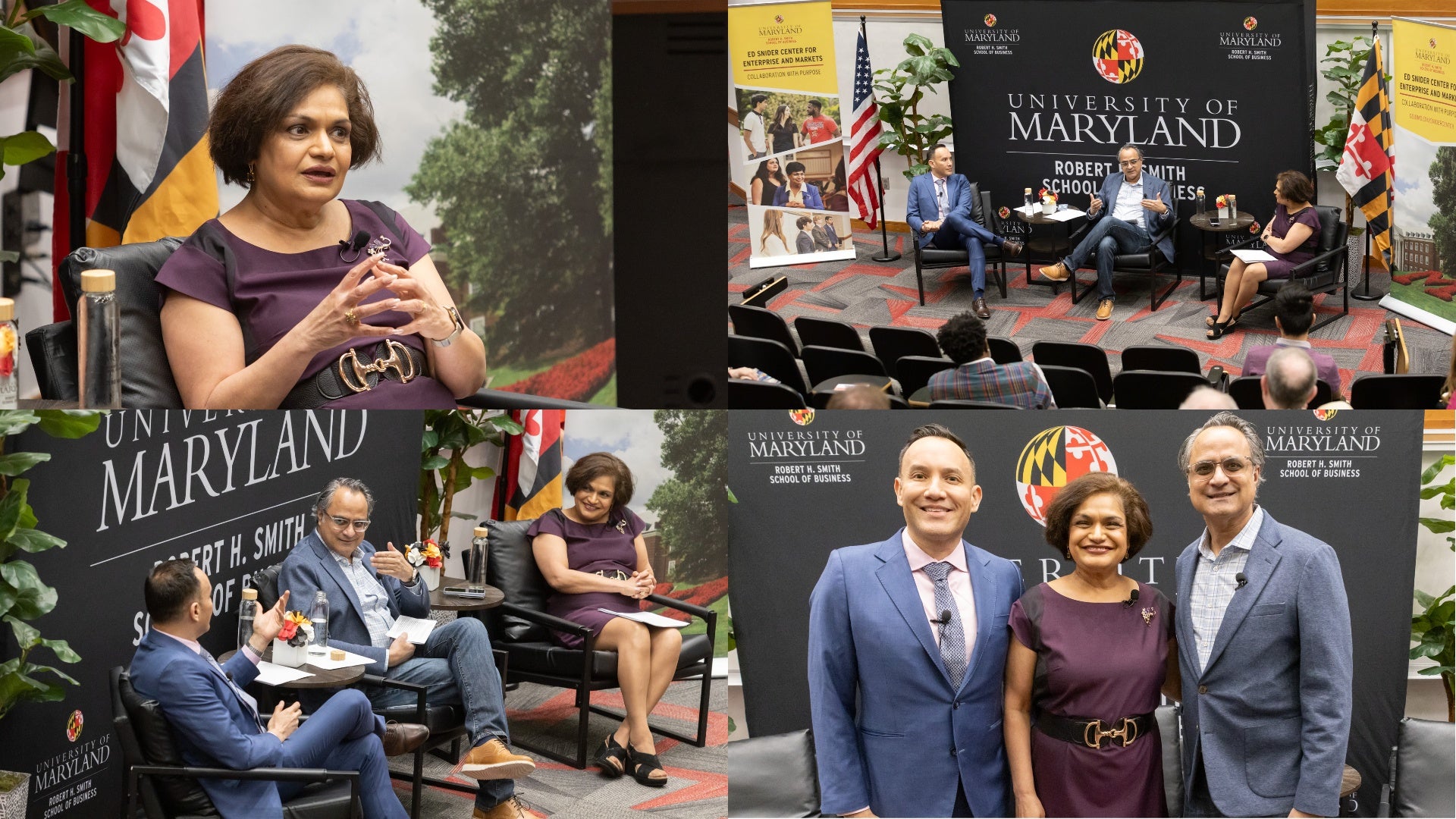
Held March 31 in Van Munching Hall, the panel, “Creative Destruction or Construction: Disruptive Technologies and Business Models in Media,” was moderated by Rajshree Agarwal, Rudolph Lamone Chair of Strategy and Entrepreneurship and director of the Ed Snider Center for Enterprise and Markets. The discussion featured two media entrepreneurs whose careers reflect that central idea: Naren Aryal, CEO of Amplify Publishing Group, and Oscar Zeballos, CEO of Podville Media.
Agarwal opened the event by challenging a common assumption about innovators and entrepreneurs.
“It’s almost assumed that people who are innovating are always looking to destroy things,” she said. “But what entrepreneurs are really trying to do is solve problems.”
That idea shaped the discussion: innovation begins not with a desire to tear down, but with the decision to build something better.
Personal Need as the Starting Point
For both Aryal and Zeballos, entrepreneurship began with a problem they encountered firsthand.
Aryal was a successful corporate attorney when he decided to write a children’s book for his daughter. But when he tried to work through mainstream publishing channels, he found a system too inflexible to embrace a niche project that did not fit the priorities of a large publishing house.
“What I found is there’s a real market need, a niche that needed to be filled that the big houses couldn’t see,” Aryal said. “It was one title, one project, which didn’t rise to their level of what they were looking for.”
Zeballos encountered a similar disconnect from inside the broadcasting world. In 2005, while hosting a talk show for CBS Radio, he was asked by a friend whether the previous day’s show could be made available online as a podcast. The technology existed, but traditional radio had not yet recognized the opportunity.
After asking for approval and receiving no response for weeks, Zeballos uploaded the show himself.
“So technically, we were the first talk show on Apple Podcasts, then called iTunes,” he said.
From Personal Experience to Broader Opportunity
As the discussion unfolded, Agarwal pointed to the deeper entrepreneurial pattern connecting both stories: each founder was, in effect, the first user of the unmet need they would later solve for others.
“In my forthcoming book, I talk about how innovation and entrepreneurship actually come because you look around in your world and you see problems,” Agarwal said. “What I heard from both of you is that you are in fact the quintessential user of the product. For you, the unmet need was personal.”
For Aryal, the experience of trying to publish his own work led to a larger realization that many high-quality authors, especially in business, thought leadership, and self-help, had valuable content but no viable path to bring it to market while retaining ownership of their intellectual property.
“Putting that system together, that would allow them to come to market with high-quality content, the same distribution, better marketing, and ownership of IP—nobody was doing it and nobody was doing it at scale,” Aryal said.
For Zeballos, podcasting revealed that the issue was not simply one radio show needing another outlet. It pointed to a broader shift in how audiences wanted to consume content—on demand, across geographies, and outside the limits of traditional broadcasting. As he and his team moved from market to market, listeners kept finding them online.
“We didn’t understand how people were finding us,” Zeballos said. “And they said, ‘Oh, I listened to the podcast.’”
Building Firms That Create Value
Those realizations became the basis not just for new ideas, but for new enterprises.
Aryal’s early publishing projects, including “Hello Hokie Bird!” and “Hello Testudo!”, helped him identify an emerging space in the market. Over time, that insight grew into Amplify Publishing Group, a hybrid publishing company built to serve authors who wanted more than self-publishing could offer, but who were unlikely to fit the narrow filters of traditional publishers. The company created value by combining professional editing, design, distribution, and marketing support with a model that gave authors greater ownership and agency.
Zeballos followed a similar arc in media. What began as an experiment with podcast distribution became proof of concept for a different future in broadcasting. Later, as radio formats shifted and station turnover created new uncertainty, he leaned into that lesson and built Podville Media, where he now serves as CEO. The company has grown beyond podcast production to develop content that moves across platforms, including television, helping creators and brands reach audiences in new ways.
“I feel fortunate to be here,” Zeballos said. “But at the end of the day, this is the future.”
In both cases, the entrepreneurs did not set out primarily to disrupt an industry. They set out to solve a problem they knew firsthand. By building firms around those solutions, they ended up reshaping the boundaries of publishing and media themselves.
Shifting the Industry, Expanding the Audience
Looking back over the last two decades, both panelists reflected on how much their industries have changed.
In publishing, Aryal noted, the field has moved from a binary structure to a much more varied ecosystem.
“Books, it was binary,” he said. “You either published traditionally, or you self-published. And now, there are all varieties of publication.”
Zeballos offered a similar perspective on media, where the boundaries between formats have become increasingly fluid. Podcasts now become television shows, while television content is repurposed for podcast audiences. What once appeared to be disruption now looks more like convergence, experimentation, and rising competition.
“The destruction really is competition,” he said. “And that competition is welcome.”
Agarwal observed that both hybrid publishing and podcasting had done more than improve distribution. They had helped creators and companies serve niche audiences with greater precision and responsiveness.
“I think there’s a premium on really understanding your target market,” Aryal said, noting that one of his first questions to authors is who will truly care about their work. “You have to make them care, but you also have to have an idea of who your target market is.”
AI as the Next Frontier
The discussion then turned to artificial intelligence and whether it may become the next major force reshaping media. The panelists emphasized its power as a tool that can expand reach and accelerate workflow with human judgement, but was not a substitute for human creativity.
Aryal encouraged writers and publishers to use AI for research, refinement, proofreading, and efficiency. He warned against AI being the primary author of the ideas, or books largely written by AI without any human experiences.
“What you don’t get, is what’s in your heart, what’s in your head, your experience, how you felt going through something,” he said. “That is the big difference.”
Zeballos made a parallel point from the production side, urging leaders not to resist AI, but to train teams to use it well.
“If you don’t involve AI in your job, the cold reality is this: you will be left behind,” he said.
Agarwal agreed, noting that her research has shown how the greatest value comes not from AI alone, but from its combination with human expertise.
“When you complement machine tools with human expertise, that’s when the value really comes through,” she said.
A Glimpse of the Future
Zeballos demonstrated exactly what that future might look like when leaning into technological advances.
Using a clip from Rajshree’s Realms, Agarwal’s forthcoming podcast, he unveiled how AI can translate a video podcast into multiple languages with such fluency that it becomes nearly impossible to tell which language was the original. It was a practical example of how media creators can extend their reach, deepen accessibility, and scale impact while maintaining the original, human insight.
“It can take over an audience you never thought about before when you can have that level of reach,” Zeballos said.
The Human Element Still Matters
Even as the discussion highlighted the potential of AI, both panelists returned to the enduring importance of human connection and originality.
“I think humans want to support other creators,” Aryal said. “It’s just the way we are wired. There’s still something about that piece of art from your favorite creator that you’ll find more value in.”
Innovation may transform the tools, platforms, and business models of media, but the most meaningful work still begins with a human problem, a human creator, and a human audience.
Agarwal closed by encouraging students in the audience to think not only about disruption, but about building first—about being “creatively constructive” as they navigate their own careers.
“If you have that mindset,” she said, “you’ll make sure that you’re the one that’s constantly adapting, constantly renewing yourself, and hence not being disrupted, but being part of the disruption.”
This story was partially written with the use of AI.
Media Contact
Greg Muraski
Media Relations Manager
301-405-5283
301-892-0973 Mobile
gmuraski@umd.edu
About the University of Maryland's Robert H. Smith School of Business
The Robert H. Smith School of Business is an internationally recognized leader in business education and cutting-edge research. The school’s world-class faculty facilitate experiential learning opportunities rooted in the real world. Smith students learn to think like entrepreneurs, prepared to drive positive impact. The school offers undergraduate, online and on-campus business master's, full-time, part-time, online and executive MBA, plus PhD and DBA degree programs, and non-degree and executive education programs. Where Smith leads, the future follows.