
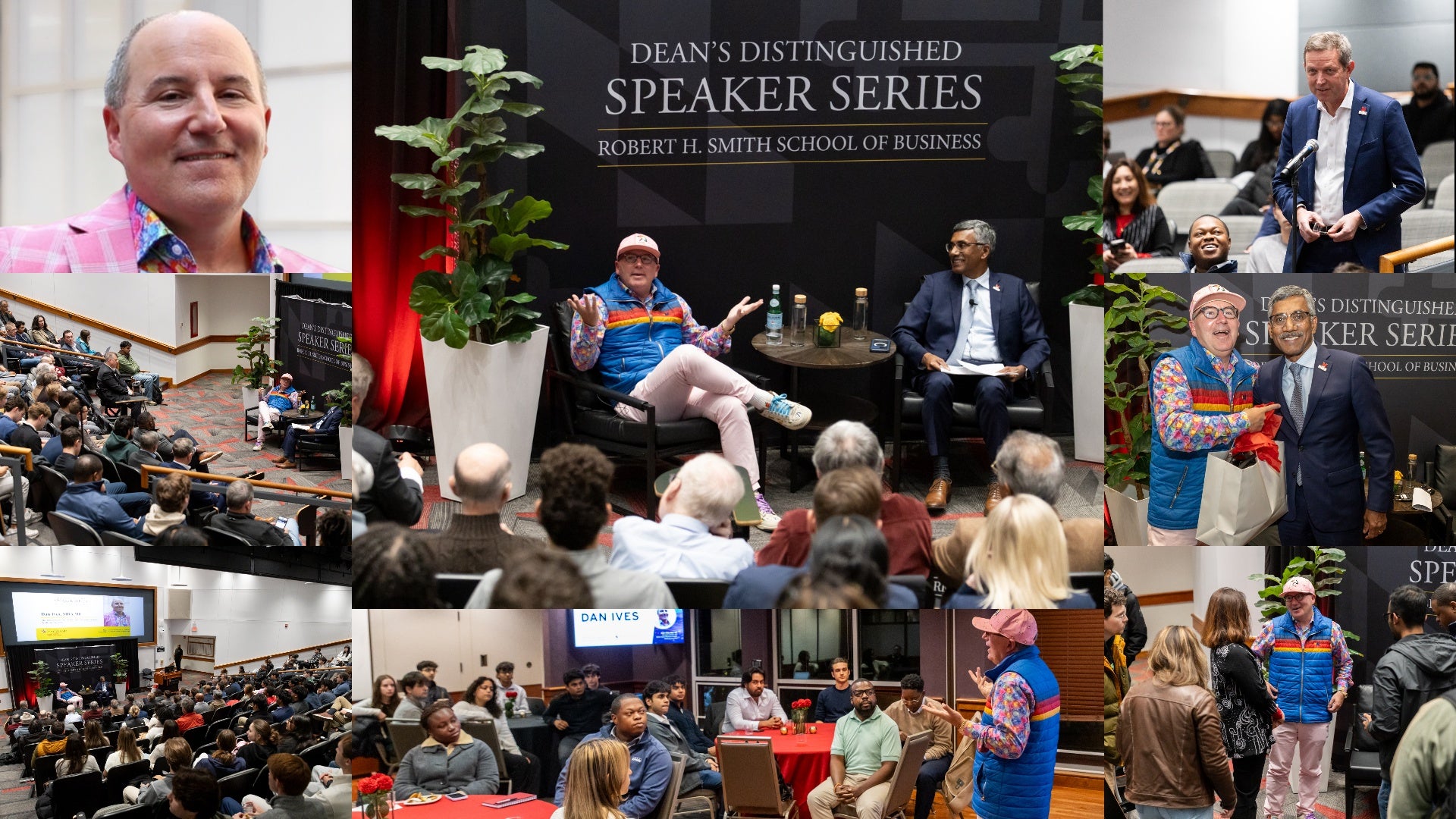
He’s one of the most recognizable analysts on Wall Street. Known for his fashion as well as his take on tech stocks, he was voted the best-dressed man on Wall Street by the New York Post in 2024, among his many accolades and successes. Alumnus Dan Ives, MBA ’00, returned to Van Munching Hall this week to speak with students and the broader Smith community as part of the Dean’s Distinguished Speaker Series at the University of Maryland’s Robert H. Smith School of Business.
During the event, which took place Tuesday, Nov. 11, 2025, Ives told students his journey was his own and encouraged them to approach their careers as a journey, not a sprint.
“I think a lot of it is trying to build your foundation,” he said during a pre-event reception with student leaders. “When one door closes, another door opens.”
Ives has been a tech analyst on Wall Street for more than two decades, covering software and the broader technology landscape. Today, he is managing director and senior equity research analyst covering the technology sector at Wedbush Securities. He also serves as global head of technology research at Wedbush.
Wedbush launched the Dan Ives Wedbush AI Revolution ETF in June 2025. Since its launch, it has surpassed $1 billion in assets—the fastest ETF to reach that milestone.
Ives told students that people often focus on his success and where he is now, but his career was built “brick by brick.” He said he learned mostly from his failures rather than his successes, and the rejection he faced early on fueled his motivation to keep going. He has been quoted widely and appears regularly on CNBC and other news outlets.
Success by Way of Smith
After graduating from Penn State with his undergraduate degree, Ives struggled to find a place on Wall Street. He landed in corporate finance with HBO, then decided to pursue an MBA to pivot to stocks, which was always his passion.
“This really launched me into that realm,” he said of coming to Smith. He started at FBR Capital Markets as a tech analyst but said he had no knowledge of technology. His coverage of the industry continued throughout the 1990s as he kept ramping up his understanding of technology.
“My strength has always been being able to pick stocks,” he said. “I think what put me on the map globally was being one of the first to identify how big Apple and the iPhone were going to be, and then getting to know Elon Musk very early in his career and basically betting on Tesla.” He said having a high EQ has been more valuable than a high IQ, in his opinion. “I think that’s helped me a lot with my style, the way that I call stocks.”
“This place played a huge role in my career,” Ives said, praising Smith’s curriculum for always being advanced in entrepreneurship and tech. “I think [Smith] has been able to keep that edge,” he said, adding that he’s not surprised by Smith’s impressive list of successful alumni.
Ives said Smith’s connections with the tech world continue to give students opportunities in that field. Though he admits he’s biased, he also credits attending a large Big Ten school with helping prepare him for life in the real world.
Is AI a Bubble That’s About to Burst?
In 2022, Ives was out to dinner in San Francisco with AI engineers from major tech companies. “I basically left that dinner being like, ‘This is not even a question—this is going to be a revolution,’ and that’s where I coined, ‘This is going to be an AI revolution.’”
“When Microsoft invested in OpenAI, in my mind, that was it. It was on. But it took time for that to play out,” he said. “But every day, this is it. And that’s how investors around the world who follow me understand the way that I look at stocks and the work that we do.”
He said people often worried about job loss due to the internet, but Ives said it created Silicon Valley—“the biggest asset in this country, in my opinion.” In terms of AI, he pointed out that today, “for the first time in 30 years, the U.S. is ahead of China when it comes to tech.” Regarding AI and job growth, Ives said the investments happening around AI are fueling the revolution. “I’m not saying there aren’t certain jobs that will suffer, but I think no technology in the last 20 years has been a net job detractor.” When he talks at universities, he encourages them to equip students with use cases, programming technology and skill sets to succeed in this new world.
Regarding everyone talking about AI being a bubble, Ives said, “You are in year three of an eight-to-10-year buildout in the AI revolution. You have eight-year-olds today who are not going to need a driver’s license when they are 16. Humanoid robots are going to be a reality in the next few years,” he said. “That’s the reality of where we are.”
Ives said there is one chip fueling the AI revolution—“and that’s Nvidia.”
Powering AI for the World
Ives noted that there are more data centers under construction now than there are active data centers, and some could be half the size of New York’s Central Park.
“So that’s real. The point is, does it ever end? There are 3% of companies in the U.S. that have gone down the AI path,” he said, adding that when it reaches 20%, there will not be enough energy to sustain the growth. “The biggest constraint in all this is energy. Nuclear, to me, is going to be the golden goose.”
He noted that the construction of the centers brings new people to new areas, adding to local economies in a ripple effect that is “pretty staggering.”
Quantum: Sideshow or Here to Stay?
“Quantum is going to be like a revolution,” Ives said. “I think from a valuation perspective, it’s going to continue to evolve. But IonQ has been our favorite in terms of a pure play,” he said, adding, “You don’t want to look at quantum names on risk-off days—you don’t want to look at your PA on risk-off days—but I think quantum is at the party.”
Handling the Haters
Ives is sometimes criticized for his views and recommendations. He was asked by a student if he sees it as an achievement when those critics come around to his picks. “You need the haters because in the market there are bulls and bears,” he said. “What makes it so fun is if you are right and you do the work and you have conviction, those moments make it that much sweeter when you get to the other side.” Even his neighbors have invested in his top picks, but depending on the day, they may not be very neighborly. “When things are going well, it’s awesome. When things are going bad, it’s not good.”
Media Contact
Greg Muraski
Media Relations Manager
301-405-5283
301-892-0973 Mobile
gmuraski@umd.edu
About the University of Maryland's Robert H. Smith School of Business
The Robert H. Smith School of Business is an internationally recognized leader in business education and cutting-edge research. The school’s world-class faculty facilitate experiential learning opportunities rooted in the real world. Smith students learn to think like entrepreneurs, prepared to drive positive impact. The school offers undergraduate, online and on-campus business master's, full-time, part-time, online and executive MBA, plus PhD and DBA degree programs, and non-degree and executive education programs. Where Smith leads, the future follows.