
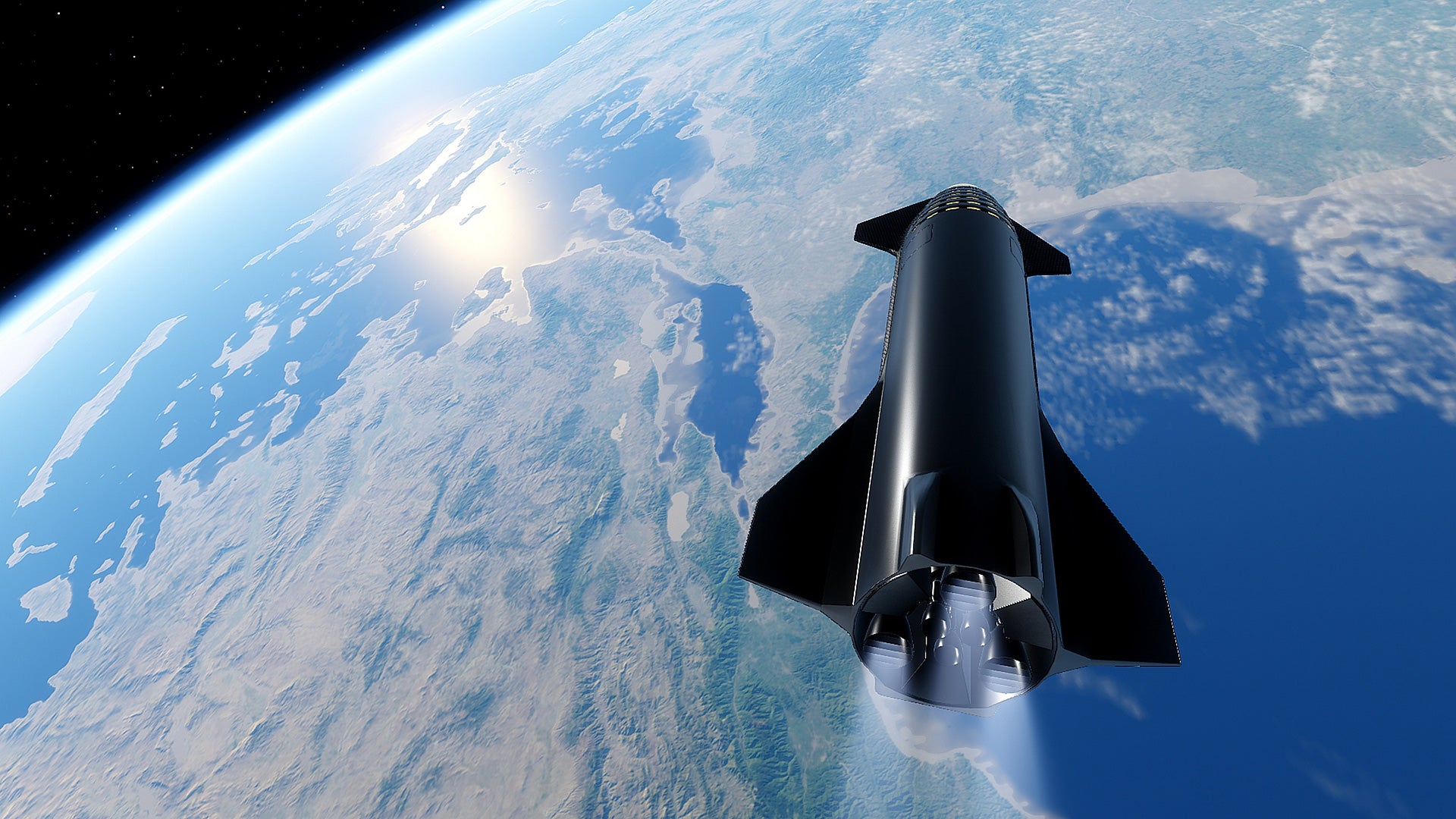
SpaceX’s Starship has reached orbit and deployed its first batch of next‑generation Starlink V3 satellites, marking a pivotal moment in the commercial space race and signaling rapid shifts in launch economics, federal contracting and global competition for low Earth orbit (LEO).
Assistant Dean for Executive Education Jon Crocker at the University of Maryland’s Robert H. Smith School of Business breaks down why this milestone matters and how it fits into the broader evolution of space commerce, defense procurement, and the emerging LEO economy.
Crocker also leads Space at Smith, an academic and industry initiative focused on the commercial space economy and the intersection of business, innovation, national security and technology.
Commercial and Logistical Impact
How does Starship’s successful orbital debut — and its deployment of next‑generation Starlink V3 satellites — reshape the economics and logistics of high‑volume payload delivery, and what downstream industries will feel the effects first?
Crocker: This was indeed a big day for SpaceX, and even though they decided to cut the mission short (after delivering the 26-satellite payload, but not the planned six complete orbits, likely due to partial engine failure, it revolutionizes the path to low Earth orbit. Some estimates have described the difference between a Falcon 9 payload and a Falcon Heavy/Starship payload as a factor of 20x. Meaning that once Starship is able to routinely achieve orbit and deliver payloads, it means that the cost per kilogram will see exponential reductions.
The immediate beneficiaries will be SpaceX’s internal customer, Starlink, and priority customers like NASA and the Space Force. Third‑party customers who previously relied on rideshare opportunities may find that capacity reallocated. Ironically, while launch costs may fall, limited supply could push prices up for companies without their own launch capability — creating profit opportunities for SpaceX as well as competitors like Blue Origin and Rocket Lab.
NASA Contracting and Artemis Implications
Given Starship’s role as NASA’s Human Landing System for Artemis, what does this milestone signal about SpaceX’s readiness to meet federal contracting, regulatory, and performance expectations for lunar operations?
Crocker: A successful launch and equipment demonstration is undoubtedly good — just as the mishap during the recent New Glenn launch was not — but we should be cautious about letting a single data point define a trend. NASA has shown a willingness to adjust mission parameters in response to events, but it’s unlikely that Artemis III will be drastically altered based on one launch.
Starship reaching orbit with such a large‑capacity vehicle is meaningful, but landing on the lunar surface is an entirely different challenge. SpaceX still must demonstrate orbital refueling to reach cislunar space and must solve the engineering feat of landing a vertical column like Starship on the Moon without tipping over. This milestone deserves celebration, but a lot of work is ahead for companies like SpaceX, Blue Origin and the United Launch Alliance.
Global Competition and Cost‑to‑Orbit Dynamics
With Starship pushing the cost‑per‑kilogram to orbit dramatically lower, how might this shift the geopolitical balance of commercial space power and accelerate global competition for LEO infrastructure dominance?
Crocker: One of the themes during this year's Space at Smith Symposium (6 p.m. Oct. 22, Frank Auditorium, Van Munching Hall) is that space is increasingly congested and contested. While space is vast, low Earth orbit is a tightly constrained global commons that is being rapidly depleted. Historically, geostationary satellites provided broad coverage (think satellite TV or streaming platforms). But the very altitude that made geostationary orbit compelling for broad coverage also means that it is out of reach for handheld communication devices. To enable satellite-based data, audio or video to your phone means a much lower orbit, and that is necessarily much more tightly constrained. The first to occupy and hold that “high ground” in LEO will have a commanding advantage.
While many companies and/or sponsoring nations may have plans for large satellite constellations, they may not have the capability to claim it as quickly as Starship may deliver payloads. In human history, competition for scarce resources has often resulted in conflict. While few will be better positioned than SpaceX to deliver payloads, one does not need to match Starship’s capacity to disrupt the environment: a single collision could create thousands of debris fragments and render LEO unusable for years. A cascade of collisions — accidental or deliberate — could make it unusable for centuries.
Media Contact
Greg Muraski
Media Relations Manager
301-405-5283
301-892-0973 Mobile
gmuraski@umd.edu
About the University of Maryland's Robert H. Smith School of Business
The Robert H. Smith School of Business is an internationally recognized leader in business education and cutting-edge research. The school’s world-class faculty facilitate experiential learning opportunities rooted in the real world. Smith students learn to think like entrepreneurs, prepared to drive positive impact. The school offers undergraduate, online and on-campus business master's, full-time, part-time, online and executive MBA, plus PhD and DBA degree programs, and non-degree and executive education programs. Where Smith leads, the future follows.