
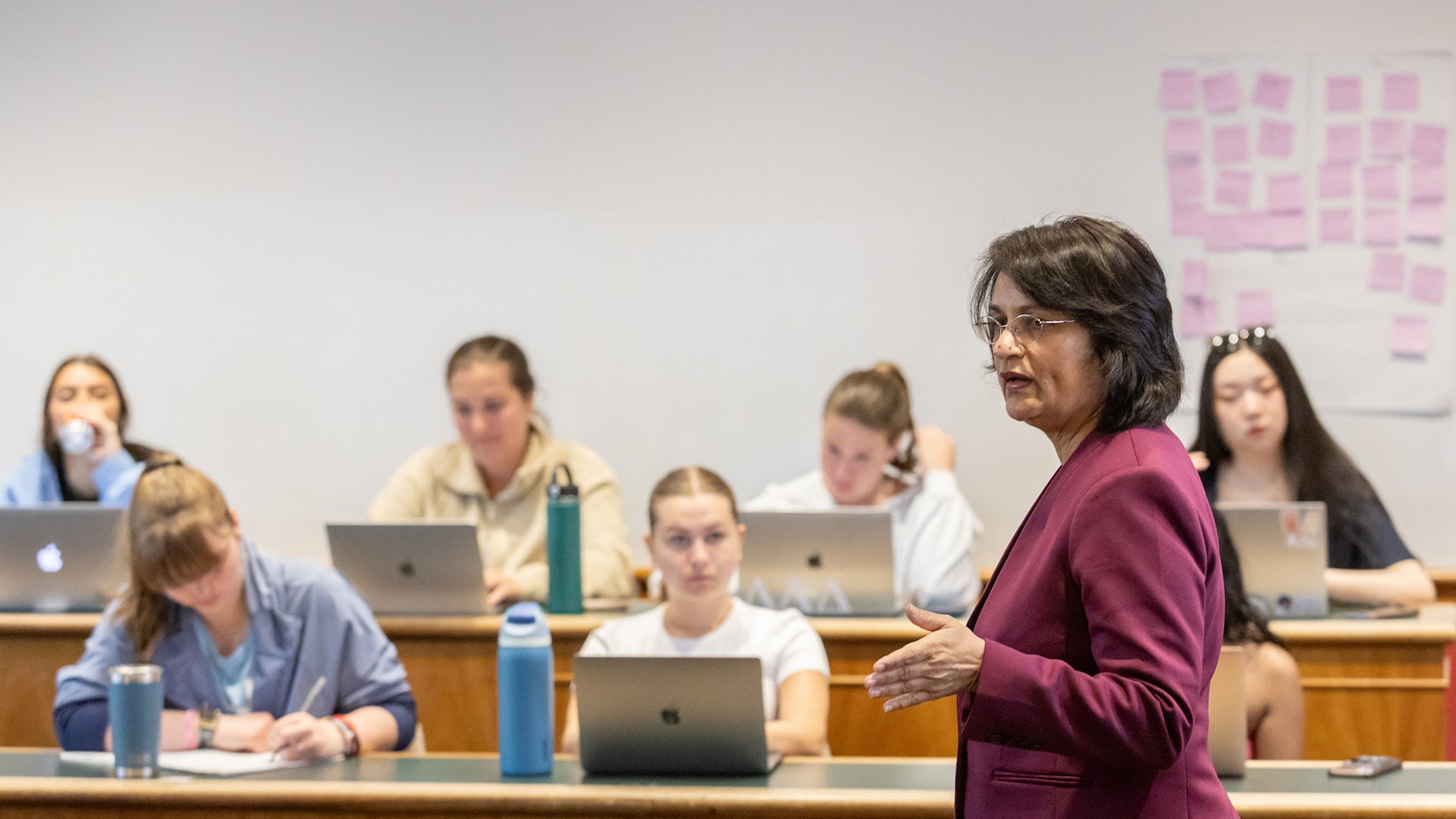
When New York Times journalist Eric Athas set out to understand why consumers feel compelled to chase the latest products, upgrades and trends, he turned to experts across neuroscience, psychology, behavioral science and persuasion. Among them: Dean’s Chair of Marketing Amna Kirmani at the University of Maryland’s Robert H. Smith School of Business, whose research on persuasion knowledge and consumer behavior is featured prominently in Athas’ newly released debut book, Saying No to New: Why New Things Are Stealing Your Time, Money, and Happiness—And How to Take Back Your Life.
Athas’ book examines the cultural and psychological forces that make “newness” irresistible—and often costly. In a 320‑word section, he draws on Kirmani’s decades of research to explain how marketers shape consumer perceptions and why some people are more resistant to persuasion than others.
Kirmani, a leading expert on persuasion, notes that her academic training has made her a highly discerning consumer — particularly when evaluating major purchases or weighing promotional offers. Her expertise gives her an advantage many consumers lack: the ability to recognize when firms are using tactics designed to influence decision‑making. Such real‑world vigilance mirrors the central theme of her research, which explores how people interpret and respond to persuasion attempts in the marketplace.
Athas highlights Kirmani’s foundational work on persuasion knowledge, defined by researchers as “people’s intuitive theories about how marketers try to persuade consumers.” Kirmani and her colleagues have framed persuasion as a strategic game between seller and buyer. Sellers deploy tactics to sway consumers; buyers rely on their understanding of those tactics to evaluate whether an offer is genuinely beneficial. “If you have accurate persuasion knowledge, you can make better decisions,” she told Athas.
Her insights help readers understand why certain marketing cues — especially those signaling novelty — are so effective. Athas notes cognitive biases that shape consumer choices, including the number format effect, where digits appear more appealing than written‑out numbers. But Kirmani points to one of the most enduring biases: the allure of “new.”
“New has always sold,” she said. “The word new and improved or just new on the packaging helps attract attention, and that’s the first step in trying to persuade people —you have to grab their attention so that they're going to spend more than a millisecond looking at that.”
Athas’ conversations with Kirmani for the book worked to shed light on how consumers can strengthen their persuasion knowledge and make more intentional choices — to learn “how our brains are wired to seek out novelty, how businesses influence our choices, and how to resist the pull of meaningless new stuff,” he writes.
Media Contact
Greg Muraski
Media Relations Manager
301-405-5283
301-892-0973 Mobile
gmuraski@umd.edu
About the University of Maryland's Robert H. Smith School of Business
The Robert H. Smith School of Business is an internationally recognized leader in management education and research. One of 12 colleges and schools at the University of Maryland, College Park, the Smith School offers undergraduate, full-time and flex MBA, executive MBA, online MBA, business master’s, PhD and executive education programs, as well as outreach services to the corporate community. The school offers its degree, custom and certification programs in learning locations in North America and Asia.