Artificial Intelligence Scholars in Business
Artificial Intelligence Scholars in Business
A program for aspiring AI & Business undergraduates
Artificial intelligence is reshaping how businesses create value, make decisions, serve customers, manage risk, and compete. For students interested in business, technology, analytics, entrepreneurship, or responsible leadership, the key is not only learning how to use AI tools, but learning how to ask better questions, evaluate evidence, understand risk, and communicate sound recommendations.
Artificial Intelligence Scholars in Business is a live online pre-college program for highly motivated high school students. Across six interactive faculty-led sessions and a final project showcase, students will learn from Smith School faculty and industry leaders about the opportunities and challenges of AI in business. Participants will explore real-world examples, discuss emerging research and practice, and complete a guided research brief on AI in a business context of their choice.
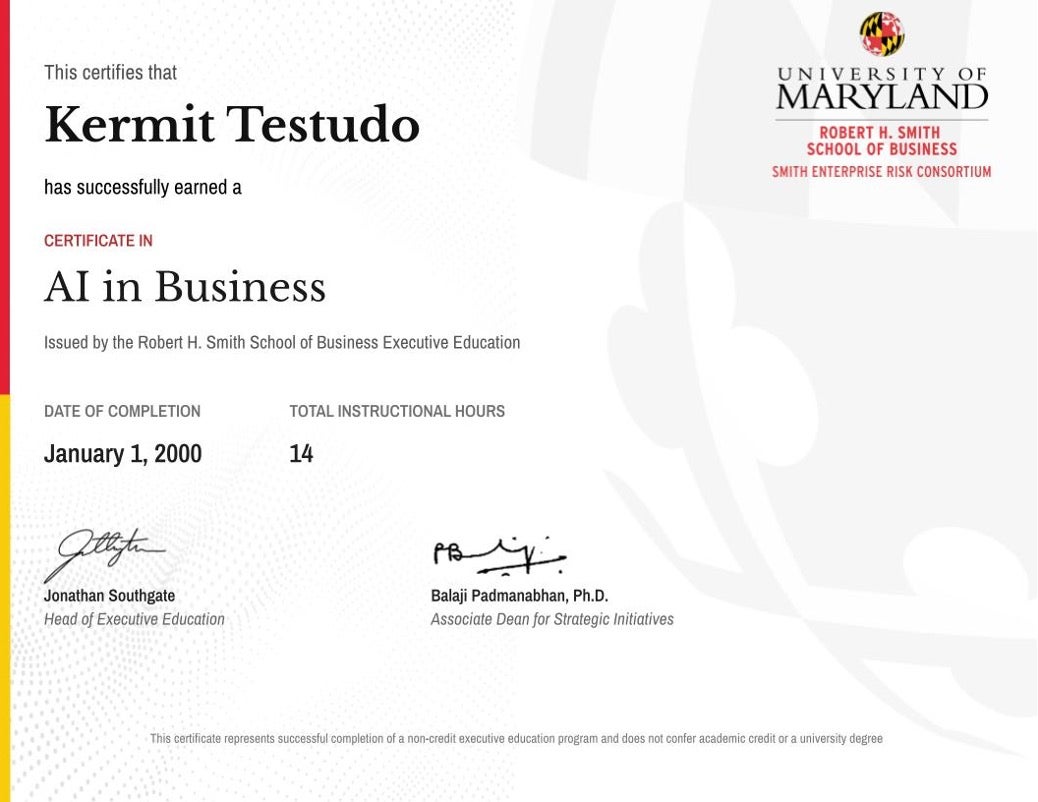
Students who actively participate in the program and complete the final project will receive a non-credit certificate of completion from the University of Maryland’s Robert H. Smith School of Business Executive Education. Selected final projects may also be featured in an online Smith School student showcase after faculty review.
| Location | 100% live online, interactive sessions with leading professors and business leaders. |
|---|---|
| Cohorts | Three times a year: Fall, Spring, and Summer. |
| Schedule | Saturdays, 10 a.m. to Noon Eastern Time, for seven sessions over a two-month period. Participants are welcome globally; all live sessions will be scheduled in Eastern Time. |
| Audience | Highly motivated self-starters in high school programs worldwide who aspire to join artificial intelligence and business programs at top schools worldwide. |
| Tuition | $1,500 |
| Contact | rhsmith-execed@umd.edu |
Who is this for:
This quarterly program is for highly motivated self-starters in high school programs worldwide who are:
- Potentially considering undergraduate programs at the intersection of AI and business and desire to join such programs with a background on contemporary issues in this area.
- Seeking to understand the frontiers of both research and practice in AI and business
- Able to attend and participate in ALL the online sessions
- Willing to work individually or in groups on a survey paper on AI and a business topic
Valuable Outcomes:
Participants who actively participate in all sessions and complete the deliverable can expect the following benefits from this program:
- An “AI Scholars in Business” certificate of completion
- A paper that may be hosted online by the Smith School of Business
- Developing knowledge in several cutting-edge topics in AI and business
- Interacting live with leading professors and business leaders
Program Outline
Understanding how AI generates, reasons, and supports work
This session introduces the foundations of generative AI and large language models in an accessible, business-oriented way. Students will learn what LLMs are, how they are trained, why they can generate text, images, code, and analysis, and where their limitations come from. The session will explain key ideas such as tokens, prompts, embeddings, context windows, hallucinations, fine-tuning, retrieval-augmented generation, and AI agents without requiring a technical background. Through hands-on exercises, students will experiment with prompting strategies, compare AI outputs, evaluate reliability, and learn how to use GenAI as a tool for research, creativity, communication, and problem-solving. The session emphasizes that understanding how GenAI works is essential for using it effectively, responsibly, and strategically in business settings.
Foundation Models • Prompting • AI Literacy • Reliability • Human Judgment • Business Applications
Smarter Decisions, Risk Management, and the Future of Financial Services
This session explores how AI is transforming finance, banking, investing, insurance, and financial decision-making. Students will learn how financial institutions use AI to detect fraud, assess credit risk, personalize financial advice, automate customer service, analyze markets, improve forecasting, and strengthen compliance. The session will also introduce students to the risks of using AI in finance, including bias in lending, model errors, data privacy, cybersecurity, overreliance on automated decisions, and explainability challenges. Through examples and a short applied exercise, students will examine how AI can support better financial decisions while still requiring human oversight, ethical judgment, and regulatory awareness. The session helps students understand finance as one of the most important domains where AI can create value, but also where mistakes can have serious consequences.
FinTech • Risk Analytics • Fraud Detection • Credit Decisions • Investment Intelligence • Responsible Finance
Artificial intelligence is already used to support decisions that affect people’s lives, from hiring and college admissions to loans and healthcare. But how can we tell whether the systems generating these decisions are fair? What happens when AI inherits human biases, and how can researchers design systems that make better decisions? Can AI be fairer than humans?
In this session, students will explore some of the biggest research questions in responsible AI, including how bias enters AI systems, why fairness is often more complicated than it first appears, and why human judgment remains an essential part of AI development. Students will step into the role of AI researchers by examining data, evaluating AI decisions, and debating difficult tradeoffs where there may be no single “correct” answer. This session highlights how research in AI and business can help build technologies that benefit society by being not only more accurate, but also more trustworthy and transparent.
This session examines how AI assistants are changing the way customers discover, evaluate, and choose products. Students will learn why being recommended by AI may become a new form of brand visibility, how AI-mediated discovery can affect customer acquisition, retention, purchase frequency, basket size, margins, and measurement, and why traditional attribution systems may miss much of AI’s impact. Students will run a simple AI visibility test for a company or product category and use a customer-based scorecard to assess whether AI is likely to increase or decrease business value.
AI visibility, awareness, customer journey, customer analytics, acquisition, CLV, attribution
What does it mean to be creative when a computer can write a song, design an image, or brainstorm ideas in seconds? In this session, students dig into the latest research on human and AI creativity, exploring why some AI-generated work feels eerily original and where it still falls short. Then, through a hands-on simulation, students generate their own ideas, go head-to-head against an AI, and test strategies for coaching and teaming up with it, discovering firsthand where their own imagination beats the machine and where collaboration makes both better. Students leave with a clearer sense of how to use AI as a creative partner without losing what makes their ideas distinctly their own.
This introductory course teaches students the foundational principles and practical skills of effective negotiation, while also introducing how artificial intelligence can support the negotiation process. Students will learn:
- The basics of negotiation, including interests, alternatives, and value creation
- How to prepare for a negotiation in a clear and structured way
- Simple techniques for building trust, managing disagreement, and reaching fair agreements
- How AI tools can help with preparation, practice, and thinking through different scenarios
- Basic considerations around using AI responsibly in negotiation settings
You've probably heard an AI-generated Drake song, seen a viral image that turned out to be machine-made, or watched a video where someone's face was replaced with a celebrity's. Maybe you spent a split second doubting your intuition about whether it was real.
AI is transforming every corner of the creative economy: music, film, journalism, visual art, fashion, gaming, and more. In this session, we'll examine AI as an economic disruption in the creative economy, with a focus on the music industry. We will discuss both sides of this disruption: how it provides opportunities for platforms and some independent creators while threatening livelihoods for working musicians, voice actors, illustrators, and writers. The same technology that lets a teenager produce a (somewhat) professional-sounding album in their bedroom is also training on artists' styles without permission or pay, replacing studio narrators, and fueling battles like the Hollywood writers' strike.
We will explore and debate two core questions in the context of the music industry: What new platform strategies and business models are these AI tools creating, and how are companies monetizing them? And what is the emerging framework for compensation, credit, and disclosure that creators and platforms will need to navigate as the line between human and machine creativity becomes blurry. We will wrap up with a discussion of the big picture question: what does this mean for the future of creative work?
This final session serves as a “capstone” where students present their research write-ups or projects. Moving beyond a standard formal presentation, this session is conducted in the format of interactive, offline-style office hours. This structure provides students with dedicated time to engage directly with individual faculty, facilitating deeper discussions, detailed feedback, and one-on-one mentorship regarding their research findings. Participants will have the opportunity to synthesize their insights and receive personalized guidance on their work, ensuring a supportive and collaborative environment for final refinements. The session concludes the program by celebrating the students' scholarly contributions and reflecting on the future of AI in business.
Research Presentation • Office Hours • Faculty Engagement • Personalized Feedback • Final Synthesis
Professional Certificate
Program Faculty


Subra Tangirala


Vijaya Venkataramani