
By Samuel Handwerger, CPA, CrFA, MS-Tax
When I started Justice for Fraud Victims, I needed a name for the people we’d work alongside: the detectives, investigators, and prosecutors who take a fraud victim’s story and try to turn it into justice. “Law enforcement” is the usual go-to term. But it sounds so cold… so unemotional.
I settled on two words. Truth seekers.
If I’m honest, the phrase was partly aspirational. I pictured what that work looks like at its best: patient, disciplined, and more interested in what actually happened than in winning an argument. I used the phrase with every law enforcement partner we met, hoping they’d recognize themselves in it.
Last night, I watched someone live up to it more fully than I had imagined.
A visit from the courthouse
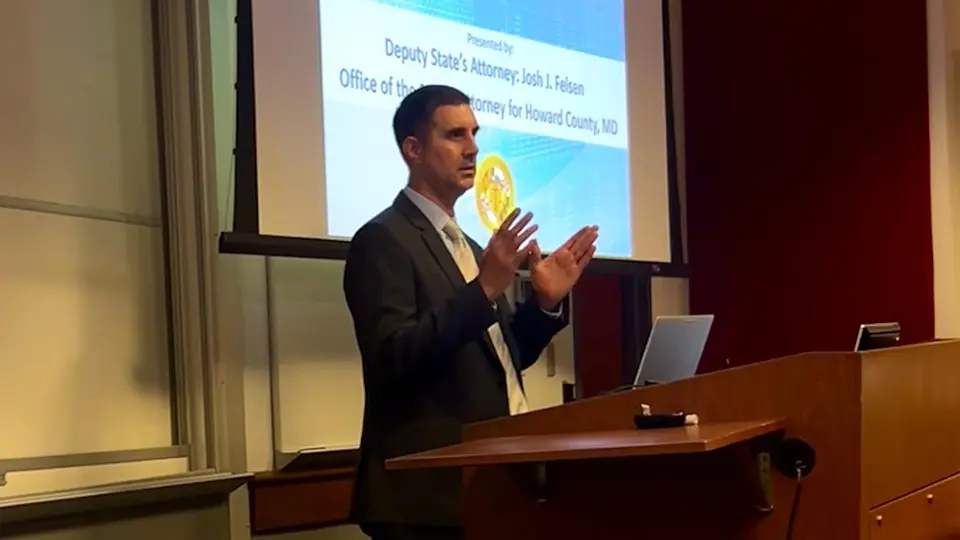
During International Fraud Awareness Week, Joshua Felsen, Deputy State’s Attorney for Howard County, came to speak with us about what it really takes to bring a case to court, and specifically a financial crimes case.
Most of us carry around a television version of a prosecution: the dramatic closing, the surprise witness, the confession on the stand.
What Josh offered instead was a look behind the curtain at how prosecutors and a State’s Attorney’s office actually do their work. It was detailed, practical and, to students who volunteer their time to track down and help convict fraudsters, completely absorbing.
What stayed with me was the thread running through it all. Every decision he described came back to the same question: what is true, and how do we show it? Not what makes the best story. Not what sounds most damning. What is true.
That question also explains how Josh carries himself. He told us he doesn’t bring emotions to his work. He brings a matter-of-fact attitude: here’s what happened, here’s what we have to prove, here’s where we go with this.
You might be tempted to call that cold and calculating. (Yes, I see the irony, given why I passed on the term “law enforcement.”) But think about it. That gets to the heart of what it means to be a truth seeker. No personal agenda. No chasing the feeling of what justice means in a particular case. Justice is served when the truth comes out: the truth, and only the truth.
‘Less is more’
Then Josh shared what he calls his “less is more” theory for building a prosecution. We’ve all heard the phrase, but he uses it more sharply than the cliché.
Here’s the idea. When a prosecutor needs to prove a particular fact and a single piece of evidence proves it “beyond a reasonable doubt,” that piece can stand on its own. It doesn’t need to be propped up. Further corroboration isn’t required, and additional evidence isn’t automatically helpful either.
That runs against instinct. Most of us assume that more evidence is always better: one document is good, and a document plus three witnesses must be stronger. Josh’s point is that each additional source is also an opportunity for confusion.
A witness may remember the date slightly differently, describe the amount loosely, or put their own interpretation on what the record already states plainly.
Each small inconsistency gives a jury something to question. Instead of one clear fact, they’re handed several versions of it, and the question of what happened, when and where becomes harder to answer, not easier.
In Josh’s experience, long, wordy cases end up as competing stories. The lean ones don’t need to argue. They let the truth speak for itself.
Imagine a bank record showing that money left a victim’s account on a particular day and landed in someone else’s account. That record proves the transfer. Calling a witness to describe the transfer from memory doesn’t make it any more true. At worst, it introduces doubt about something that was never in doubt and shouldn’t be.
For those of us in forensic accounting, this was a bit of a revelation and a bit of a homecoming.
Fraud lives in the paperwork. It hides in ledgers, bank statements, invoices, and wire confirmations. Our entire discipline rests on the belief that if you follow the records carefully enough, the truth is already written down somewhere. Josh’s approach is the courtroom version of that same faith: find the cleanest proof of each fact, present it plainly, and resist the urge to pile on.
It’s also a lesson in restraint. It takes confidence to say this is enough and stop. Adding one more voice, however well-meaning, can obscure the very point you’re trying to make.
When I first called our law enforcement partners “truth seekers,” I was expressing a hope. After hearing Josh, I realized I had undersold the term. A truth seeker isn’t just someone who goes looking for the truth. It’s someone disciplined enough to recognize it when they’ve found it and to protect it from being buried under everything else.
Saying Josh Felsen embodied what I envisioned for Justice for Fraud Victims when we founded it would be an understatement. We’re grateful for his time and candor, and we hope to welcome him back soon.
In a fraud case, the truth is usually already on paper. The job is to find it and then have the discipline to let it speak for itself.
Sam Handwerger is a senior lecturer at the University of Maryland’s Robert H. Smith School of Business, a CPA, and the founder of Justice for Fraud Victims, Inc., a nonprofit that provides pro bono forensic accounting for fraud victims with student investigators. He also blogs at Tax Insights & Fraud Awareness. Joshua Felsen is a UMD alumnus (psychology and criminal justice) with two daughters now at UMD and a son in high school who hopes to join them soon.
Media Contact
Greg Muraski
Media Relations Manager
301-405-5283
301-892-0973 Mobile
gmuraski@umd.edu
About the University of Maryland's Robert H. Smith School of Business
The Robert H. Smith School of Business is an internationally recognized leader in business education and cutting-edge research. The school’s world-class faculty facilitate experiential learning opportunities rooted in the real world. Smith students learn to think like entrepreneurs, prepared to drive positive impact. The school offers undergraduate, online and on-campus business master's, full-time, part-time, online and executive MBA, plus PhD and DBA degree programs, and non-degree and executive education programs. Where Smith leads, the future follows.